Fernando de Noronha

Fernando de Noronha

Lots of little islands in Fernando de Noronha.

  • Fernando de Noronha is a tropical island archipelago consisting of 21 islands located near the coast of South America’s Brazil in the Atlantic Ocean.
  • ‘Fernando de Noronha’ is named after Portuguese Fernão de Loronha, a wood merchant from Lisbon, who is said to have funded and organised the expedition fleet that is believed to have discovered the islands in 1503, although there are accounts of possible earlier discoveries by other people.
  • The total area of Fernando de Noronha is 26 square kilometres (10 square miles).
  • Fernando de Noronha was listed as a UNESCO World Heritage Site in 2001 due to the importance of the islands’ ecosystem and their fauna and flora.
  • The largest island, also called Fernando de Noronha, is 10 kilometres (6 miles) in length and 3.5 kilometres (2.2 miles) in width.
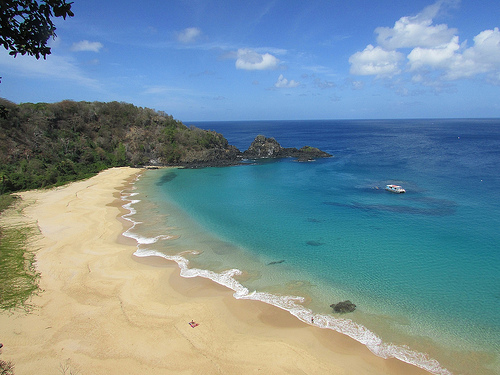
Fernando de Noronha, Beach, Water, Island, South america, Brazil, Large, Tide out, Ten Random Facts, Blue, Clear, Ocean, Scenic, Flickr

Fernando de Noronha
Image courtesy of Rosanetur/Flickr
  • Fernando de Noronha was originally mostly forest, but it is said that is was cut down in the 1800s when prisoners were taken to the islands, and is now home to mostly schrubs and small forests.
  • Fernando de Noronha is home to the largest population of dolphins in the world; a significant population of tropical seabirds; the endangered hawksbill turtle; numerous aquatic species; important plant species; and the endemic species of two birds, a dove and two reptiles.
  • The Fernando de Noronha islands attract tourists, although visitors are limited, so as to not upset the fragile ecosystem.
  • In 2012, the population of Fernando de Noronha was just over 2,700 people and the islands are accessed by plane or boat.
  •  Fernando de Noronha is popular among tourists for its beaches, diving, marine wildlife and fort ruins.
Bibliography:
Brazilian Atlantic Islands: Fernando de Noronha and Atol das Rocas Reserves, 2014, World Heritage Convention UNESCO, http://whc.unesco.org/en/list/1000
Fernando de Noronha, 2014, Wikipedia, http://en.wikipedia.org/wiki/Fernando_de_Noronha

Amazon:  

Australian Brush Turkey

Australian Brush Turkey

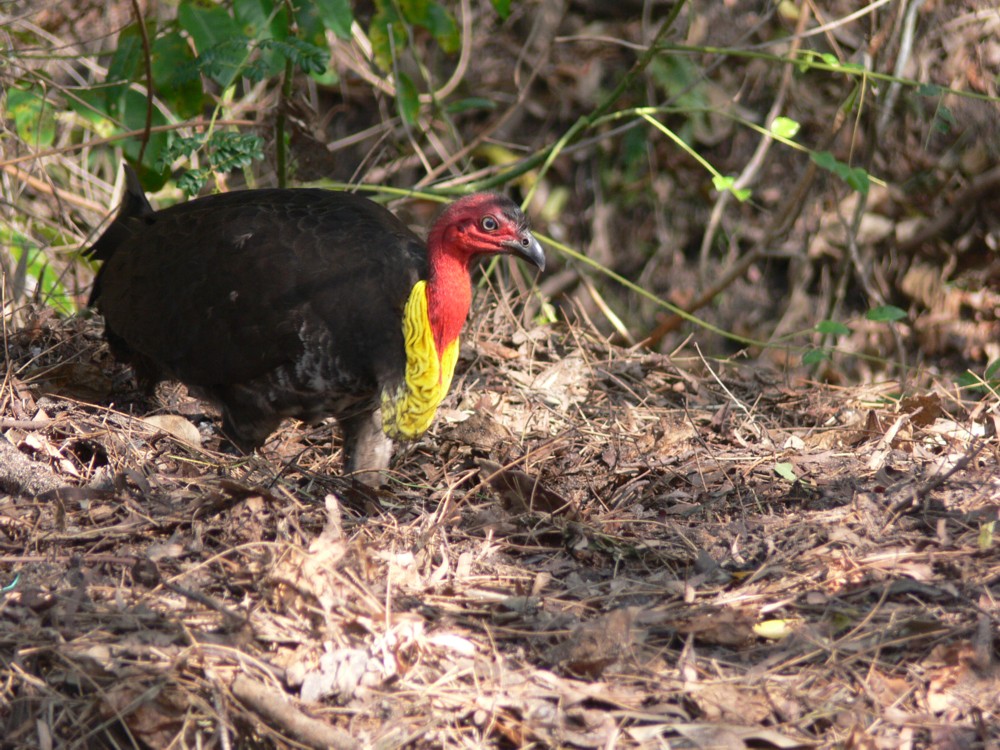
Can you hear the quiet grunt of an Australian brush turkey?

  • Australian brush turkeys are common ground dwelling birds, native to the eastern areas of Australia’s Queensland and New South Wales.
  • ‘Australian brush turkeys’ are also known as ‘Australian brush-turkeys’, ‘scrub turkeys’, ‘bush turkeys’ and ‘brush turkeys’.
  • An Australian brush turkey has the scientific name of Alectura lathami, and comes from the family Megapodiidae, the family of mound building birds.
  • Australian brush turkeys have mostly black feathers, yellow wattles and red necks and heads.
  • Male Australian brush turkeys use leaf matter and other organic litter to create mounds, up to 1.5 metres (5 feet) in height and 4 metres (13.1 feet) in diameter, that covers the 16 to 24 eggs that a female lays.

Australian Brush Turkey, animal, Mound, Tall, Male, Yellow, Maintaining, Ten Random Facts, Australia

Photo courtesy of Val Laird
  • Australian brush turkeys grow to be 60 to 75 centimetres (23 to 30 inches) in length, weigh 2.27 kilograms (5 pounds) on average, and have an 85 centimetre (33 inches) wingspan, although they only fly very short distances.
  • Australian brush turkeys are found mostly in rainforests, urban areas, and scrublands.
  • Male Australian brush turkeys use their mound as an incubator, often for more than one female’s eggs, and keep the mound at a constant temperature in the mid thirties °C (nineties °F), using their beak to test the temperature, and changing the temperature by adding or removing leaf matter.
  • Australian brush turkeys have a diet that mainly consists of seeds, insects and fruit.
  • Australian brush turkey chicks are not cared for by their parents and are capable of looking after themselves, although they are often preyed upon by animals and birds, and are said to have a 1 in 200 chance of survival to adulthood.
Bibliography:
Australian Brush Turkey, 2013, Wildlife, http://www.wildlife.org.au/wildlife/speciesprofile/birds/brushturkey.html
Australian Brushturkey, 2014, Wikipedia, http://en.wikipedia.org/wiki/Australian_Brushturkey
Brush-turkey: The Rainforest Rake, 2007, Skyrail, http://www.skyrail.com.au/news/skyrail-nature-diary/1040-brush-turkey-the-rainforest-rake

Amazon:   

Fire Extinguisher

Fire Extinguisher

Fire extinguishers can save lives…

  • Fire extinguishers are emergency items used in the case of a small fire.
  • ‘Fire extinguishers’ are also known as ‘extinguishers’.
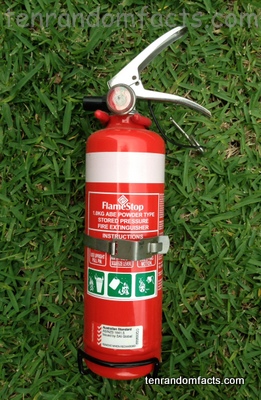
  • Fire extinguishers are typically in the form of a cylindrical container that is generally red in colour for high visibility, with squeeze style handles to release the contents.
  • Fire extinguishers contain a fire extinguishing substance and a pressurised agent as the propellant, and can be handheld or on wheels with different extinguishers used for different fire types.
  • Handheld fire extinguishers are typically 0.5 to 14 kilograms (1.1 to 30.9 pounds) in weight.

fire extinguisher, red, white, bottle, handheld, holder, Australian, single, Ten Random Facts, Emergency tool

  • The earliest known and patented fire extinguisher was invented by Ambrose Godfrey, a German chemist, in 1723 in England, and used gunpowder and fuses for expelling the liquid.
  • The first modern style portable fire extinguisher, a copper container filled with potassium carbonate and pressurised air, was invented by George William Manby, a British captain, author and inventor, between 1810 and 1820.
  • Fire extinguishers typically contain substances of  either water, dry chemicals, wet chemicals, foam or carbon dioxide to extinguish fires.
  • Fire extinguishers are typically found in public and commercial buildings, houses, and land water and air vehicles.
  • Fire extinguishers should be periodically checked and maintained, as damage can cause incorrect discharge and ruptures that lead to deaths and explosions.


Bibliography:
Fire Extinguishers, 2014, Wikipedia, http://en.wikipedia.org/wiki/Fire_extinguisher
History of Fire Extinguishers, 2011, Fire Safety Advice Centre, http://www.firesafe.org.uk/history-of-fire-extinguishers/

Amazon:     

Quinoa

Quinoa

Quinoa is the superfood.

  • Quinoa is an edible grain that is native to parts of the central and northern areas of the Andes, in South America.
  • The word ‘quinoa’, pronounced ‘KEEN-wah’, in the South American Quechua language is ‘kinwa’, while the English word comes from the Spanish word ‘quinua’, and it has also been dubbed as a ‘super grain’ and a ‘super food’.
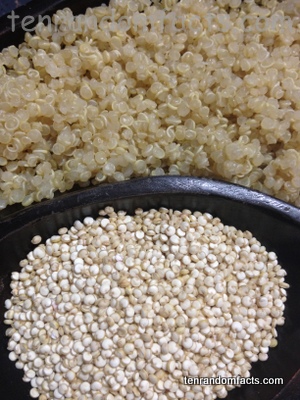
  • Quinoa is the small edible seed of an annual plant with the same name, that grows to 1 to 2 metres (3.3 to 6.6 feet) in height, of which there are different varieties that produce seeds coloured red, black or white.
  • Quinoa has the scientific plant name Chenopodium quinoa, and is a species of goosefoot, from the Amaranthaceae family, the family of amaranths.
  • Quinoa is, when raw, covered with a layer of bitter saponin, which is disliked by birds, and is the reason the grain needs washing before cooking.

Quinoa, White, Brown, Curls, Cooked, seeds, grain, uncooked, Ten Random Facts, Food, Gluten Free

  • Quinoa was the staple grain of the Ancient South and Central Americans, the Incans, Mayans and Aztecs.
  • Quinoa is typically not mechanically picked, and instead, picked by hand as the plant ripens individually, although consistent ripening varieties are being established for harvesting by machine.
  • In 2011, South America’s Peru was the greatest producer of quinoa, producing 41,200 tonnes (45,400 tons), over half of the total worldwide production, and Bolivia ranked as a close second.
  • Quinoa has a nut-like flavour and a texture similar to rice, is gluten free, and high in protein, manganese, magnesium, phosphorus, fibre, iron, copper, zinc and folate, and contains a significant source of other vitamins and minerals.
  • Quinoa can be purchased as an uncooked grain, like rice; as a ground flour; and as flakes used like rolled oats; and can be cooked to make a porridge; used instead of rice or couscous; added to salads; and in used as an ingredient in baked goods.
Bibliography:
Quinoa, 2014, The World’s Healthiest Foods, http://www.whfoods.com/genpage.php?tname=foodspice&dbid=142
Quinoa, 2014, Wikipedia, http://en.wikipedia.org/wiki/Quinoa

Amazon:      

Camphor Laurel

Camphor Laurel

Sit under the shade of a camphor laurel tree.

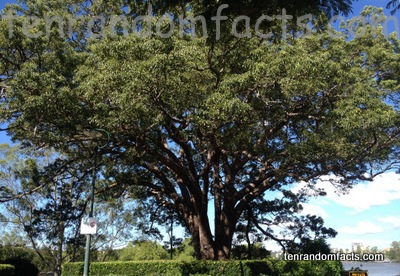
  • Camphor laurels are large shade trees that are evergreen and are typically used in parkland areas and gardens as an ornamental tree.
  • ‘Camphor laurels’ are also known as ‘camphor trees’ and ‘camphorwood’.
  • The scientific name of a camphor laurel tree is Cinnamomum camphora, from the family Lauraceae, the family of laurels.
  • Camphor laurels grow to be 20 to 30 metres (65 to 100 feet) in height and can live for hundreds of years.
  • Camphor laurel leaves are typically green and glossy, and if they are crushed they give off a camphor scent.

camphor laurel, tree, water, Brisbane, vegetation, large, Ten Random Facts, Australia

  • In spring, camphor laurel trees have tiny flowers that are generally white in colour, that develop into small green berries that turn black when ripe, that contain a seed.
  • Camphor laurels are a significantly invasive species in Australia’s Queensland and New South Wales and in the United State’s Florida, as well as a weed in other states of the United States, and they are commonly spread by birds and animals that eat the berries and expel the seeds.
  • Camphor laurel trees produce camphor, that is extracted from the wood, which are chemical crystals that have a waxy texture and are used as a moth repellent, as well as for medicinal and culinary purposes.
  • Camphor laurels have a tendency to have a spreading and invasive root system that can disturb buildings and underground water and waste services.
  • Camphor laurels are native to south-east Asia, including China, Japan, Borneo, Taiwan, Vietnam and Korea and prefer hot, damp conditions.
Bibliography:
Cinnamomum camphora, 2009, Metropolitan Tree Growers, http://www.metrotrees.com.au/treehandbook/page-listings/cinnamomum-camphora.html
Cinnamomum camphora, 2014, Wikipedia, http://en.wikipedia.org/wiki/Cinnamomum_camphora
D Firth, Camphor laurel, 2009, NSW Government: Department of Primary Industries, http://www.dpi.nsw.gov.au/agriculture/pests-weeds/weeds/profiles/camphor-laurel

Amazon:     

Scrabble

Scrabble

“Every word’s a winner.” – slogan of Scrabble.

  • Scrabble is a 2 to 4 player game revolving around words, requiring orthographic, strategy and probability skills.
  • ‘Scrabble’, meaning to ‘scratch’, ‘scramble’ or ‘struggle’, is played by placing tiles to make interconnecting words, in a way that scores points, left to right or downwards, on a board.
  • Since 1999, Scrabble has been produced by Hasbro Inc, in the United States and Canada, and it is manufactured by Mattel in all other countries.
  • Scrabble is sold in many countries and languages, 121 and 29 respectively, but the game cannot be played in Chinese or Japanese.
  • The square tiles used in Scrabble are typically made of wood or plastic, and are 0.4 cm  (0.16 in) high and 1.9 centimetres (0.75 inches) square,

Scrabble, Old, Original, Started, same, Play, Words, Wooden Tiles, Board, Ten Random facts

  • In 1938, Alfred Mosher Butts, an architect and artist from New York in the United States, invented Scrabble, originally known as ‘Lexico’ and then ‘Criss-Crosswords’, but the game did not start becoming popular until the 1950s.
  • Scrabble typically contains 100 tiles in the English version, and the words accepted in the game are generally those found in standard dictionaries or word game dictionaries.
  • Major tournaments for Scrabble include the World Championships, National Championships and the Brand’s Crossword Game King’s Cup.
  • There are many variations of the game Scrabble, that can be played, including online or digital versions that can be played by two players or one player.
  • It is estimated that 150 million Scrabble sets have been sold in the world, since its invention.


Bibliography:
Scrabble, 2014, Wikipedia, http://en.wikipedia.org/wiki/Scrabble
Scrabble History, n.d, Hasbro Gaming, http://www.hasbro.com/scrabble/en_US/discover/history.cfm

Amazon:     

Related Posts Plugin for WordPress, Blogger...