Athabasca Falls

Athabasca Falls

The strength of Athabasca Falls is mighty.

  • Athabasca Falls is a waterfall located on the upper section of Athabasca River in Alberta’s Jasper, in Canada.
  • Athabasca Falls drops a distance of 24 metres (80 feet) and reaches 18 metres (60 feet) in width.
  • Athabasca Falls is made primarily of quartzite, very hard rock, and limestone also exists in some parts.
  • Athabasca Falls is part of Jasper National Park, that became a national park in 1930, and it is said to be the most powerful waterfall in the Rocky Mountain area in Canada.
  • Athabasca Falls can be accessed via a walking track of approximately 1 kilometre (0.6 miles), that includes some stairs, and parts are surrounded by a safety barrier, which should not be crossed, as fatalities can occur outside these zones due to slippery surfaces.
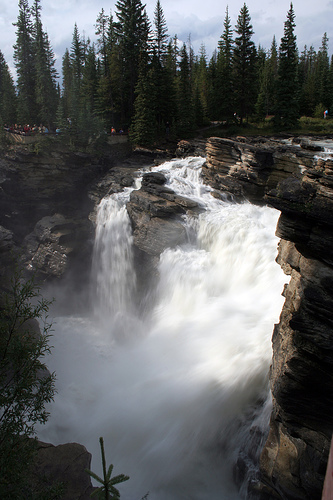
Athabasca Falls, Tall, Waterfall, Canada, Ten Random Facts, Majestic, Flickr, RockAthabasca Falls
Image courtesy of Tony Hisgett/Flickr
  • The water of Athabasca Falls drops at a great force and thus shapes the surrounding rocks and creates holes in them.
  • One of the contributing factors to the power and force of the Athabasca Falls, is the width of the Athabasca River and the relatively narrow opening where the water falls over the rocks.
  • Athabasca Falls is the home to much vegetation including trees, lichen, and moss, as well as the Canyon sprite, a bird.
  • The water of Athabasca Falls can freeze during winter, creating interesting ice structures.
  • Athabasca Falls is generally accessible year round, and as part of the Jasper National Park, an entrance fee is payable.
Bibliography:
Athabasca Falls, 2014, Trailpeak, http://www.trailpeak.com/trail-Athabasca-Falls-near-Jasper-AB-1679
Athabasca Falls, 2014, Wikipedia, http://en.wikipedia.org/wiki/Athabasca_Falls
Athabasca Falls, Jasper National Park, 2014, TD Canada, http://www.todocanada.ca/athabasca-falls-jasper-national-park/

Amazon:      

Walrus

Walrus

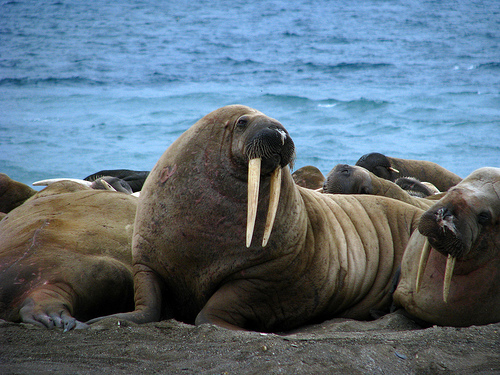
Walruses are gentle giants with super strength.

  • Walruses are large mammals that live in the Arctic areas of the Northern Hemisphere, including the Atlantic Ocean and the Pacific Ocean.
  • Walruses have the scientific name Odobenus rosmarus, of which there are up to three subspecies, and they are the only extant member of the family Odobenidae, a family of pinnipeds or seals.
  • Walruses can weigh 400 to 2,000 kilograms (880 to 4,400 pounds) in weight and grow up to 2.2 to 3.5 metres (7.2 to 11.5 feet) in length.
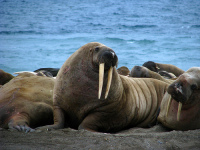
  • Walruses have two long tusks that can be 1 metre (3.3 feet) in length, that are used for latching onto and digging holes in ice, and in males they are used for fighting.
  • A female walrus usually gives birth to one pup during spring, not more than once every two years, around the time they migrate north, and the animal’s life span is generally between 20 to 50 years.
Walrus, herd, Blue, Animals, Marine, Ten Random Facts, Brown, Marine, Large, TuskA Herd of Walruses
Image courtesy of Claumoho/Flickr
  • Walruses generally hunt for food in the water in small groups, and typically eat shrimp, coral, worms, molluscs, sea cucumbers and other small aquatic animals.
  • Data relating to walrus populations has been difficult to obtain, making it difficult to determine whether they are endangered or not, however, they were heavily hunted in the 1700 and 1800s, causing a significant population decrease, and in some areas, extinction.
  • Legislation in some areas has protected the walrus for almost a century, however they have been illegally poached for their tusks, blubber, hide, meat and flippers, and now it is only legal for them to be hunted by local natives to the area, although permission has been granted to allow natives to include other hunters to participate in the hunt under special conditions.
  • A walrus has skin typically coloured brown to grey, that is scattered with hairs, and the animal also has whiskers above its mouth that are used as sensors.
  • Walruses live on ice in herds that can number in the thousands, with adult males usually living in a separate group to the females and their pups, and they are sometimes preyed on by orcas and polar bears.
Bibliography:
Walrus, 2013, A-Z Animals, http://a-z-animals.com/animals/walrus/
Walrus, 2014, National Geographic, http://animals.nationalgeographic.com.au/animals/mammals/walrus/
Walrus, 2014, Wikipedia, http://en.wikipedia.org/wiki/Walrus

Amazon:      

Jelly Bean

Jelly Bean

Every event requires a jar of jelly beans.

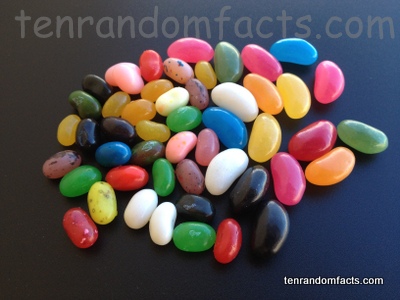
  • Jelly beans are small, brightly coloured confectionery items made mostly of sugar.
  • A ‘jelly bean’ is also known as a ‘jellybean’, or a ‘Jelly Belly’, and the latter is named after the popular brand.
  • Jelly beans are typically shaped as a bean, with a hard exterior and a softer inside.
  • The basis and idea for jelly beans is said to have originated from the traditional confectionery known as ‘Turkish delight’, that is like a firm jelly, as well as ‘Jordan almonds’, that have a hard sugary exterior.
  • Jelly beans are believed to have existed as early as the 1860s, and were made by confectioner William Schrafft, from Boston, United States, who suggested they be sent to the soldiers fighting in the American Civil War.

Jelly Bean, Colourful, Assortment, Jelly Belly, Many, Lollies, Candy, Confectionery, Culinary , Ten Random Facts

  • Jelly beans are typically made of sugar, glucose syrup from corn or wheat, as well as starch, and generally contain flavourings and colourings.
  • The 22nd of April is annually celebrated and declared as National Jelly Bean Day.
  • Jelly beans come in numerous colours and flavours, and generally a particular colour is associated with a particular flavour.
  • In the United States, jelly beans became popular in the early 1900s and became strongly associated with Easter in the 1930s.
  • Jelly beans are generally sweet, although they can be purposefully sour, while the Jelly Belly company has over 50 different flavours of the confectionery.


Bibliography:
Jelly Bean, 2014, Wikipedia, http://en.wikipedia.org/wiki/Jelly_bean
Moncel B, The History of Jelly Beans, 2014, About Food, http://foodreference.about.com/od/history_myths/a/The-History-Of-Jelly-Beans.htm
Prince J, A Brief History of Jelly Beans, 2014, Candy Favourites, http://www.candyfavorites.com/shop/jelly-bean-history.php

Amazon:     

Towel

Towel

As author Douglas Adams said, towels are the one of the most useful items.

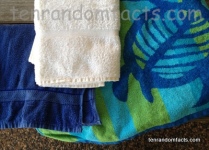
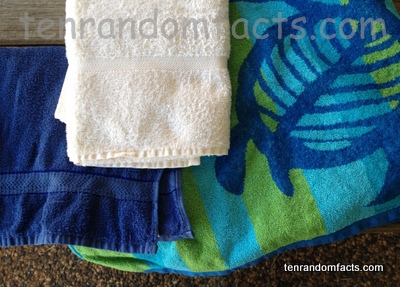
  • Towels are a textile item commonly used to remove and collect moisture, often water, from an object.
  • Towels are generally used by being placed on an object, and are typically pressed and rubbed for maximum effect.
  • Towels are most often made of absorbent material like cotton, bamboo, paper, synthetic fibres or other textiles, and the fabric often has a looped pile and is known as ‘terry cloth’.
  • The size of towels generally range between 30 x 61 centimetres to 76 x 152 centimetres (12 x 24 inches to 30 x 60 inches), although smaller and larger ones are available, and they are usually rectangular in shape.
  • Towels are commonly used after showering or bathing to dry oneself or one’s hands, and they can also be used for, but are not limited to, drying dishes and kitchen items, by sports enthusiasts to remove perspiration, at the beach to lay on, or for decorative purposes.

Towel, White, Blue, Beach, Washing, Bath, Ten Random Facts, Invention, Cotton

  • Towels are often dyed a single colour, although imagery or patterns can be imprinted or woven in, and other decorative features can also be included.
  • Until the availability of mass production machinery in the 1800s, towels were uncommon, due to being time-consuming to make, and as a result, expensive.
  • Towels are generally made by machines that spin, warp, weave, bleach and dye the material, as well as package the product.
  • It is said that towels were invented in Turkey, in the Middle East, and they were originally light and sheet-like.
  • Annually, on the 25th of May, National Towel Day is observed in some countries.
Bibliography:
Bath Towels, 2014, Make How, http://www.madehow.com/Volume-4/Bath-Towel.html
Rodd R, A Brief History of Towels, 2013, Lidtime.com, http://www.lidtime.com/a-brief-history-of-towels/
Towel, 2014, Wikipedia, http://en.wikipedia.org/wiki/Towel

Amazon:     

Gyokusendo Cave

Gyokusendo Cave

Gyokusendo Cave is bright, beautiful and peaceful.

  • Gyokusendo Cave is a large underground cave and water body located underneath the city of Nanjo, located in the southern part of the island of Okinawa, Japan in Asia.
  • ‘Gyokusendo Cave’ is also known as ‘Illuminated Cave’, and it is part of the above ground amusement park Okinawa World.
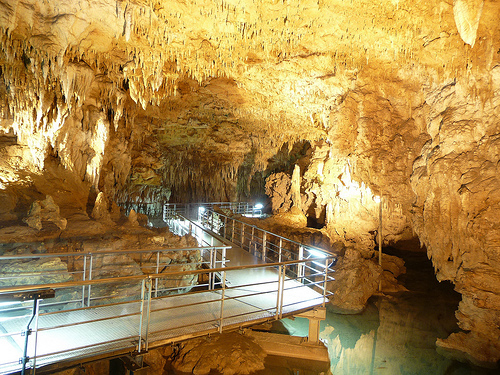
  • Gyokusendo Cave contains more than a million fragile stalactites that can fall from the ceiling as a response to loud noises that cause vibrations.
  • Gyokusendo Cave is full of moisture, with pleasant air movement, and it has temperatures typically averaging 21°C (70°F).
  • Gyokusendo Cave is lit with numerous multicoloured lights, ranging from yellow, blue and green, among others, to enhance the cave’s natural beauty.
Gyokusendo Cave, Rock, Limestone, Place, Japan, Underground, Lit, Stalactites, Ten Random Facts, Flickr
Gyokusendo Cave
Image courtesy of SteFou!/Flickr
  • Although the cave is approximately 5 km (3.1 miles) long, only 890 metres (973 yards) of Gyokusendo Cave can be accessed by the public, and ramps and man-made paths lead visitors through.
  • Gyokusendo Cave was first made known to the public in 1967, when it was discovered by a group from a Japanese university, although it is believed that locals to the area already knew of its existence.
  • Water flow thousands of years ago is the most likely cause of the Gyokusendo Cave, that is made primarily of limestone, while a river can be seen in the cave, as well as small waterfalls.
  • Gyokusendo Cave is the home to much wildlife including fish, bats, insects and reptiles, many of which are on display in the cave.
  • Gyokusendo Cave is a very popular tourist attraction, while access requires an entry fee, and the cave system is the second largest in Japan.
Bibliography:
Going Down in Okinawa, Japan, 2010, Go Backpacking, http://gobackpacking.com/gyokusendo-cave-okinawa-japan/
Illuminated Caves – Okinawa, Japan, 2014, Planet Den, http://planetden.com/architecture/illuminated-caves-okinawajapan
Top 10 Places to See Before You Die, n.d, Funzim, http://funzim.com/top-10-places-to-see-before-you-die/6/

Amazon:     

Serval

Serval

Servals, worshipped by Ancient Egyptians.

  • Servals are 19 subspecies of cat-like mammals native to Africa’s savannah habitats, south of the Sahara desert.
  • A ‘serval’ is also known as a ‘bush cat’, a ‘tiger bush cat’ and a ‘giraffe cat’.
  • Servals have the scientific name Leptailurus serval, although they are the only species in the Leptailurus genus, and they are from the family Felidae, the family of felids or cats.
  • Servals are most active during the night, when they hunt mostly for rodents, although they also consume birds, reptiles, frogs, insects, fish, hares and hyraxes, and they eat the meat and bones.
  • Servals have the longest legs of any cat in proportion to the animal’s body size, and the legs are used for jumping a height of 2 to 3 metres (7 to 10 feet) and they can run at top speeds of at least 64 kilometres/hour (40 miles/hour).
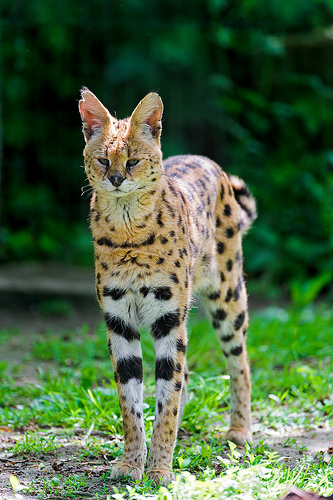
Serval, Animal, Cat, Spot, Zoo, Ten Random Facts, Flickr
A Serval
Image courtesy of Tambako the Jaguar/Flickr
  • Vocalisation among servals includes purrs, hisses, chirps, growls and meows, although meeting with others of the same species often results in fights as they are generally solitary animals.
  • Female servals have litters of one to four blind cubs, most often two, and they can have more than one litter in the year.
  • Servals, although they are classified as ‘least concerned’, have declined in numbers due to poaching and habitat loss.
  • Servals are typically coloured a yellow-orange to brown colour, with dark spots that pattern their coat, and they have very large ears compared with their head, that have distinct markings on the back.
  • Servals are occasionally preyed on by leopards and hyenas, while their lifespan is 10 to 20 years, and they can even reach up to age 23.
Bibliography:
Serval, 2013, A-Z Animals, http://a-z-animals.com/animals/serval/
Serval, 2014, San Diego Zoo, http://animals.sandiegozoo.org/animals/serval
Serval, 2014, Wikipedia, http://en.wikipedia.org/wiki/Serval

Amazon:      

Related Posts Plugin for WordPress, Blogger...