Honey Badger

Honey Badger

Are you as crazy for honey as a honey badger?

  • Honey badgers are mammals that are native to parts of Asia and Africa, and they do not have the appearance of a typical badger.
  • ‘Honey badgers’ are also known as ‘ratels’, and they have the scientific name Mellivora capensis, and are from the family Mustelidae, the family of weasels and other mammals.
  • Most honey badgers have fur typically coloured black with an upper white stripe, and they have baggy skin that allows freedom of movement, that is particularly advantageous when being attacked.
  • Honey badgers range from 55 to 77 centimetres (22 to 30 inches) in length, excluding the tail, and weigh 5 to 16 kilograms (11 to 35 pounds).
  • A honey badger typically lives by itself, however, others may be found nearby when looking for food, especially in breeding periods.
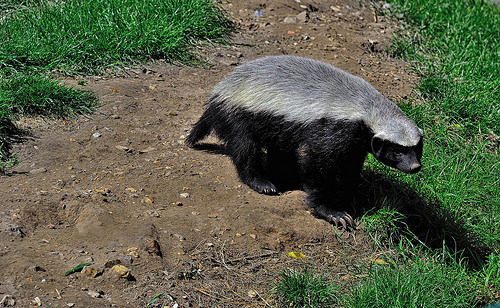
Honey Badger, Animal, Mammal, White, Black, Ten Random Facts,
A Honey Badger
Image courtesy of Steve Slater/Flickr
  • Honey badgers live in 1 to 3 metres (3.3 to 9.8 feet) long burrows underground, that can be dug in as little as ten minutes, and they can also climb and swim.
  • Honey badgers have robust skin that can deflect bites, stings and punctures, making it a hard animal to kill, and they will also attack aggressively and release a smelly odour, and are therefore unpopular prey.
  • The diet of honey badgers includes honey, bee larvae, insects, eggs, rodents, birds, amphibious animals, vegetation, and reptiles, including venomous snakes and turtles, and they consume all components of their prey including shell, bones, fur, and feathers.
  • Honey badgers that live near livestock owned by humans can be a significant nuisance, as it is difficult to kill the badger and prevent it from capturing and eating the animals.
  • Female honey badgers typically give birth to one or two cubs at a time, and can live up to 24 to 26 years in captivity.
Bibliography:
Honey Badger, 2014, Wikipedia, http://en.wikipedia.org/wiki/Honey_badger
Honey Badger (Ratel), 2014, San Diego Zoo, http://animals.sandiegozoo.org/animals/honey-badger-ratel

Amazon:     

Tapioca

Tapioca

Tapioca is a diverse substance.

  • Tapioca is a starch taken from the root of the plant with the scientific name, Manihot esculenta, that is commonly known as cassava.
  • The cassava or manioc tuber, as it is sometimes called, that tapioca is derived from, is native to South America, and was eventually taken to Africa and Asia as a result of explorers from Portugal and Spain.
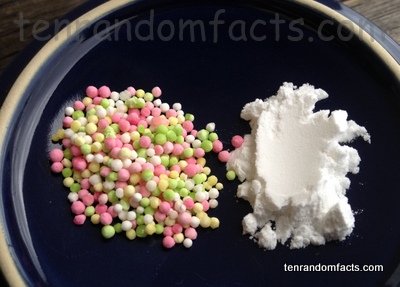
  • Tapioca can be bought as powder, flakes, pearls, sticks and meal, and the latter four often require soaking before use.
  • Tapioca is often made into desserts; is used as a thickener in liquids; and can be used as a flour in baked goods.
  • The roots of cassava are poisonous and contain cyanide until they are thoroughly processed, after which the tapioca is extracted.

Tapioca, Starch, White, Pearls, Ten Random Facts, Food, Culinary, Invention

  • Tapioca was a staple food item during the food shortages in Southeast Asia during World War II.
  • The word ‘tapioca’ comes from the native Tupí language term for the method of making the cassava root fit for consumption, known as ‘tipi’óka’.
  • Tapioca is commonly used in gluten free cooking, and it helps to give a crispy or chewy feel to baked goods, depending on the item.
  • Tapioca is high in iron and manganese and is very high in carbohydrates.
  • Tapioca is typically white in colour, but very rarely does it affect the colour of other food, and it generally does not provide flavour, although too much of the starch in a food item can cause an unpleasant or slimy texture, as well as taste.
Bibliography:
Tapioca, 2014, Wikipedia, http://en.wikipedia.org/wiki/Tapioca
Tapioca Flour, 2014, Bob’s Red Mill, http://www.bobsredmill.com/tapioca-flour.html
WHAT IS TAPIOCA STARCH AND TAPIOCA FLOUR? {GLUTEN FREE FOOD FACTS}, 2012, Lynn’s Kitchen Adventures, http://www.lynnskitchenadventures.com/2012/10/what-is-tapioca-starch-and-tapioca-flour-gluten-free-food-facts.html

Amazon:     

Bali

Bali

Ever fancy a trip to Bali?

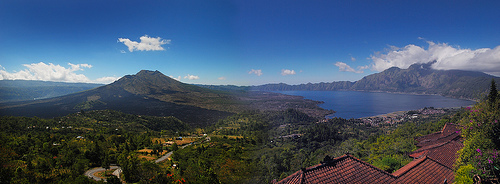
  • Bali is part of the Lesser Sunda Islands archipelago, and is one of the islands of Southeast Asia’s Indonesia.
  • Bali is a popular tourist destination, with impressive scenery, and many attractions, including cultural artistic talents.
  • The population of Bali was approximately 4.2 million people in 2014, while the majority followed Hindu religious beliefs.
  • The province of Bali covers an area of 5,780 square kilometres (2,232 square miles) and its largest city and capital is Denpasar.
  • Bali was settled during the ancient times by the Austronesians, and the culture was mainly shaped by the Asian communities of India and China.
Bali, Panorama, Aerial View, Ten Random Facts, Island, Place, Land, Asia,
Part of Bali
Image courtesy of William Cho/Flickr
  • Indonesian is Bali’s official language, and the island is thought to have been first visited by Europeans in 1512, by the Portuguese navigator António de Abreu and explorer Francisco Serrão.
  • Bali beaches can have sand that is either black or white in colour, depending on which side of the island they are on, and the island is encompassed by many coral reefs.
  • Bali is the home to a number of mountains including the active volcano and the highest mountain on the island, Mount Agung, that is 3,031 metres (9,944 feet) in height, that last erupted in 1963, killing many people.
  • Many animals can be found on the island of Bali, including many mammals and reptiles, approximately 280 bird species, and at least 952 fish species that exist around the reefs, and the notable Bali tiger also belonged there until it became extinct in the early to mid 1900s.
  • Bali tourism provides the greatest income for the area, and second to that is agriculture, particularly rice farming.
Bibliography:
Bali, 2014, Wikipedia, http://en.wikipedia.org/wiki/Bali
General Information About Bali, 2000, indo.com, http://www.indo.com/geo/gen_info.html
General Information About Bali, 2012, Lombok Network, http://www.bali.lombok-network.com/general_info.htm

Amazon:     

Blue Billygoat Weed

Blue Billygoat Weed

Blue billygoat weed is a strange name for a strange plant.

  • Blue billygoat weeds are an annual plant, native to areas of Central America and Mexico.
  • Blue billygoat weeds have the scientific name Ageratum houstonianum and are from the family Asteraceae, the family of asters and daisies.
  • ‘Blue billygoat weeds’ are also known as ‘blueweeds’, ‘floss flowers’, ‘blueminks’, ‘pussy foots’, ‘Mexican paintbrushes’ and ‘goatweeds’, among others.
  • Blue billygoat weed typically grows to be 30 to 100 centimetres (1 to 3.3 feet) in height and the leaves grow to be 2 to 7 centimetres (0.8 to 2.8 inches) in length.
  • Blue billygoat weed has small seeds that are coloured brown to black, and are covered in small scales that look like hairs.

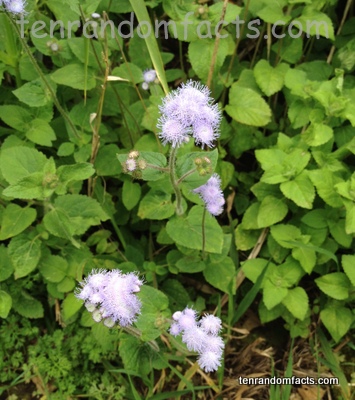
Blue billygoat weed, Purple, Flower, Ten Random Facts, Plant, Vegetation, Weed

  • Blue billygoat weed is often used for ornamental purposes, such as in gardens, and some of the cultivars have been awarded the British Royal Horticultural Society’s Award of Garden Merit.
  • The flowers of blue billygoat weed can be blue, pink, white or purple in colour, and the flower heads are covered with numerous, clustered, tiny tubular flowers, that are thread-like in appearance.
  • Blue billygoat weed contains a chemical that causes premature moulting in insects, and they can be poisonous to animals such as sheep and cows, causing liver problems.
  • Blue billygoat weed has been classified as an invasive weed in many areas, such as parts of the United States, Asia, New Zealand, Europe, Africa and Australia.
  • Blue billygoat weeds are readily grown from seeds, that are easily spread in water and wind, and this is the main cause of its widespread weed status.
Bibliography:
Ageratum houstonianum, 2013, Wikipedia, http://en.wikipedia.org/wiki/Ageratum_houstonianum
Blue billygoat weed, 2011, Weeds of Australia, http://keyserver.lucidcentral.org/weeds/data/03030800-0b07-490a-8d04-0605030c0f01/media/Html/Ageratum_houstonianum.htm

Amazon:     

Flaxseed

Flaxseed

Flaxseeds are nutrition bombs.

  • Flaxseeds are the seeds from the flax plant that has the scientific name Linum usitatissimum, which is from the family Linaceae, a family of flowering plants.
  • Flaxseeds can be eaten cooked, raw or ground, and are often used to flavour dishes and baked goods as well as breakfast cereals, and oil can also be extracted from them.
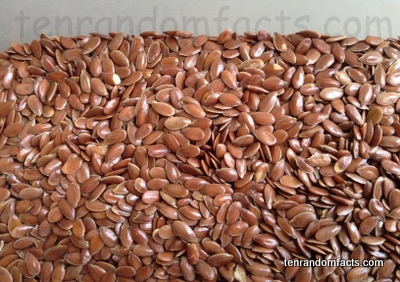
  • Flaxseeds are typically brown, red brown, yellow, tan or gold in colour, and white, black or green seeds can be obtained, however they are either immature, or over mature, and it is best to avoid them.
  • ‘Flaxseeds’ are also known as ‘flax seeds’ and ‘linseeds’, and are best ground and consumed with water to make them more digestible.
  • Flaxseeds have been used medicinally, primarily in Austrian folk medicine, for infections, colds, fever and problems with eyes and respiratory areas, among others.

Flaxseed, Red, Seed, Grain, Ten Random Facts, Linseed, Culinary, Flavour, Red

  • Ground flaxseeds require refrigeration unless consumed quickly, as they can go rancid in short periods of time – as quickly as seven days, if left at room temperature, although raw unground seeds have a much longer storage life.
  • Flaxseeds and their oil can cause an allergic reaction in some people, and symptoms include itchy skin and nausea.
  • In 2011, Canada was the leading producer of flaxseeds, with 368,300 tonnes (406,000 tons) of the world production of 1,602,000 tonnes (1,765,900 tons), and China ranked a close second.
  • Flaxseeds have been used as a food for thousands of years, particularly in Mediterranean and Middle Eastern countries.
  • Flaxseed nutrition varies slightly depending on their colour, however, they are very high in fibre, magnesium, manganese, thiamin, and notably, omega-3, as well as being high in copper and phosphorus, and they also contain many other vitamins and minerals.
Bibliography:
Flax, 2014, Wikipedia, http://en.wikipedia.org/wiki/Flax
Flaxseeds, 2014, The World’s Healthiest Foods, http://www.whfoods.com/genpage.php?tname=foodspice&dbid=81

Amazon:     

Crochet Hook

Crochet Hook

Crocheting without a crochet hook must have been pretty difficult.

  • A crochet hook is a tool used in the art and craft of crocheting, and the tool is manipulated with one’s hand to make a series of loops from yarn, thread or other fibres, to create fabric or cord.
  • ‘Crochet hooks’ are also known as ‘crochet needles’ and the word ‘crochet’ is a French word that comes from the Old Norse word ‘krókr‘ meaning ‘hook’.
  • Crochet hooks are typically long and stick like with a hooked end, and sometimes they have a handle for better comfort and/or grip.
  • Crochet hooks come in a variety of sizes and thicknesses, with at least 25 different sizes that are graded using letters or numbers.
  • Crochet hooks can be used in knitting to pick up dropped stitches, and for other craft purposes, and they can also be used to maintain hair dreadlocks.

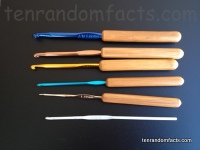
Crochet Hook, Many, Wooden, Shiny, Textile, Tool, Craft, Invention, Ten Random Facts

  • Crochet hooks can be held like a knife or a pencil, although one technique is not necessarily better than the other, and it comes down to personal preference as to which is used.
  • Crochet hooks were most likely invented in the early 1800s, and first made of wire, and possibly originated in Ireland, Europe.
  • Some unique versions of crochet hooks include the much longer Tunisian hook, used in Tunisian crochet; and the cro-hook, used for double-sided crochet, that is particularly effective using two different colours of yarn.
  • Crochet hooks are typically made of plastic, wood, or aluminium, and originally they were made of steel, bone, ivory, and other materials.
  • It is common that only a single crochet hook is used in the practice of crochet, and it can be used in either the left or right hand, depending the user’s dominant hand.


Bibliography:
Crochet Hook, 2014, Wikipedia, http://en.wikipedia.org/wiki/Crochet_hook
Marks R, History of Crochet, 2009, CGOA, http://www.crochet.org/?page=CrochetHistory

Amazon:     

Related Posts Plugin for WordPress, Blogger...