Wheat Tortilla

Wheat Tortilla

Did you know that wheat tortillas are really popular?

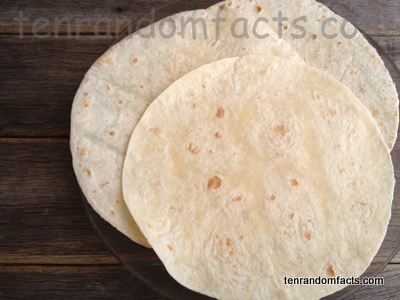
  • Wheat tortillas are wheat based bread items that are generally thin and soft in texture.
  • ‘Wheat tortillas’ are also known as ‘flour tortillas’, or simply as ‘tortillas’, although this is used as a general term.
  • Wheat tortillas have their origins in the similar corn versions of Ancient North and Central American societies, after wheat was introduced to the area.
  • Wheat tortillas are typically circular in shape and range from 6 to 30 centimetres (2.4 to 12 inches) in diameter, and are able to be rolled out to larger diameters than those made from corn.
  • Food that often accompanies wheat tortillas includes cheese, meat, potato and/or salad.
Wheat Tortilla, White, Homebrand, Food, Bread, Culinary, Australia, Ten Random Facts, Circular

  • Wheat tortillas are generally made using a unique machine, which, every hour, can create 60,000 of them.
  • The typical process of making wheat tortillas involves making the unleavened bread mix, and then pressing and cooking it.
  • Wheat tortillas are very popular in Central and North America, and have become a prominent food item especially in northern Mexican cuisine; while tortillas have become the second most common bread item on the continent.
  • Wheat tortillas are commonly used in outer space trips originating from America, as the food creates limited mess, unlike common bread, which helps to prevent machinery malfunctions from small particles.
  • Wheat tortillas are high in fibre, sodium, carbohydrates, and protein, and packaged tortillas often contain preservatives to prolong shelf life.
Bibliography:
Tortilla, 2014, Wikipedia, http://en.wikipedia.org/wiki/Tortilla
Tortilla Talk, n.d, TIA, http://www.tortilla-info.com/default.asp?contentID=6

Amazon:      

Cheque

Cheque

Do you consider cheques ancient or commonplace?

  • A cheque is a slip of paper that directs a bank to give the payee money, from the bank account of a person, known as the ‘drawer’, who issued the slip.
  • ‘Cheque’ is a British English term, and it is known in the United States as a ‘check’, and it is also considered as a type of ‘bill of exchange’.
  • Cheques were invented as an easy and relatively safe way to obtain and hold money of large quantities, and they were originally known as ‘drawn notes’.
  • Early types of cheques were in use in 321 to 185 BC in India, Asia, named ‘adeshas’, and were particularly similar to the modern invention, and a similar idea was used in Ancient Rome from around 100 BC.
  • The first use of early cheques in European society were in Europe’s Venice in the 1200s, for trade purposes, and the practice of issuing bills of exchange became more widespread a few hundred years later, and were very common by the 1700s when banks were more commonplace.
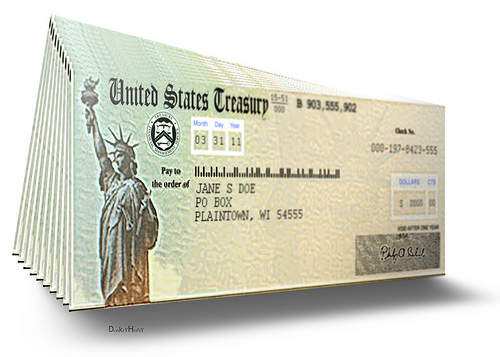
Cheques, America, Fake, 3D, Ten Random Facts, Money, Invention, Illustration
Cheques
Image courtesy of DonkeyHotey/Flickr
  • Cheques are commonly obtained in a booklet form, generally with pre-printed details of the drawer, and this practice emerged in the early 1800s.
  • With the introduction of more practical, efficient and cost effective technology, cheque use is decreasing rapidly and they are no longer used in some countries.
  • Cheques generally have the details of the drawer’s bank account number, the person the money is to be given to, the bank that issued the slip, and the amount of money to be given.
  • Cheques often expire after a certain time frame, ranging typically from 6 months to 15 months, if they have not been banked or cashed.
  • Cheques are usually smaller than a standard size piece of paper, although the largest one issued spanned 12 by 25 metres (39 by 82 feet), although large ones are usually for display and promotional purposes.
Bibliography:
Cheque, 2014, Wikipedia, http://en.wikipedia.org/wiki/Cheque
THE ROLE OF CHEQUES IN AN EVOLVING PAYMENTS SYSTEM, 2011, Australian Payments Clearing Association, http://www.apca.com.au/docs/role-of-cheques—consultations/future-of-cheques.pdf

Amazon:     

Selkirk Mountains

Selkirk Mountains

Welcome to the not so Scottish, Selkirk Mountains.

  • Selkirk Mountains is a range of mountains located in Canada’s British Columbia and the United State’s Idaho and Washington states, and it is made primarily of granite rock and forms part of the Columbia Mountains group.
  • Selkirk Mountains cover a distance of 525 kilometres (326 miles) and are 175 kilometres (109 miles) in width.
  • The Selkirk Mountains are named after the 5th Earl of Selkirk, Thomas Douglas, a Scottish nobleman, who purchased land in Canada and helped to colonise some areas with poor Scottish farmers.
  • The peak of Mount Sir Sandford is the highest point of Selkirk Mountains, at 3,519 metres (11,545 feet) above sea level.
  • A number of valuable metals or stone deposits have been found in some areas of the Selkirk Mountains, including coal, copper, mercury, zinc, silver, marble and gold, while the latter was discovered in the mid 1800s.
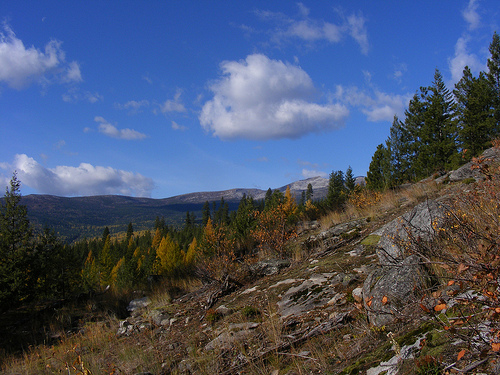
Selkirk Mountain, Scenic, America, Ten Random Facts, Trees, Country, Range
Part of Selkirk Mountains
Image courtesy of Jesse Taylor/Flickr
  • A major obstacle of the building of the Canadian Pacific Railway was the Selkirk Mountains; and a pass through the mountains was discovered by American surveyor, Albert Rogers in 1881, and as a result the pass was named ‘Rogers Pass’.
  • Selkirk Mountains is the home to much wildlife, including woodland caribou, deer, bears, eagles, herons, wolves, moose, foxes and bobcats, while vegetation and trees such as conifers and cedars are prominent.
  • Selkirk Mountains are predominately cared for and managed by the Idaho Panhandle National Forest agency.
  • Selkirk Mountains have been previously inhabited by native American Indians of the tribe, the Lower Kootenai.
  • Selkirk Mountains are the home to many sights including 76 lakes, such as the very clear Priest Lake, and numerous mountain peaks, including 30 that are over 2133 metres (7,000 feet) high.
Bibliography:
Selkirk Mountains, 2014, The Free Dictionary, http://www.thefreedictionary.com/Selkirk+Mountains
Selkirk Mountains, 2014, Wikipedia, http://en.wikipedia.org/wiki/Selkirk_Mountains
Selkirk Range, 2013, SummitPost.org, http://www.summitpost.org/selkirk-range/171132

Amazon:     

Caracal

Caracal

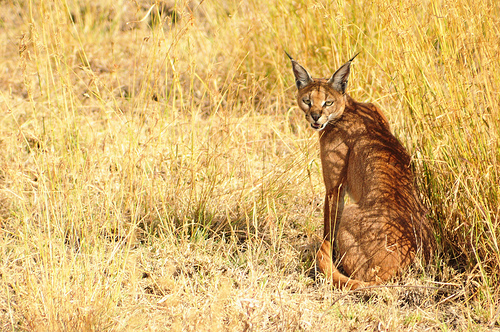
Don’t mistake the power of a caracal.

  • Caracals are a species of wild cat, native to parts of central and southwest Asia, and Africa, and are found in savannah, semi-arid and woodland habitats.
  • The Turkish words, ‘kara kulak’, meaning ‘black ear’, is where the ‘term ‘caracal’ originates from, and they have the scientific name Caracal caracal and are from the family Felidae, the family of felids or cats.
  • Although they are only related to lynx by family and not genera, a caracal is also known as a ‘desert lynx’, ‘Asian lynx’, ‘Persian lynx’ and ‘African lynx’.
  • Caracals range in length between 61 and 106 centimetres (2 to 3.5 feet), are 6 to 20 kilograms (13 to 44 pounds) in weight, and have a lifespan of 12 to 15 years.
  • Caracals have notably long, erect fur on their ears, which is typically black, while its fur coat ranges from tan, brown to black in colour.
Caracal, Animal, Felid, Ten Random Facts, Rare, Beauty, AmazingA Caracal
Image courtesy of Gopal Vijayaraghavan/Flickr
  • Caracals usually live by themselves, and they mark their territory with urine to discourage others of the same species from entering into their zone.
  • The diet of caracals mainly consists of small mammals, such as rodents, and birds, although they do stalk and attack larger animals like antelopes; and if their prey is airborne, they can leap high into the air to catch it.
  • Female adult caracals typically give birth to between one to six kittens in an enclosed area, such as an already existing den, burrow or hollow, and the females raise them alone.
  • Although their conservation status is classified as least concerned, caracals are negatively affected by the removal of habitats, causing limited populations in some areas, and they are a protected species in many countries.
  • Caracals are preyed on by lions and hyenas; are occasionally kept as pets; and have previously been used in countries, such as India, for hunting purposes.
Bibliography:
Caracal, 2013, A-Z Animals, http://a-z-animals.com/animals/caracal
Caracal, 2014, San Diego Zoo, http://animals.sandiegozoo.org/animals/caracal
Caracal, 2014, Wikipedia, http://en.wikipedia.org/wiki/Caracal

Amazon:     

Smarties

Smarties

“Only Smarties have the answer” – the brand’s slogan in Europe.

  • Smarties are food items produced by Nestlé, and are made primarily of chocolate that has been coated in a coloured shell made of sugar and other ingredients.
  • Smarties are particularly common in countries such as the United Kingdom, Canada, Australia, Spain, Germany, Italy and Netherlands.
  • Smarties are circular in shape, and they are like a flat sphere, generally 15 millimetres (0.6 inches) in diameter and approximately 5 mm high.
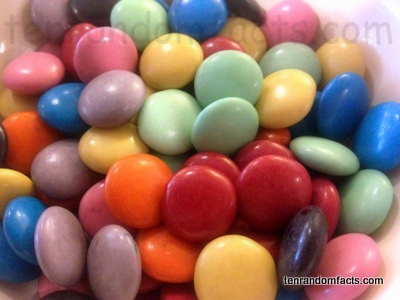
  • Smarties typically come in the eight colours of green, yellow, orange, mauve, red, pink, brown and blue, while the latter has been previously substituted with white.
  • Smarties are not commonly found in the United States, as the name has already been trademarked by another company for a candy that looks like a tablet or pill.

Smarties, Food, Colourful, Chocolate, Confectionary, Bowl, Ten Random Facts, Company, Handful

  • Smarties were invented in 1882 by Rowntree’s of York, an English confectionery company which Nestlé bought in 1988, however, they are no longer manufactured in York, but they are produced in other countries, including Germany, Canada, and Australia.
  • Smarties were not named as such until 1937, and they were originally called ‘chocolate beans’, although variations of this former term have been used as names for other brands of similar candy not produced by Nestlé.
  • From 2006, Smarties produced in various countries gradually changed from artificial to natural colours, causing blue to be changed to white, until a natural replacement was found.
  • Smarties are commonly eaten as a sweet snack, and are sometimes used as a topping with ice-cream, or for decorative baking purposes.
  • Smarties can be commercially bought in cylindrical or hexagonal containers, packets, or boxes, or purchased combined with ice-cream, chocolate or other confectionery.


Bibliography:
Smarties, 2014, Nestle, http://www.nestle.co.uk/brands/chocolate_and_confectionery/chocolate/smarties
Smarties, 2014, Wikipedia, http://en.wikipedia.org/wiki/Smarties

Amazon:      

Gear

Gear

Gears are in nature and in machines… just where to look?

  • Gears are items used in machinery, and have the primary function of transferring power from a source to an application.
  • ‘Gears’ are also known as ‘cogwheels’, and when different sized ones are meshed against each other, the result is that the application speed will be different to the source speed.
  • Gears have protruding spikes, or ‘teeth’ , that interlock, or ‘mesh’ with others that have teeth of the same size, causing all those that are meshed to move when a force is applied to one.
  • Gears originated in Ancient Greece, particularly around 300 to 200 BC, when Archimedes, a Greek polymath, discovered many of the item’s properties and physics.
  • The most common type of gear is named the ‘spur’, that is circular or cylindrical in shape, and has teeth that sit on the circumference, parallel to the central rotating point; while other types can have curved or other differently shaped or positioned teeth, including internal teeth, or teeth that are placed along the item’s width.
Gear, Silver, Ten Random Facts, moving, Invention, Grey, Small, Large, Mechanical
Gears
Image courtesy of Brent 2.0/Flickr
  • When a gear changes direction while moving, a lapse, or ‘backlash’ is created, caused by a space, due to the positioning of the teeth as they mesh.
  • Gears are typically made of metals such as steel or iron, but plastic ones are also available, and they come in numerous shapes and sizes.
  • The size of gears can be measured in ‘modules’, which is typically the item’s diameter divided by the number of teeth, although they can be measured in ‘pitches’ when using imperial units, which is a teeth per inch measurement.
  • Gears are generally made using a mold, and the molding technique generally reduces or eliminates the need for finishing touches.
  • Insects from the planthopper family, Issidae, such as an Issus nymph, have legs that include a gear mechanism, that causes the insect to jump at a tremendous speed.
Bibliography:
A Brief History of Gears, 2014, Ronson Gears, http://www.ronsongears.com.au/a-brief-history-of-gears.php
Gear, 2014, Wikipedia, http://en.wikipedia.org/wiki/Gear

Amazon:     

Related Posts Plugin for WordPress, Blogger...