Meringue

Meringue

Light and airy meringues.

  • Meringues are a light weight and traditionally white food made by whipping ingredients, and they are often eaten as a sweet dessert.
  • Meringues are made primarily of sugar and egg whites that have been whipped together, and sometimes binders, such as cornstarch; acids, such as cream of tartar; and flavouring, such as vanilla, are included.
  • Meringues are typically sweet flavoured and have a crisp outer surface, with either a light chewy or crisp textured interior, and food colouring can be added for decorative effects.
  • The earliest known record of the word ‘meringue’, is found in the 1692 cookbook written by the chef François Massialot of France, in Europe, although it is believed that the food has its origins in the 1500s.
  • One of the first documented meringue recipes was from an early 1600s recipe book written by Lady Elinor Fettiplace, from England’s now Oxfordshire in Europe, and the recipe was named ‘white biskit bread’.
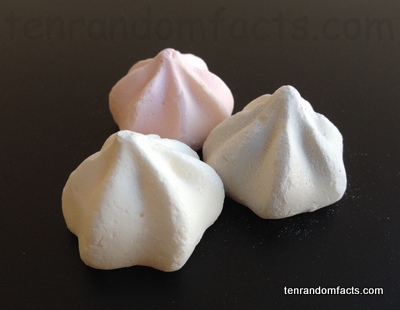
Meringues, Small, Factory, White, Pink, Green , Coloured, Three, Group, Culinary, French, Ten Random Facts

  • The shape of meringues is generally achieved by using spoons or a piping bag, and once formed to the desired shape, they are generally cooked in an oven on a low temperature.
  • The primary reason for beating the whites of eggs is to break certain bonds, which causes the mixture to stiffen, and if the sugar is not well incorporated into the mixture by significant beating, it will cause small droplets of moisture to appear on the exterior once cooked, which is known as ‘sweating’.
  • There are three main types of meringue: Italian; Swiss; and French; each made using different procedures, and the latter is the most common.
  • Meringues can be used as an ingredient in many other desserts, notably tarts, pavlovas, puddings and cakes.
  • Meringue never contains fat, as its inclusion would cause the mixture to cave in, although it does contain a significant portion of sugar and protein.


Bibliography:
Meringue, 2014, Wikipedia, http://en.wikipedia.org/wiki/Meringue
Muster D, The Origins and History of the Meringue, n.d., In Mamas Kitchen, http://www.inmamaskitchen.com/FOOD_IS_ART/meringue2.html

Amazon:      

Refrigerator Magnet

Refrigerator Magnet

Life is not complete without refrigerator magnets.

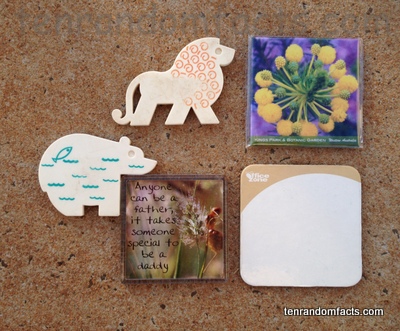
  • Refrigerator magnets are decorative objects that can be magnetically attached to flat metal surfaces such as fridges.
  • ‘Refrigerator magnets’ are also known as ‘fridge magnets’.
  • Refrigerator magnets are often used for decorative purposes as well as to hold objects in place, such as paper for convenience or as a reminder.
  • There is a very large diversity of refrigerator magnets, with various colours, images, designs, shapes and sizes.
  • The magnetic part of a refrigerator magnet is generally set out in a ‘Halbach array’, with both north and south poles in an alternate pattern on the same side, which adds to the magnet’s strength and is more cost effective.

Refridgerator Magnets, Collection, Flat, Square, Shapes, Note, Picture, Ten Random Facts, Invention, Decorative

  • Refrigerator magnets are collected by numerous people; and the largest collection in the world is owned by Louise Greenfarb from the United States’ Nevada, and in 2013 the collection consisted of at least 35,000 magnets.
  • The unofficial term for a refrigerator magnet collector is a ‘memomagnetist’, coined by an enthusiast from Russia.
  • Originally, the magnets of refrigerator magnets where manufactured in the shape of a rectangular prism or cylinder, but they are commonly now thinner and often more flexible.
  • Do-it-yourself refrigerator magnets can be easily made, due to the increasing availability of magnetic material suitable for this purpose, and it has become a common craft activity.
  • Some refrigerator magnets can be used for educational purposes, especially those that depict letters, to make words, and these have been available since the mid 1900s.


Bibliography:
Refrigerator Magnets, 2014, Wikipedia, http://en.wikipedia.org/wiki/Refrigerator_magnet

Amazon:      

Cuicul

Cuicul

Learn about some very well preserved Roman architecture with these Cuicul facts.

  • Cuicul is an ancient city and ruins built by Romans in a mountainous area, located in north Africa’s Algeria.
  • ‘Cuicul’ is the Latin name for the city, which is also known as ‘Djémila’, that can literally be translated to ‘beautiful’ in Arabic.
  • Cuicul was declared a UNESCO World Heritage Site in 1982 due to the site’s historically significant Roman architecture.
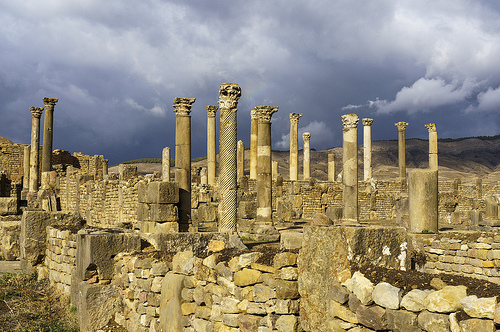
  • The Cuicul group of ruins consists of temples, houses, arches, streets, and also a theatre, that were originally built and designed by Romans.
  • Cuicul was built around 96 to 98 AD, and further developments and building occurred in the 3rd century, although, by the end of the 6th century it lay abandoned.

Cuicul, Ruins, Roman, Algeria, Columns, Ancient, Ten Random Facts, Structure, Architecture

Part of Cuicul
Image courtesy of Dan Sloan/Flickr
  • Cuicul was built on a mountain in the northern part of the country, in the Sétif Province, 900 metres (2953 feet) above sea level.
  • Until the 500s, marking the Roman Empire’s fall, Cuicul was used both as a Roman soldier base and a trade centre for the area.
  • The Christian religion was introduced to Cuicul during the 300s, so a chapel, baptistry and houses from the time are able to be seen today.
  • Cuicul is susceptible to damage by natural disasters including earthquakes; raids by humans; and nearby land illegally being used for agricultural purposes.
  • Cuicul is visited annually by approximately 45,000 tourists and students, that seem to have little or no detrimental effect on the area.
Bibliography:
Cuicul (Djémila), 2014, Wikipedia, http://en.wikipedia.org/wiki/Cuicul_(Dj%C3%A9mila)
Djémila, 2014, UNESCO World Heritage Convention, http://whc.unesco.org/en/list/191

Amazon:      

Barnacle

Barnacle

Whatever you do, do not have a barney over barnacles!

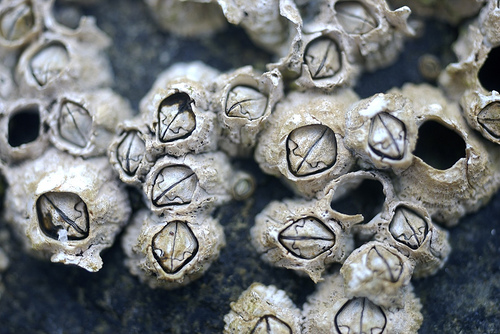
  • Barnacles are a group of over 1000 species of marine animal that have an exoskeleton and segmented body, and are typically found near or in saltwater of shallower depths.
  • Barnacles are an infraclass that have the scientific name, Cirripedia, and are from the class Maxillopoda, a class of various crustaceans such as copepods.
  • Barnacles live on a single sturdy object for its entire life of approximately 8 to 20 years, absorbing food such as plankton and algae from the surrounding water.
  • Mussels and limpets are common neighbours of barnacles; and the three animals often battle for space on available surfaces.
  • Barnacles are preyed on by many animals including fish and crabs during the larval phase as they have little protection, however, once they have settled and produced their outer shell, they are generally protected from most predators, but they are susceptible to whelks.

Barnacles, Animals, Ten Random Facts, Marine, Cement, Shell, Rock, Jetty, Stuck, Bradley  Beach, Flickr

Barnacles
Image courtesy of Mo Riza/Flickr
  • Barnacles live in a shell made of 6 plates, that are grown once the young permanently attaches onto a surface, and they are commonly found in groups as another form of protection against predators.
  • Larvae of barnacles generally swim in the water for 6 months or more, until the animals find a permanent surface that they attach to via the head, using antennae and a glycoprotein based mixture.
  • Some countries eat ‘goose’ barnacles from the order Pedunculata, in their culinary dishes, including Spain and Portugal of Europe.
  • Barnacles are typically white, cream, black or yellow in colour, while shells are often a bleached white.
  • Barnacles attach themselves to objects such as rocks, but also animals including turtles, whales and crabs, or buildings and boats, which can be both hard to remove and damaging to the object, and can cause significant speed loss in boats.
Bibliography:
Barnacle, 2013, A-Z Animals, http://a-z-animals.com/animals/barnacle/
Barnacle, 2014, Wikipedia, http://en.wikipedia.org/wiki/Barnacle

Amazon:     

Pizza

Pizza

Would you like a slice of pizza facts?

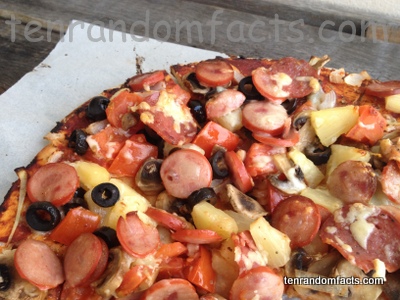
  • A pizza is a cooked bread based meal, that is often topped with a tomato paste or sauce, cheese and other items such as meat or vegetables.
  • An early style of pizza was eaten by both Greeks and Romans in ancient times, and it was primarily topped with herbs, cheese and oil.
  • The more modern pizza probably originated from Italy’s Naples, in Europe, from the 1700s to 1800s, that were topped with herbs, garlic and cheese, and eventually tomato.
  • According to legend, pizzas were cooked for Queen Margherita of the Kingdom of Italy, who was visiting Italy’s Palace of Capodimonte in Naples, and she took a liking to the one topped with mozzarella, tomato and basil, and this combination became famously known as a ‘Magherita’.
  • Pizzas were introduced to the United States by immigrants from Italy in the late 1800s, and while 1905 marked the opening of the first pizzeria in the US, they became popular after World War II, and now during October the food is particularly celebrated in parts of America.

Pizza, Ten Random Facts, Food, Circular, Part, Red. Pineapple, Meat, Olive, Culinary, Delicious, Homemade

  • Studies in 2010 suggest that pizza is eaten by approximately 13% of the United States population every day, and they can be bought frozen or ready to cook from supermarkets, or straight out of the oven at retail outlets including prominent pizzerias like Pizza Hut, Domino’s and Papa John’s.
  • The traditional way of cooking pizza is on a flat stone surface in a brick oven near an open flame, known as ‘wood-fired’, although they are often cooked in contemporary style ovens, in trays or pans.
  • Pizzas typically come in a circular shape, although other shapes are sometimes produced, while the crust is either thin, medium or thick,
  • The most expensive commercially available pizza listed in the Guinness World Records, was available in England’s London, that could be bought for £100 or 156 USD, although more expensive ones have been available from time to time, and as of 2014, South Africa had produced the largest, spreading 37.4 metres (122.7 feet) in length, in 1990.
  • Pizzas are high in selenium, riboflavin, folate and protein, and can contain many other vitamins and minerals, however they are known to have unhealthy amounts of salt and fat.
Bibliography:
Pizza, 2014, Wikipedia, http://en.wikipedia.org/wiki/Pizza
Turim G, A Slice of History: Pizza throughout the Ages, 2012, History, http://www.history.com/news/hungry-history/a-slice-of-history-pizza-through-the-ages

Amazon:      

Ice Pack

Ice Pack

It is never a good idea to eat an ice pack.

  • An ice pack is generally a sealed pouch that contains liquid or a semi-liquid substance, such as water or gel, that emits cold temperatures for extended periods of time, generally after freezing the pack.
  • ‘Ice packs’ are also known as ‘gel packs’ and ‘cold packs’, while ‘ice bricks’ are often used for the same purpose, although they usually have a rigid casing.
  • Ice packs are typically used to keep items at low temperatures, like food items in a cooler or portable ice box, or a shipping container; as well as for medical purposes, like reducing swelling and pain from minor injuries.
  • Ice packs are usually soft, plastic pouches, often rectangular in shape, but various other shapes are also available, and their advantage over ice bricks is that they are often more flexible, allowing them to be moulded around a human limb.
  • Some ice packs can be permanently stored at room temperatures, and can be ‘cracked’ when needed, to create a chemical reaction that releases cool temperatures.

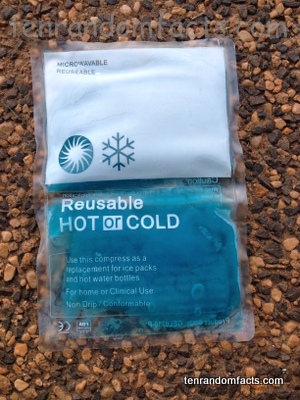
Ice Pack, Gel, Ten Random Facts, Blue, Hot and Cold, Reusable

  • The substance in ice packs can be toxic and potentially fatal, and toxic gels include ethylene or diethylene glycol, which can be illegal in some countries.
  • Common, safe gels used in ice packs include hydroxyethyl cellulose or silica gel, and they are most often coloured blue, but come in a variety of colours.
  • Often ice pack’s contain gel, however, when the pouch contains a liquid, the liquid will still usually contain chemicals that assist with keeping the pack colder for longer.
  • One of the earliest ice pack patents was filed in 1938, by Claude Brown from Chicago, in the United States, and ice packs were available for purchase in 1948.
  • Some ice packs can also be heated to be used for similar purposes, except they emit hot temperatures instead of cold.


Bibliography:
Ice Pack, 2014, Wikipedia, http://en.wikipedia.org/wiki/Ice_pack
M Rehak, Who Made That Ice Pack?, 2014, The New York Times, http://www.nytimes.com/2014/07/13/magazine/who-made-that-ice-pack.html?_r=0

Amazon:      

Related Posts Plugin for WordPress, Blogger...