Phoropter

Phoropter

Even modern phoropters look like gizmos from the 1900s.

  • Phoropters are an invention used primarily to determine the refraction error – the inaccuracy of an eye’s ability to focus light, of a person’s eyes.
  • ‘Phoropters’ are also known as ‘refractors’, and the word may be spelled ‘phoroptors’.
  • A phoropter has a set of interchangeable lens, and as the lenses are changed, the patient is required to comment on the lens effectiveness.
  • The term ‘phoropter’ originated as a trademark from 1921, originally owned by DeZeng Standard, and was a shortened form of ‘phoro-optometer’.
  • While using a phoropter, a patient is normally required to look at an eye chart from behind the machine as the machine’s lenses are interchanged, to determine whether they can see more clearly, or less so.

Phoropter, Invention, Optometrist, Trivia, Ten Random Facts, Mechanism,

  • Phoropters typically consist of twin ellipsoid plates that sit next to the left and right sides of one’s face, and are connected to an overhanging and adjustable beam.
  • The practice of using lenses interchangeably to measure optics originated from the 1600s, while early predecessors of the phoropter first emerged in the 1800s.
  • Phoropters were first patented in 1909 by American Henry DeZeng, though a patent by American Nathan Shigon was also accepted a year later.
  • Although commonly used to measure refraction error, phoropters can be used to determine optical posture, as well as rest positions and amplitudes of the eyes.
  • Ophthalmologists and optometrists, especially those who handle eye tests, will most often use a phoropter, to enable an accurate spectacles’ prescription for a patient.
Bibliography:
Phoropter Handouts, n.d, Scribd., http://www.scribd.com/doc/19428106/Phoropter-Handouts#scribd
Phoropter, 2015, Wikipedia, https://en.wikipedia.org/wiki/Phoropter
What Is It: Phoropter, 2013, Eyeglass Guide, http://www.eyeglassguide.com/my-visit/vision-testing/phoropter.aspx

Amazon:       

Common Nightingale

Common Nightingale

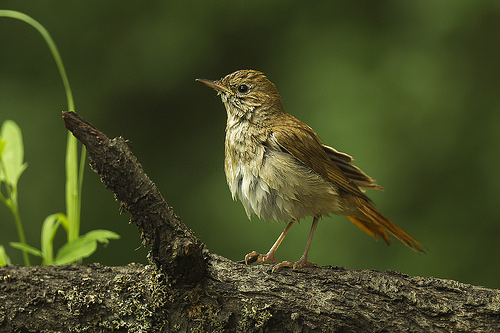
Common nightingales are musical wonders of nature.

  • Common nightingales are a small bird native to Europe and Asia, and they migrate to Africa where they spend winter.
  • ‘Common nightingales’ are also called ‘rufous nightingales’ or plain ‘nightingales’.
  • The scientific name of common nightingales is Luscinia megarhynchos and it is from the family Muscicapidae, the family of Old World flycatchers.
  • Common nightingales grow to be around 14 to 17 centimetres (5.5 to 6.7 inches) in length and their wings span 20 to 24 centimetres (7.9 to 9.5 inches).
  • The weight of common nightingales is roughly 18 to 23 grams (0.6 to 0.8 ounces), and they have a typical lifespan of one to five years.
Common Nightingale, Trivia, Ten Random Facts, Bird, Brown, Yellow, Animal, Feathers,
Common Nightingales
Image courtesy of Francesco Veronesi/Flickr
  • The common nightingale feathers spread from browns to light tans, and they have a light coloured underside, while the tail feathers are a reddish-brown, and the eyes are surrounded by a white ring.
  • Common nightingales are well known for their ability to sing beautiful notes during both day and night, that are highly pleasant and inspirational, though the males generally sing more than the females, and do so to attract their mate.
  • The term ‘nightingale’ originates from the word in Old English ‘nihtegale’, or similar, which literally means ‘to sing at night’.
  • The diet of common nightingales consists primarily of insects, though fruit, seeds and nuts, are also consumed at times.
  • Nests of common nightingales are typically concealed and made of twigs and leaf litter, with females laying four to five eggs each breeding season.
Bibliography:
Common Nightingale, 2015, Wikipedia, https://en.wikipedia.org/wiki/Common_nightingale
Nightingale, 2015, A-Z Animals, http://a-z-animals.com/animals/nightingale/
Song H, Luscinia Megarhynchos, 2008, Animal Diversity, http://animaldiversity.org/accounts/Luscinia_megarhynchos/

Amazon:       

Giant Kelp

Giant Kelp

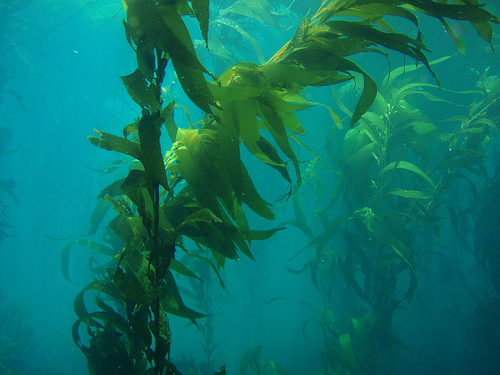
Don’t mistake undersized kelp for young giant kelp.

  • Giant kelp is a species of large seaweed, native to the waters of the eastern Pacific, as well as southern South America, South Africa and Australia.
  • ‘Giant kelp’ is also known as ‘giant bladder kelp’ and ‘string kelp’, and the plant has large leafy blades that grow on long stems known as ‘stipes’, and to assist the plant to float or stay upright in the water, there is a ‘pneumatocyst’ (a bladder filled with gas) at the bottom of each blade.
  • The scientific name of giant kelp is Macrocystis pyrifera and it is from the family Laminariaceae, the family of brown algal seaweed.
  • Giant kelp can grow up to 40 to 65 metres (44 to 71 yards) in height, and as such, is the earth’s largest ocean plant.
  • With a potential growth rate of up to 60 centimetres (2 feet) daily, giant kelp is among the fastest growing wildlife known.
Giant Kelp, Trivia, Random Facts, Ten, California, America, Plant, Seaweed, Grown, Leaves
Giant Kelp
Image courtesy of NOAA Photo Library/Flickr
  • Young giant kelp grow from the trillions of spores released from the reproductive blades near the bottom of the mature kelp plant, and the young kelp will latch onto a sturdy base, such as a rock, using a root-like system, known as a ‘holdfast’.
  • Giant kelp is common among ecosystems in providing shelter for numerous aquatic life in the form of kelp beds and forests.
  • Giant kelp can be eaten by humans, and contains a high potassium and iodine content, and the plant has historically been used to create potash, while in modern times it is used as a fertiliser; commonly as an emulsifier; and for chemical purposes in various industries.
  • Typically, giant kelp is found at depths of 5 to 20 metres with a water temperature of 6°C to 20°C (43°F to 68°F).
  • Giant kelp is a perennial seaweed, however the blades, or ‘fronds’ as they are also known, last only for a few months or up to a year, after which they die, although the plant continues to grow new ones.
Bibliography:
Bushing W, Giant Bladder Kelp, n.d, Star Thrower, http://www.starthrower.org/research/kelpmisc/kelp_mp.htm
Edyvane K, Conservation, Monitoring & Recovery of Threatened Giant Kelp (Macrocystis pyrifera) Beds in Tasmania – Final Report, 2003, Australian Government Department of Environment, https://www.environment.gov.au/system/files/pages/f250cead-de41-4b9d-9a52-91d5cb66f6b1/files/co01kelp.pdf
Macrocystis Pyrifera, 2015, Wikipedia, https://en.wikipedia.org/wiki/Macrocystis_pyrifera

Amazon:       

Hvítserkur

Hvítserkur

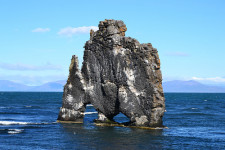
Let your imagination run wild interpreting the form of Hvítserkur.

  • Hvítserkur is an eroded rock that protrudes out from the shores of north-western Iceland, in the waters of Húnafjörður, near the Vatnsnes peninsula.
  • Hvítserkur reaches a height of 15 metres (49 feet) from sea level, and it is a grey and white colour, with the white caused by minerals deposited through bird droppings.
  • Hvítserkur is made primarily of basalt rock, that has been eroded over years due to the constant activity of ocean waves.
  • In 1955, there were three holes at the base of Hvítserkur, giving it four ‘legs’, however, there were concerns that the structure would give way, so plans were made that year to preserve the structure with concrete.
  • Birds, including seagulls and fulmars, are attracted to nest on Hvítserkur, while seals are located nearby.
Hvítserkur, Rock, Sea, Ocean, Iceland, Blue, Grey, Trivia, Ten Random Facts
Hvítserkur
Image courtesy of Janko Hoener/Flickr
  • The term ‘Hvítserkur’ in Icelandic, means ‘white shirt’, which refers to the mottled white colours visible on the formation.
  • Before the crater wore away, Hvítserkur is said to have plugged the mouth of a now extinct volcano.
  • The base of Hvítserkur is reinforced with concrete, which stabilises the formation to prevent it from breaking away, and this has reduced the number of large holes at the base of the structure from three, to two.
  • Hvítserkur can be seen from a viewing platform on land, and the formation is close enough to the shore, that it can be reached on foot at low tide.
  • Local legend suggests that Hvítserkur was once a troll, who failed to evade the morning sun, and as a result, was petrified in stone.
Bibliography:
Ætla að styrkja Hvítserk í Húnaflóa, 1955, VÍSIR, http://timarit.is/view_page_init.jsp?issId=82970&pageId=1182163&lang=is&q=styrkja
Hvítserkur, 2015, Atlas Obscura, http://www.atlasobscura.com/places/hvitserkur
Hvítserkur, 2015, Wikipedia, https://en.wikipedia.org/wiki/Hv%C3%ADtserkur
Ragnarsdóttir R, Hvítserkur | The Troll of North-West Iceland, n.d, Guide to Iceland, https://guidetoiceland.is/connect-with-locals/regina/hvitserkur-up-north

Amazon:       

Ranch Dressing

Ranch Dressing

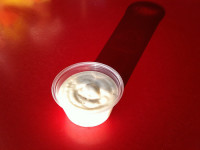
Get into the American taste with ranch dressing.

  • Ranch dressing is a condiment popularly used as flavouring for a variety of foods.
  • Typically, ranch dressing is made of buttermilk, mayonnaise, herbs and onion, with the occasional spice, however, many different versions are available, that come in a variety of flavours.
  • Ranch dressing was invented in the early 1950s by American Steve Henson, and was served to the guests of his tourist accommodation known as Hidden Valley Ranch.
  • The ranch dressing served to tourists was well received, leading to the sauce being made so that it could be sent home with the guests, and later began being manufactured commercially.
  • Hidden Valley Ranch Food Products Inc were the original producers of ranch dressing, and it was sold to The Clorox Company in 1972 for eight million dollars.
Ranch Dressing, Trivia, Ten Random Facts, Food, Condiment, Sauce, White, American,
Ranch Dressing
Image courtesy of Brad.K/Flickr
  • Ranch dressing is commonly used to flavour salads, and it is also used as a dip and as a sauce, for both vegetables and meat.
  • Ranch dressing took the status of the United State’s most commercially popular dressing as of 1992, a title previously held by Italian dressing, and held that spot for at least 20 years.
  • Ranch dressing was originally difficult to store, due to the quantity of dairy in the recipe, however, in 1983, the recipe was developed so that a shelf stable product could be sold in supermarkets, where it could be obtained in a bottle without the need of refrigeration.
  • The popularity of ranch dressing saw a sharp increase during the 1980s, as restaurants began to offer the dressing as part of their menu, and its ready availability in supermarkets also contributed to its prominence.
  • Depending on the recipe, ranch dressing may be high in vitamin K, and it has significant quantities of fat, and sodium.
Bibliography:
Jones A, History of Ranch Dressing, 2015, eHow, http://www.ehow.com/about_5065787_history-ranch-dressing.html
Koerner J, Ranch Dressing, 2015, Slate, http://www.slate.com/articles/arts/number_1/2005/08/ranch_dressing.html
Ranch Dressing, 2015, Wikipedia, https://en.wikipedia.org/wiki/Ranch_dressing

Amazon:       

Plate Armour

Plate Armour

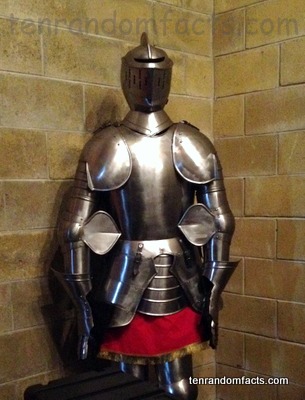
Plate armour has saved the lives of millions.

  • Plate armour is an invention designed as a body covering, that was worn to defend against attacks, and was most commonly used for humans, but it was also used on horses.
  • The stereotypical image of plate armour is often known as a ‘suit of armour’.
  • The Ancient Greeks and Romans were major innovators in using plate armour, with the torso most protected, although full body coverings were relatively non-existent during this time.
  • Plate armour was reinvented in Medieval Europe around the 1200s, and reached a full suit by the 1400s, capable of protecting the entire body.
  •  A full suit of plate armour, including the helmet, generally weighed around 15 to 29 kilograms (33 to 64 pounds) and only minimally restricted movement.

Plate Amour, Suit, Metal, Shiny, Trivia, Ten Random Facts, Medieval, Armor

  • The development of plate armour led to the redevelopment of weaponry, with such weapons aimed at penetrating the weakest points of the armour.
  • Plate armour declined in viability by the late 1600s due to the introduction of practical and portable fire-powered weapons, which most armour was useless in defending against.
  • A suit of plate amour typically consisted of a helmet, a torso covering, leg and arm coverings, and a pair of gauntlets to cover the hands.
  • Plate armour ranged in quality and price, from those available to commoners, to those commissioned by royalty, and they are still available for sale today, mainly as collector’s item or used for medieval festivities.
  • Either steel or iron was normally used to craft plate amour, and higher quality armour was generally well-tempered.
Bibliography:
Armour, 2013, Medieval Warfare, http://www.medievalwarfare.info/armour.htm
Arms and Armor—Common Misconceptions and Frequently Asked Questions, 2015, Heilbrunn Timeline of Art History, http://www.metmuseum.org/toah/hd/aams/hd_aams.htm
Plate Amour, 2015, Wikipedia, https://en.wikipedia.org/wiki/Plate_armour

Amazon:       

Related Posts Plugin for WordPress, Blogger...