FOXTEL

FOXTEL

“See something, feel something” – Slogan of FOXTEL

  • FOXTEL is a company that supplies customers with a payed television channel service; broadcasting in many Australian cities and towns.
  • FOXTEL is owned equally by Telstra and News Corp Australia, telecommunication and mass media companies respectively.
  • The name ‘FOXTEL’, was derived from a blend of ‘Fox’, from the original News Corporation’s Fox Broadcasting Company, and ‘tel’, from Telstra.
  • The most popular entertainment program broadcasted with FOXTEL is ‘The Simpsons’, with approximately 110,000 people watching the show each week night.
  • FOXTEL is the current holder of the record of the most views of a single program in one day on paid television, and set the record in 2007, 2011, and, most recently, with nearly 950,000 viewers, for the 2012 London Summer Olympic Games Opening Ceremony.

FOXTEL, Logo, Orange, 2012, copyright, Television, Ten Random Facts

Logo
Image courtesy of Foxtel
  • FOXTEL was formed in 1995, with 20 channels, broadcasted by Telstra, while the connections and channel negotiations were organised by News Corp.
  • In 2012, FOXTEL had over 1.68 million people subscribed to its service and 70% of homes in Australia would have been able to access the network once they had paid for the service.
  • FOXTEL was not permitted to include advertising during programs for the first two years of broadcasting, and still can not earn over 50% of its income via advertising.
  • FOXTEL broadcasts hundreds of different programs, and popular channels include entertainment, sport, documentaries and news.
  • In the 2009 to 2010 financial year, FOXTEL boasted an income of AUD$2.2 billion and a profit of AUD$258 million.
Bibliography:
Foxtel announces integration progress and earnings growth, 2012, FOXTEL, http://www.foxtel.com.au/about-foxtel/communications/foxtel-announces-progress-on-austar-integration-and-solid-ea-194907.htm
Foxtel, 2014, Wikipedia, http://en.wikipedia.org/wiki/Foxtel

Amazon:  

Hourglass

Hourglass

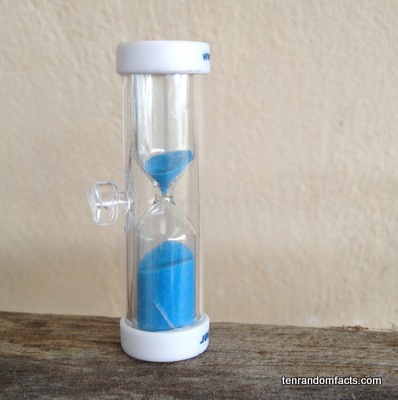
Hourglass… One of a boat captain’s saviours.

  • ‘Hourglasses’ are also known as ‘sandglasses’, ‘sand timers’, ‘egg timers’, ‘sand watches’ and ‘sand clocks’.
  • Hourglasses are usually made from blown glass that has a bulb at each end, joined by a ‘neck’, that is housed in a frame, enabling it to stand vertically, while the bulbs contain many fine grains, which drop from one bulb to another through the neck.
  • Hourglasses are used for time measurement, from minutes to hours, and even a year, and when the top bulb is empty, time is up.
  • The time an hourglass measures can be altered by changing the grain type, the grain amount, size of the bulb, size of the neck and the quality of the grains.
  • Hourglasses were most likely invented in Medieval Europe, possibly in the 700s by Luitprand, a monk in France, although evidence of the invention is not depicted until 1338.

Hourglass, Blue, Grain, Three minute, Water, Ten Random Facts, Sand timer

  • Hourglasses replaced waterclocks, as they did not spill in sudden movements or evaporate, condensate, or freeze, at certain temperatures like the waterclocks (clepsydra) were prone to do.
  • Hourglasses were favoured on ships, due to their ability to keep accurate time, despite the rocking of the vessel, and churches and households, for timing of events and cooking respectively.
  • The first versions of hourglasses had bulbs that did not attach with a neck, but instead were joined together by cord and wax.
  • Hourglasses in the modern era, are more commonly used for decorative purposes or timing something, such as cooking eggs or tasks in a board game, that do not need exact time measurements.
  • Hourglass ‘sand’ is often not real sand, but rock dust, marble dust, silica or fine glass beads, and the grains flow better when they are completely round, so angular grains are avoided.
Bibliography:
A History of the Hourglass, n.d, Online Clock.net, http://blog.onlineclock.net/history-of-the-hour-glass/
Hourglass, 2013, Wikipedia, http://en.wikipedia.org/wiki/Hourglass

Amazon:      

Cocoa Powder

Cocoa Powder

No cocoa, no chocolate… that would be the end of the world.

  • ‘Cocoa powder’ is also known as  ‘cocoa’, ‘cocoa solids’ and ‘cacao’.
  • Cocoa powder is processed from cacao beans, that grow in pods on Theobroma cacao trees that are native to south and central America.
  • Cacao beans, when fermented, dried and ground, contain a mix of 50 to 60% cocoa butter and 40 to 50% cocoa solids, and the latter is generally sold as ‘cocoa powder’.
  • Cocoa powder, combined with cocoa butter, is the main ingredient of chocolate, so therefore it is also used in many chocolate flavoured products like cakes, biscuits, flavoured dairy products, and chocolate syrup.
  • Cocoa powder is coloured in many shades of brown, from light brown to red-brown to dark brown.

Cacoa Powder, Brown, Cacoa, Chocolate, Solid, Food, Flavour, Ten Random Facts

  • Cocoa powder is very high iron, magnesium, manganese and phosphorus, with 100 grams (3.5 ounces) making up over 100% of the recommended dietary intake, and it is high in zinc.
  • In 1828, the Dutchmen Casparus van Houten, a chocolate factory owner, made an hydraulic press to separate cocoa powder and cocoa butter.
  • Cocoa powder is said to be the food with the highest content of flavonoids, which may positively affect the cardiovascular system.
  • Cocoa powder was originally processed to easily make beverages of hot chocolate, that had become popular in the 17th and 18th centuries, which can be quite healthy without extra sugar or the like.
  • Cocoa powder contains a number of chemicals that can make people feel happy and promote positive feelings.
Bibliography:
Cocoa Solids, 2013, Wikipedia, http://en.wikipedia.org/wiki/Cocoa_solids
Some like It Hot: Best Hot Chocolate Mix & Cocoa Mix, 2014, The Nibble, http://www.thenibble.com/reviews/main/beverages/cocoas/hot-chocolate-overview.asp
Teta K, Cocoa: Benefits for Health, Fitness & Fat Loss, 2011, Metabolic Effect, http://www.metaboliceffect.com/cocoa/

Amazon:       

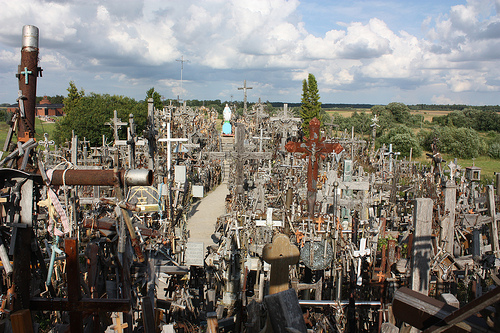
Hill of Crosses

Hill of Crosses

Have you ever seen thousands of crosses in one place, like the Hill of Crosses?

  • The Hill of Crosses is a 60 metre (200 feet) long hill, covering more than 4500 square metres (1.1 acre), north of the city of Šiauliai, in Lithuania, in northern Europe.
  • The first crosses to be placed on the Hill of Crosses were probably erected there sometime after 1831, to remember dead relatives that were killed in a rebellion around that time.
  • In 1900, 130 crosses existed on the Hill of Crosses, and now it is believed to have a collection of more than 200,000 crosses on site.
  • The Hill of Crosses originally held a fortress that was destroyed, and now it attracts Catholic pilgrims, who bring, and leave there, crosses, crucifixes, carvings, rosaries, statues and the like.
  • During its history, more than 6,200 crosses and other items have been destroyed on the Hill of Crosses in many demolition attempts by the Soviet government, but these were quickly replaced by new crosses each time.

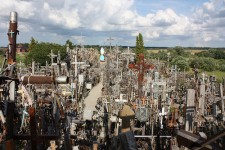
Part of the Hill of Crosses, metal, Wood, crucifix, crowded, statue, many, Ten Random facts, Flickr

Part of the Hill of Crosses
Image courtesy of Arian Zwegers/Flickr
  • The crosses placed on the Hill of Crosses are symbolic of faith, love and sacrifice, and many prayers for peace over the centuries have been offered, amid religious and political unrest.
  • Most crosses on the Hill of Crosses are made of wood, metal or plastic, and can be found in many different colours, shapes and sizes.
  • In 1993, the Hill of Crosses was visited by Pope John Paul II, which brought attention to the site, and caused it to gain in popularity.
  • Although entry onto the Hill of Crosses if free, parking at the base of the hill requires a fee.
  • At the pope’s urging, a monastery was built a few hundred metres away from the Hill of Crosses, and it was consecrated in the year 2000.
Bibliography:
Hill of Crosses, 2002, Sanctuaries and Pilgrimage Sites, http://www.lcn.lt/en/bl/sventoves/kryziuk/
Hill of Crosses, 2013, Wikipedia, http://en.wikipedia.org/wiki/Hill_of_Crosses
History of the Hill of Crosses, 2012, HillofCrosses.com, http://www.hillofcrosses.com/hill-of-crosses-history.html

Amazon:  

Meerkat

Meerkat

Stay alert like a meerkat.

  • ‘Meerkats’ are also known as ‘suricates’, while their scientific name is ‘Suricata suricatta’, and they are from the family Herpestidae, the family of mongooses.
  • Meerkats are mammals native to the grassy plains and desert areas of southern Africa, residing in burrows, sometimes sharing them with fellow mongoose or squirrels, and they live in clans, generally consisting of 10 to 30 individuals, but up to 50.
  • Meerkats have a typical lifespan of 4 to 14 years, often depending on their position in the mob that they live in, and are mainly preyed on by birds such as hawks, vultures and eagles, although jackals and snakes also take an interest in them, and the venom of some potentially dangerous animals, such as snakes or scorpions, do not affect them.
  • ‘Meerkat’ comes from the Dutch word for a long tailed monkey and ‘lake cat’ and they have a thin tail that is used for balance and signals, and they have small ears that can be closed to prevent dirt entering them.
  • Meerkats generally weigh between 720 to 900 grams (1.6 to 2 pounds), can grow to be a height of 25 to 35 centimetres (10 to 14 inches) from the head to the body, and have a tail length of 17 to 25 centimetres (6.7 to 9 inches).

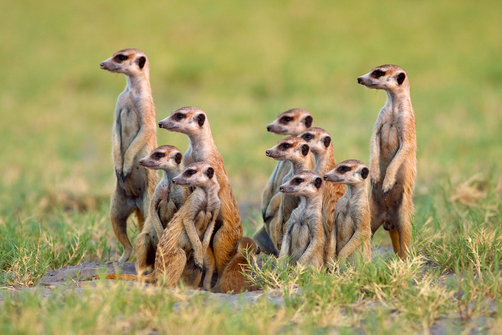
Meerkat, Family, Guard, Clan, Burrow, Botswana, africa, Ten Random Facts, National Geographic Stock

Meerkats on Guard
Image courtesy of National Geographic
  • Meerkats are typically brown in colour, with their own, individual decorative patterns, such as stripes of black or with a red tinge, and they have a wide range of vision with dark coloured skin around their eyes, that work a bit like human sunglasses.
  • Meerkats’ diets typically consist of insects, small birds, reptiles and mammals, and vegetation, and they usually gain moisture from the foods they eat.
  • Individual meerkats in a clan will stand erectly on guard to lookout for danger, while the rest scavenge for food, using barks or whistling noises as warnings.
  • Meerkats can have up to four litters in a year, of one to five pups, and they are taught to defend and forage for food by older clan members.
  • Meerkats have a dominant pair in the group, that are the main breeders, and sometimes they will kill the offspring of other meerkats to give their’s the best chance of survival.
Bibliography:
Meerkat, 2013, Wikipedia, http://en.wikipedia.org/wiki/Meerkat
Meerkat, n.d, Melbourne Zoo, http://www.zoo.org.au/melbourne/animals/meerkat

Amazon:        

Slender Vervain

Slender Vervain

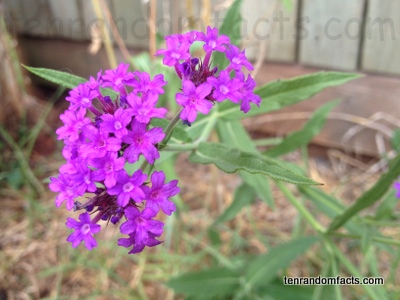
Slender vervain: a pest in some places, an ornament in others.

  • A ‘slender vervain’ is also known as a ‘tuberous vervain’, ‘purpletop’, ‘purple verbena’, ‘veined verbena’, ‘large-veined verbena’, ‘sandpaper verbena’, and it also has many other common names.
  • Slender vervains are native to many countries in South America, and more specifically Brazil and Argentina.
  • Slender vervains can grow up to 60 centimetres (24 inches) in height.
  • The scientific name for slender vervain is ‘Verbena rigida’, and it has also been known as ‘Verbena venosa’, and it comes from the family Verbenaceae, the family of vervains or verbenas.
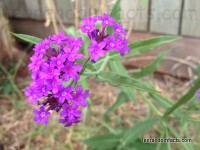
  • Slender vervains have purple or magenta coloured flowers that bloom on the top of spikes at the top of the plant in summer and autumn, and the plants have rigid, rough and hairy leaves that have serrated edges.

Slender Vervain, Purple, verbena rigidia, weed, Australia, Flower, Ten Random Facts

  • In 1993, Slender vervains were awarded the United Kingdom Royal Horticultural Society Award of Garden Merit.
  • Slender vervains are best grown in areas with full sun and damp, well drained soil, and are often grown to add colour in the garden, in pots, or for cut flowers.
  • Slender vervains grow from rhizomes, and are herbacious perennials with parts of the plants dying off each year.
  • Slender vervains are classified as a weed in South Africa, Australia and some parts of the United States, and are found near roads, inhabiting forests, fields and river areas, as well as cotton farming land.
  • Slender vervains were introduced into Europe by Dr John Gillies, a Scottish botanist and retired navy surgeon, in approximately 1820.
Bibliography:
Bourne V, How to Grow: Verbena Rigidia, 2013, The Telegraph, http://www.telegraph.co.uk/gardening/howtogrow/3348813/How-to-grow-Verbena-rigida.html
Verbena Rigidia (Herb), 2010, Global Invasive Species Database, http://www.issg.org/database/species/ecology.asp?fr=1&sts=&lang=EN&si=1371
Verbena Rigida, 2013, Wikipedia, http://en.wikipedia.org/wiki/Verbena_rigida

Amazon:     

Related Posts Plugin for WordPress, Blogger...