Saxophone

Saxophone

“The potential for the saxophone is unlimited.” Steve Lacey

  • Saxophones are usually a curved, hollow, metal cylinder, with a bell, keys and a mouthpiece with a reed, and different variations and alterations can make different sounds.
  • A ‘Saxophone’ is also known as a ‘sax’, while those who play the instrument are known as ‘saxophonists’.
  • Saxophones are musical instruments of woodwind class, although though are generally made of brass.
  • In 1840, Adolphe Sax, an instrument maker from Belgium, invented the saxophone to bring balance to the combination of woodwinds, brass, and strings, and in the few years following, they were marketed in Paris.
  • Saxophones were first patented in 1846, with a range of 14 instruments that included an E flat and F sopranino, and an E flat and F contrabass, and also other instruments pitched in C and F, as well as the B flat and E flat saxophones that are commonly used today.
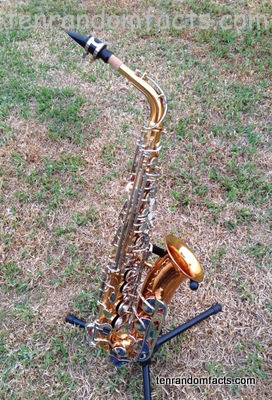
Saxophone, King 660, Gold, Silver, Alto, Ten Random Facts, Instrument, Woodwind, copper

  • Saxophones became the subject of modification from 1866, due to Sax’s expired patent; with multiple changes to the keys and a major addition of the F# key.
  • Saxophones are most commonly used in jazz and classical music genres, and are very commonly used in military bands and jazz bands.
  • There are nine instruments in the family of saxophones, all typically pitched in E or B flat, and the most common are, from smallest to largest, soprano, alto, tenor and baritone.
  • Saxophones are generally coated with an acrylic lacquer or often plated with silver to stop the brass from discolouring, but nickel and gold are also used to coat the instrument.
  • Soprano saxophones are usually straight, rather than the typical curved shape, and other straight sax instruments are also available, including the saxello, which has a curved top and a tilted bell.
Bibliography:
The History of the Saxophone, 2014, The Saxophone.com, http://www.the-saxophone.com/history-of-the-saxophone.html
Saxophone, 2014, Wikipedia, http://en.wikipedia.org/wiki/Saxophone

Amazon:     

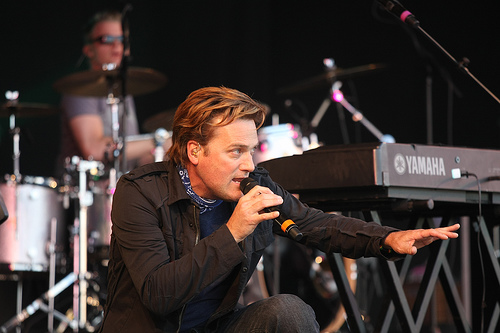
Michael W. Smith

Michael W. Smith

“Change your world” – Michael W. Smith

  • Michael W. Smith is a singer-songwriter musician, who performs and writes popular Christian music, and he also plays piano, keyboard and guitar.
  • Michael W. Smith’s full name is Michael Whitaker Smith, and he was born on 7 October, 1957, in Kenova, West Virginia, United States.
  • Michael W. Smith has earned three Grammy Awards, 36 Dove Awards, 16 gold albums and six platinum albums.
  • Of Michael W. Smith’s albums, over 17 million have been sold, with 31 songs featured as number one on the Christian radio charts, and nine in the top 25 on the mainstream charts.
  • After high school, Michael W. Smith became addicted to alcohol and drugs, but he renewed is faith in 1979, and shook off the addictions during a tour with band ‘Higher Ground’.

Michael W Smith, Church Big Day Out, Sing, Ten Random Facts, Christan, Flickr

Michael W. Smith
Image courtesy of Paul Williams/Flickr
  • Michael W. Smith has written popular songs for Sandi Patty, Kathy Troccoli, Bill Gaither and Amy Grant, particularly in 1981 when he worked as a song writer.
  • Michael W. Smith produced his first album in 1983, and has released at least 23 more albums, including instrumental and worship albums.
  • Michael W. Smith founded the Rocketown club for teens, has been a member of the President’s Council on Service and Civic Participation, a spokesperson in Compassion International and starred in the movie ‘The Second Chance’.
  • Michael W. Smith was married in 1981 to Deborah Davis and has five children by the names of Ryan, Whitney, Tyler, Anna and Emily.
  • Michael W. Smith has released ten videos and written thirteen books, and also contributed to a number of other works.
Bibliography:
Biography, n.d, Michael W. Smith, http://www.michaelwsmith.com/bio.html
Biography, n.d, Michael W. Smith.net, http://www.michaelwsmith.net/biography.html
Michael W. Smith, 2013, Wikipedia, http://en.wikipedia.org/wiki/Michael_W._Smith

Amazon:     
Michael W. Smith Songs

Caraway Seed

Caraway Seed

Do not be carried away with caraway seeds.

  • Caraway seeds grow on the caraway plant, that has the scientific name of ‘Carum carvi’, and is from the family Apiaceae, the family of parsley and carrot.
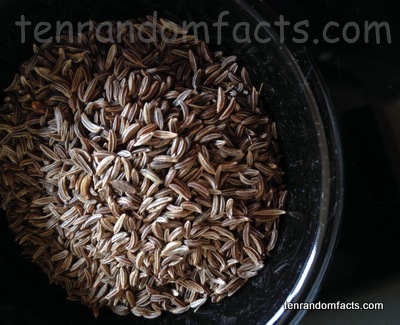
  • Caraway seeds are shaped as a crescent and grow to be 2 millimetres (0.08 inches) in length.
  • Caraway seeds are technically dry fruit, rather than seeds, from the European, and possibly Asian and North African, biennial plant of the same name that grows to be 40 to 60 centimetres (15 to 24 inches) in height.
  • Caraway seeds have a taste hinting of anise and a smell of sweet pepper, and sometimes caraway thyme can be used as a replacement, along with similar flavoured spices that include anise, fennel, dill, cumin, liquorice-root and coriander.
  • Caraway seeds are often used as spice, most famously in bread, but are also used in cakes, desserts, alcoholic beverages, German sausages, curry and Indian traditional food, among others.

Caraway Seeds, Spice, Fruit, plant, Bowl, Many, Ten random facts, food

  • Oil can be distilled from caraway seeds, that is then used to add a pleasant smell to soap, perfume and other fragrant toiletry products.
  • Caraway seeds are probably one of the oldest used spices, having been eaten for thousands of years, and in Ancient Egypt they were used to treat digestive system problems, and is still believed to be effective for the digestion of foods, soothe stomach pains and cramps, and to help prevent wind buildup.
  • Caraway seeds have significant quantities of zinc, vitamin C, manganese, potassium, magnesium, copper, phosphorus and protein, and are high in calcium and dietary fibre.
  • Caraway seeds were believed to ward off witches, so they were historically used as a ‘protection food’.
  • Caraway seeds are typically brown to grey in colour, with a pale outline, and are harvested in the middle of summer upon ripening.
Bibliography:
Caraway, 2014, Wikipedia, http://en.wikipedia.org/wiki/Caraway
Grieve M, Caraway, 2014, Botanical.com, http://www.botanical.com/botanical/mgmh/c/carawa20.html
History of Caraway, 2014, Our Herb Garden, http://www.ourherbgarden.com/herb-history/caraway.html

Amazon:     

Belgium

Belgium

“Strength through Unity” – Belgium’s Motto.

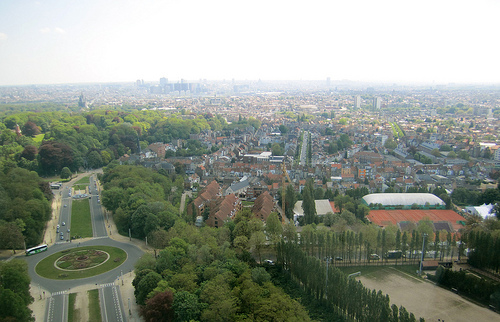
  • Belgium is a country found in Europe’s west, that covers just over 30,500 square kilometres (11,700 square miles) in area, and its neighbours are Germany, France, the Netherlands and Luxembourg, and the capital city is Brussels.
  • Belgium has a constitutional monarch in place; and is the only country in the world with the ‘popular monarchy’ system, and as such the king is known as the king of the people (King of the Belgians), rather than the king of the country.
  • ‘Belgium’ is also known as ‘België’ in Dutch, ‘Belgique’ in French, ‘Belgien’ in German, the ‘Kingdom of Belgium’ (its official name), and the ‘Battlefield of Europe’, referring to the country being the ground of many wars.
  • Of the 11 million people who populate Belgium, approximately 59% are Dutch speaking and 41% are French speaking, as well as a small quantity of German speaking people, causing the country to have three official languages.
  • Belgium is split into three areas, the two major areas being Flanders and Wallonia; the former mainly houses those of Flemish origin (Dutch speakers) while the latter mainly houses those of Walloon origin (French speakers) as well as the small group of 70,000 Germans that generally reside in the eastern part of the country.

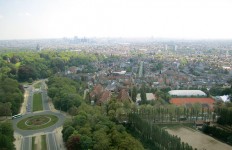
Belgium, Brussel, Capital City, Birds Eye View. Aerial, Ten Random Facts, Flickr, Europe, From Atonium

Aerial View of the capital city, Brussels
Image courtesy of La Citta Vita/Flickr
  • Belgium was originally occupied by Celtic and Germanic communities until 100 BC when it was conquered by Romans and known as ‘Gallia Belgica’, which is where the modern name of the country is derived from.
  • Belgium’s politics involves the king, who is the head of state, and from 2013 was King Philippe, who allocates the position of all ministers for the federal government.
  • In 2012, Belgium had a nominal GDP estimate of $484.7 billion, with food, finished diamonds, metal, machinery, and chemicals as major exports.
  • Belgium is known for its contribution to the arts, and for its cuisine, with many famous chocolates and over 1000 different types of beer.
  • Belgium is the home of 11 or more UNESCO World Heritage Sites and many famous architectural buildings and galleries, including the Cathedral of Notre-Dam.
Bibliography:
Belgium, 2014, Wikipedia, http://en.wikipedia.org/wiki/Belgium
Belgium, n.d, European Union, http://europa.eu/about-eu/countries/member-countries/belgium/index_en.htm

Amazon:     

Tapir

Tapir

Tapir: A piggish elephant.

  • Tapirs are typically nocturnal and solitary pig-like mammals, that are often great swimmers, and they have strange feet with four and three toes on the front and behind respectively.
  • There are five species of tapirs; the Mountain tapir, Kabomani tapir, Brazilian tapir, and Baird’s tapir, in Central and South America, and the Malayan tapir in South East Asia.
  • Tapir’ means ‘thick’, in the Tupi language belonging to some of the indigenous Brazilians, that refers to the animal’s hide, and the scientific name is ‘Tapirus’, from the family Tapiridae, the family of tapirs, that is also related to horses and rhinoceroses.
  • Depending on the species, tapirs grow to be approximately 0.8 to 1 meter (2.6 to 3.3 feet) in height, and 1.3 to 2.4 metres (4.2 to 7.8 feet) in length, and range from 110 to 320 kilograms (242 to 705 pounds) in weight, with females being generally larger than males.
  • Tapirs are typically red-brown to grey-black in colour, although the Malayan species are part white and part black, and the Mountain species have a woolly coat.

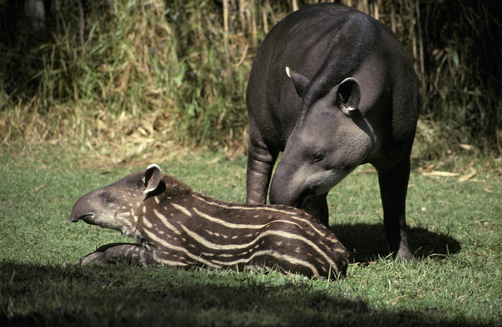
Tapir, Baby, Brown, Black, adult, Ten Random Facts, National geographic, Melbourne Zoo, Australia

Adult and Baby
Image courtesy of National Geographic
  • Tapirs have a free-moving snout to poke in hard-to-get places, grip vegetation, or use as a snorkel, and it is often raised when it smells something.
  • Tapirs live on vegetation, mainly fruit, berries and leaves, and can consume 34 kilograms (75 pounds) or more in a single day, and they have an approximate lifespan of 25 to 30 years.
  • Tapirs have an interval of at least two years after every birth of one calf, and the young have sand coloured stripey and spotty markings for up to six months.
  • Tapirs are mainly preyed on by jaguars, tigers, crocodiles and anacondas, as well as humans, who hunt them for their meat and hides, and along with loss of habitat, this is causing them to be either endangered or vulnerable, depending on the species.
  • Although tapirs do not generally attack humans, they have a bite that can cause severe damage, if threatened.
Bibliography:
Tapir, 2014, National Geographic, http://animals.nationalgeographic.com.au/animals/mammals/tapir/
Tapir, 2014, San Diego Zoo, http://animals.sandiegozoo.org/animals/tapir
Tapir, 2014, Wikipedia, http://en.wikipedia.org/wiki/Tapir

Amazon:      

Queensland Bottle Tree

Queensland Bottle Tree

Bulging Queensland bottle trees.

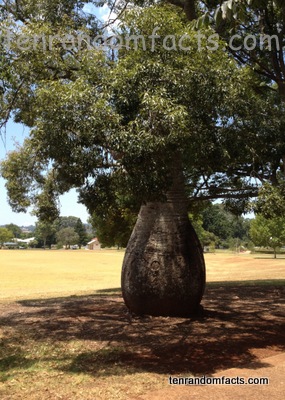
  • Queensland bottle trees are Australian native trees that have a trunk shaped like a bottle and have bell shaped, creamy-yellow coloured flowers that usually appear in spring and summer.
  • The scientific name of a Queensland bottle tree is Brachychiton rupestris, and they are from the family Malvaceae, the family of mallows that includes hibiscus plants, but were originally from the archived family Sterculiaceae.
  • Contrary to popular belief, Queensland bottle trees are not hollow, but have fibrous interiors, and are bottle-shaped due to the stored water in the trunk.
  • Queensland bottle trees are usually grown from seed, and are popularly used in recreation areas and gardens, often providing good shade.
  • Queensland bottle trees have been traditionally used as shelter, rope and food, particularly by indigenous Australians.

Queensland Bottle Tree, Swell, Adult, Australia, Ten Random Facts, Plant

  • Queensland bottle trees can range from 4 to 20 metres (13 to 65 feet) in height and do not produce a bottle shaped trunk until about five to eight years of age.
  • Queensland bottle trees grow best in full sun and in temperatures of the sub-tropics and the tropics.
  • Queensland bottle trees have boat-shaped seed pods full of many seeds that have hairs on them that can irritate the skin if touched.
  • ‘Queensland bottle trees’ are also known as ‘Queensland-flaschenbaums’, ‘Narrowleaf bottle trees’, ‘Kurrajong bottle trees’ and ‘Kurrajongs’.
  • Queensland bottle trees can survive up to three months out of soil, and they are therefore commonly transported to various countries, even as a mature tree.
Bibliography:
Brachychiton rupestris, 2013, Wikipedia, http://en.wikipedia.org/wiki/Brachychiton_rupestris
Campbell C, Fact Sheet: Bottle Trees, 2008, Gardening Australia, http://www.abc.net.au/gardening/stories/s2183287.htm
Cheung P, Brachychiton rupestris, 2013, AustraliaNationalBotanic Gardens, http://www.anbg.gov.au/gnp/interns-2005/brachychiton-rupestris.html

Amazon:  

Related Posts Plugin for WordPress, Blogger...