Greater Flamingo

Greater Flamingo

Tall, pink flamingos are greater flamingos.

  • Greater flamingos have the scientific name Phoenicopterus roseus, and are from the wading bird family, Phoenicopteridae, that only consists of six species of flamingos.
  • Greater flamingos are native to areas in Africa, Europe’s south and South Asia.
  • Greater flamingos are titled as the world’s largest flamingo, with figures of approximately 110 to 150 centimetres (43 to 60 inches) in height and 2 to 4 kilograms (4.4 to 8.8 pounds) in weight; with records of 187 cm (just over 6 feet) and 4.5 kg (10 lb).
  • Greater flamingos have red feathers in some areas, and black flight feathers, but they are well known for their pink-white feathers that are best seen when the bird is standing, although flamingos are born with white and grey feathers that are absent of pink colouration for two years or more.
  • Greater flamingos obtain their pink coloured body and plumage by eating organisms that contain carotenoid pigments, that are mostly found in the algae they eat, and if their diet consists mostly of algae, they will be a deeper colour pink than those that feed mainly on shrimp and the like.
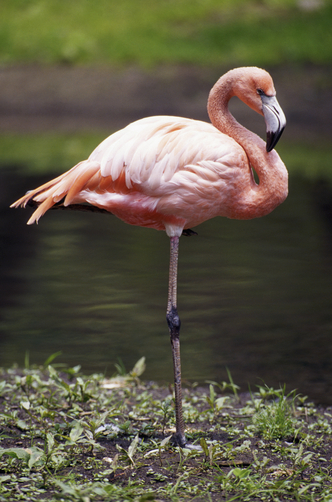
Greater Flamingo, Pink, White, Adult, One Leg Full, Zoo, Bronx Zoo, New York, United States, statuesque, Ten Random Facts, National Geographic

Adult Flamingo
Image courtesy of National Geographic
  • The Greater flamingo’s diet mainly consists of shrimp, tiny fish, seeds, blue-green algae and other algae, molluscs and plankton, and they obtain their food by filtering the food from water in their bill.
  • Greater flamingos can live to be over 60 years old in captivity, with the oldest Greater in captivity dying at an age of around 83 years old in Australia’s Adelaide Zoo, in early 2014.
  • The tongues of Greater flamingos were historically eaten luxuriously by Roman emperors.
  • Greater flamingos generally live in colonies, which helps to protect them from predators, that can be as large as a thousand or more birds, in habitats of lakes, particularly alkaline lakes, and mudflats.
  • When calling, greater flamingos produce a sound like a honk of a goose, and they lay one white egg per season in a nest of mud.
Bibliography:
Greater Flamingo, 2014, Wikipedia, http://en.wikipedia.org/wiki/Greater_Flamingo
Greater Flamingo, n.d, Adelaide Zoo, http://www.zoossa.com.au/adelaide-zoo/animals-exhibits/animals/birds?species=Greater%20Flamingo

Amazon:      

Play School (Australia)

Play School (Australia)

“Open wide, … it’s Play School.”

  • Play School is an award winning television program, that has educational and entertainment content targeted at children in the preschool years, and is broadcasted at least once every weekday on multiple ABC, Australian Broadcasting Company channels.
  • The first Australian version of Play School was produced and broadcasted on 18 July, 1966, and was based on the same-named British program that began in 1964.
  • Play School generally features games, activities like craft and cooking, and songs, as well as telling the time, naming the day of the week, and looking through the window into ‘reality’.
  • In 2000, Play School commenced major changes to its set, such as making it more colourful and changing features such as the clock and the windows.
  • Play School won Logie’s Most Outstanding Children’s Program, in 1998, appeared in the Logie Hall Of Fame in 2006, and won Aria’s award for Best Children’s Album in 1997.

Play School, Graphic, Come and Play, Blocks, Logo, Little Ted, Jemimah, Cartoon, Ten Ranom Facts, ABC Australian TV Program

Logo
Image Courtesy of Play School
  • Play School have released 17 albums containing many popular songs, with many more featured on the program.
  • Play School is typically presented by two people, and has had more than 100 people featured as presenters on the program during its history.
  • Play School has a repertoire of over 4,500 episodes in over 45 years and 46 seasons, and is the second longest running children’s television show in the English-speaking world.
  • Play School features many different toys, with the main toys named Big Ted, Little Ted, Jemima and Humpty.
  • In a week, Play School, on estimate, is viewed by 4 out of 5 children under the age of six, at least once during that time.
Bibliography:
Play School (Australian TV Series), 2014, Wikipedia, http://en.wikipedia.org/wiki/Play_School_(Australian_TV_series)
Taylor R, Play Schooling for 45 Years, 2011, Television.au, http://televisionau.com/2011/07/play-schooling-for-45-years.html

Amazon:    
             Playschool CDs

Vegemite

Vegemite

“Happy little vegemites.” – Slogan.

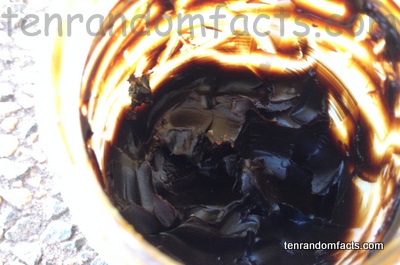
  • Vegemite is a healthy black-brown food spread made primarily from yeast extract, as well as malt and vegetable extracts, with the addition of salt and flavours.
  • Vegemite was invented by the Australian chemist, Cyril P Callister, in 1922 in Melbourne, for the Fred Walker Company, later owned by Kraft, and is now the property of Mondelēz International.
  • Vegemite qualifies as a savoury foodstuff, and is popularly used as spread on products such as bread or toast, biscuits and crumpets, often with cheese, lettuce, tomato, butter or avocado, and as a flavouring in dishes like soup, stew and casseroles.
  • Consumers buy approximately 22 million jars of Vegemite each year, and the spread is one of a number of similar products, including Marmite of New Zealand, Britain and South Africa, Promite of Australia, Cenovis of Switzerland and Hefeextrakt of Germany.
  • Vegemite is very high in a range of B vitamins, although it is best spread thinly, as the taste is quite salty, and it can taste a bit like malt, as well as being a little bitter.

Vegemite, Yeast Extract Spread, Food, Black, Dark, Container, Ten Random Facts

  • The name ‘Vegemite’ came from a chance competition in 1923, with prize money of 50 pounds, that was equivalent to $3,527 in 2010, and was named by Hilda and Laurel Armstrong.
  • The spread was renamed ‘Parwill’ for a time, a name from its new slogan ‘If Marmite… then Parwill’, due to lack of sales, but it was changed back to ‘Vegemite’ for the same reason.
  • Vegemite lacked popularity until 1937, when a limerick competition with substantial prizes caused the product to become more well known, and it was later used to supplement the Australian army’s nutrient intake in World War II, and within a decade of the competition, the product was used in 9 out of 10 homes.
  • Vegemite was, in 1984, Australia’s first product to be commercially and electronically scanned using a barcode at a checkout.
  • Vegemite has been sold in various sized glass jars, porcelain jars, tins, tubes, pots, plastic cups, portion control packaging, and a number of reusable containers, and the product has been combined with cream cheese to produce a product called ‘Vegemite Cheesybite’.
Bibliography:
Vegemite, 2014, Wikipedia, http://en.wikipedia.org/wiki/Vegemite
The Vegemite Story, n.d, Vegemite, http://www.vegemite.com.au/pages/the-vegemite-story.aspx

Amazon:      

Buxus

Buxus

Grow a hedge of buxus.

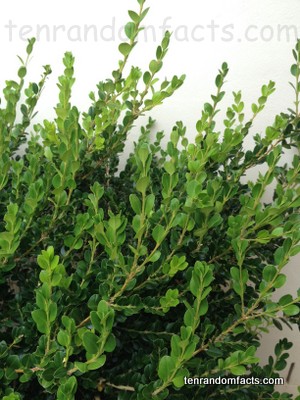
  • Buxus is a group of evergreen plants that contain 70 species that are native to parts of Europe, Asia, America and Africa.
  • Buxus suit a wide range of conditions and are generally best grown in full sun, although shady conditions can be tolerated by some species.
  • ‘Buxus’ is also known as ‘boxwood’ and ‘box’, and comes from the family Buxaceae, the box family.
  • Buxus are shrubs or small trees that grow to a height of 2 metres to a maximum of 15 metres (6.5 to 50 feet) in height, depending on the species and whether the plant is clipped to contain its size.
  • Buxus have flowers that are small and coloured in yellow-green shades, that generally appear in spring.

Buxus, boxwood, plant, hedge, white, green, Ten Random Facts, Australia

  • Buxus are slow growing and are popularly used as a decorative plant, particularly as hedges, topiary or bonsai.
  • Buxus plants have very good quality, hard wood, which is denser than water, and has historically been used to make boxes, chess pieces, printing using woodblocks, and musical instruments and parts, particularly form the strings and woodwind class and is still used for many of these purposes today.
  • Small branches of Buxus have been found in Ancient Romans’ tombs.
  • Buxus sometimes have a scent of a fox or cat urine, which displeases some people.
  • Buxus leaves have a low level of toxicity if consumed, although it can be fatal for small animals.
Bibliography:
Boxwood, n.d, BCI, http://www.bonsai-bci.com/files/Boxwood.pdf
Buxus, 2013, Wikipedia, http://en.wikipedia.org/wiki/Buxus

Amazon:     

Lake Nakuru

Lake Nakuru

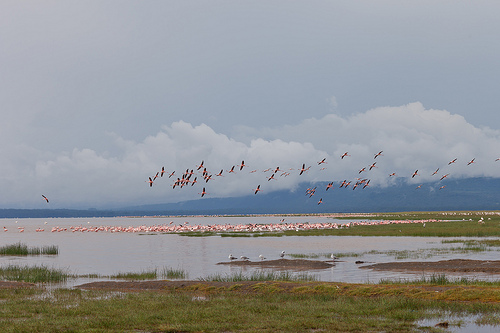
Lake Nakuru is a blue and pink lake.

  • Lake Nakuru is an alkaline rich lake located in Kenya, Africa, in the East African Rift.
  • Lake Nakuru has been included in Lake Nakuru National Park, since 1961, which supports endangered white rhinoceroses, black rhinoceroses and giraffes.
  • Lake Nakuru covers an approximate area of up to 45 kilometres squared (17 miles squared) and has an approximate depth of 2.3 metres (7.5 feet).
  • Lake Nakuru is popularly known for its abundant attraction of thousands to millions of flamingos, although this number has been diminishing, that feed on the large quantities of blue-green algae growing on the lake.
  • Wildlife surrounding Lake Nakuru , in the national park, include black and white rhinoceroses, giraffes, waterbucks, lions, leopards, baboons, cheetahs, warthogs and pythons, as well as 300 different bird species.

Lake Nakuru, Flamingos, Flying, Alkaline, Soda, Africa, Kenya, National Park, Ten Random Facts

Flamingos on Lake Nakuru
Image courtesy of Andrea Schieber/Flickr

  • During 1951 to 1953, Lake Nakuru was dry, which led to programs of alkaline dust control.
  • Lake Nakuru contains fauna including the salt tolerant fish, Tilapia grahami, clawless otters and hippopotamuses.
  • Lake Nakuru is protected and is surrounded by a fence to deter poachers, and the word ‘nakuru’ is a local Maasai word meaning ‘dust’ or ‘dusty place’.
  • In 2007, Lake Nakuru boasted a tourism count of nearly 347,000 people, which included visits from local Kenyans, as well as visitors from around the world.
  • Lake Nakuru has been in danger of industrial and domestic pollution from nearby Nakuru town situated 4 km (2.5 miles) away, that causes poisonous water and shortage of algae, which has led to large migrations and fatalities of flamingos.
Bibliography:
Lake Nakuru, 2013, Wikipedia, http://en.wikipedia.org/wiki/Lake_Nakuru
Lake Nakuru National Park, 2013, UNESCO World Heritage Centre, http://whc.unesco.org/en/tentativelists/1344/
Parks & Reserves: Lake Nakuru National Park, 2013, Kenyalogy, http://www.kenyalogy.com/eng/parques/nakuru.html

Amazon:     

Proboscis Monkey

Proboscis Monkey

Proboscis monkeys: unusual monkeys, unusual facts.

  • ‘Proboscis monkeys’ are also known as ‘long-nosed monkeys’, and in the Malay language, ‘bekantan’ and ‘monyet belanda’, the latter literally meaning ‘Dutch monkey’, referring to the perceived appearance of some Dutchmen.
  • Proboscis monkeys are endangered primates from the family Cercopithecidae, the family of Old World monkeys and they can only be found in the wild on Asia’s Borneo, an island that has regions that belong to Indonesia, Malaysia and Brunei.
  • Proboscis monkeys can grow to be 53 to 76 centimetres (21 to 30 inches) in height and typically weigh 16 to 22.5 kilograms (35 to 50 pounds) in males or 7 to 12 kilograms (15 to 26 pounds) in females, and greater weights for both genders have been recorded.
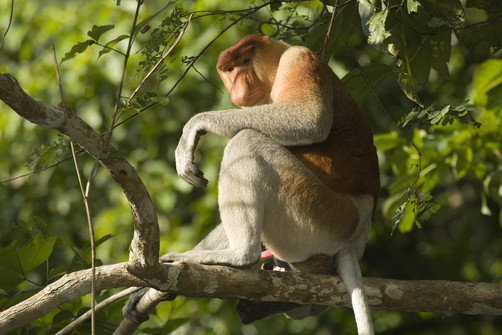
  • Proboscis monkeys have a fur coat that differs in colour, that can include orange shades, red-brown, yellow-brown and shades of grey in colour.
  • Male proboscis monkeys have exceptionally large noses, growing up to at least 10 centimetres (3.9 inches) in length, that are believed to be used to project sound, and both genders have protruding bellies.

Proboscis Monkey, Male, Sitting in tree, big nose, primate, Ten Random Facts, National Geographic, Borneo, Malaysia,

Male Proboscis Monkey
Image courtesy of National Geographic

  • Proboscis monkeys generally live in single-male or male-only bands or harems, of up to 60 and 19 monkeys respectively, and the females give birth to their young most commonly during night or early in the morning.
  • Proboscis monkeys are preyed on by leopards, monitor lizards, pythons, eagles and crocodiles.
  • Proboscis monkeys usually live a close distance to water, usually in forests near rivers, oceans, and swamps, and they have webbed feet and are accomplished swimmers, reaching depths of 20 metres (65.5 feet), sometimes ‘belly flopping’ into the water from trees.
  • Proboscis monkeys commonly use honk noises to vocalize when communicating, although they use roaring or snarling sounds when aggressive.
  • Proboscis monkeys’ diet mainly consists of fruit, seeds, and leaves, and the fruit is usually eaten when it is not ripe due to the sugar content in ripe fruit that can cause death due to bloating.
Bibliography:
Proboscis Monkey, 2014, National Geographic, http://animals.nationalgeographic.com.au/animals/mammals/proboscis-monkey/
Proboscis Monkey, 2014, Wikipedia, http://en.wikipedia.org/wiki/Proboscis_monkey


Amazon:      

Related Posts Plugin for WordPress, Blogger...