Warthog

Warthog

Warthogs do not have a wart virus.

  • ‘Warthogs’ are sometimes called ‘common warthogs,’ and are known as the ‘pig of the plains’ or ‘vlakvark’ as the Afrikaans call them.
  • Warthogs are scientifically known as ‘Phacochoerus africanus’, and are from the family Suidae, the family of pigs.
  • Warthogs are native to sub-Saharan Africa, and are usually found in their natural habitat of grassy plains and wooded areas.
  • Warthogs grow to be 0.9 to 1.5 metres (3.0 to 4.9 feet) in height and weigh 45 to 150 kilograms (99 to 330 pounds) depending on the gender.
  • Warthogs have four ivory tusks that curve from the mouth at a 90° angle that they use for digging, fighting or for defence against predators such as humans who hunt them for their meat and tusks, hyenas, leopards, lions and crocodiles.
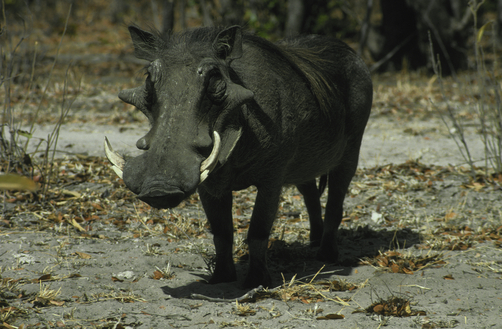
Warthog, Four, Tusk, Pig, Hog, Ugly, Mane, Zimbabwe, Ten Random Facts

Warthog
Image courtesy of National Geographic
  • Warthogs have four ‘warts’ or bumps on their face, that are said to be used as fat reserves and for protection.
  • Warthogs typically have a thin fur coat in black and brown colours, and birds often sit on their backs to eat the small insects that can be found on the mammal.
  • Warthogs have a diet that mainly consists of grass and other vegetation, various fruit and berries, and insects, although sometimes they are meat eaters.
  • Warthogs are more likely to run away than fight, and can run up to 48 kilometres per hour (30 miles per hour).
  • Warthogs generally breed during seasons of wet and rain, giving birth to piglet litters from two to four, although a greater number are sometimes born.
Bibliography:
Warthog, 2014, National Geographic, http://animals.nationalgeographic.com.au/animals/mammals/warthog/
Warthog, 2014, Wikipedia, http://en.wikipedia.org/wiki/Warthog

Amazon:     

Red Orchid Bush

Red Orchid Bush

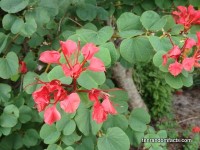
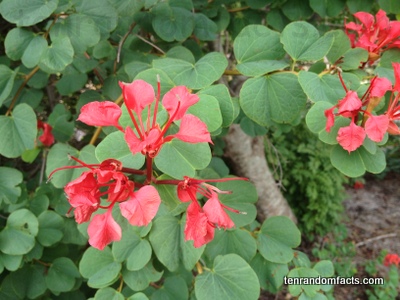
Red orchid bushes have red flowers and are bushes, but they are not orchids.

  • ‘Red orchid bushes’ are also known as ‘red bauhinias’, ‘Pride of De Kaaps’, ‘orchid trees’, ‘nasturtium bauhinias’, ‘African orchid trees’ and ‘African plumes’.
  • Red orchid bushes are from the family Fabaceae, which is the family of legumes, beans and peas, and their scientific name is ‘Bauhinia galpinii’.
  • Red orchid bushes are clambering, evergreen perennial shrubs that are native to south and east Africa.
  • Red orchid bushes have flowers 5 to 10 cm (2 to 4 inches) in diameter, with five petals and three large stamens, and are usually red, although pink and orange varieties are also available.
  • Red orchid bushes generally grow to be a height of 3 to 5 metres (10 to 16.4 feet), but may climb higher with the support of other trees.

Red Orchid Bush, Pride of De Kaap, Baulinia galpnii, Ten Random Facts, Green, Red, Plant, Bush,

  • Red orchid bushes generally bloom during spring, summer and early autumn, and follow with long green seed pods that turn brown and split open, releasing the seeds.
  • Red orchid bushes are often used as an ornamental in gardens, and they prefer sunny or partly shady conditions.
  • Red orchid bushes are a weed in some countries, including parts of Australia, as the seeds and cuttings are easily grown and spread by garden waste, water and garden trimmings, and the plants can be found on abandoned urban land, forest and woodlands.
  • Red orchid bushes attract butterflies and bees, and the branches have been used for basket weaving and roof trusses.
  • The green leaves of the red orchid bush are shaped a bit like a hoof, and are symmetrical with two lobes.
Bibliography:
Bauhinia galpinii, 2013, Wikipedia, http://en.wikipedia.org/wiki/Bauhinia_galpinii
Red bauhinia, n.d, Brisbane City Council, http://weeds.brisbane.qld.gov.au/weeds/red-bauhinia-bauhinia-galpinii

Amazon:    

Nikola Tesla

Nikola Tesla

Nikola Tesla was an inventor of many ideas and less inventions.

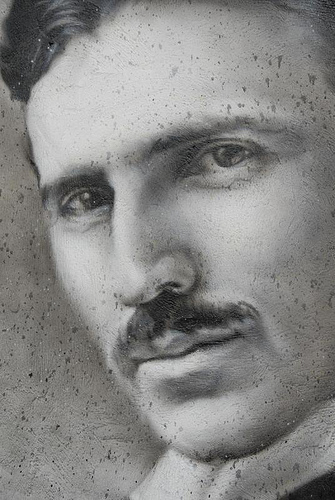
  • Nikola Tesla was a Serbian American who was a renowned inventor for his AC (alternating current) electrical system, and he was also an engineer, physicist, futurist and author.
  • Nikola Tesla was born on 10 July, 1856 in Smiljan in the Austrian Empire, now Croatia, in Europe, and died quietly on 7 January 1943 in America’s New York, but was not discovered dead until the next day, by a maid.
  • Nikola Tesla was to be a priest, like his father, but when Tesla caught life-threatening cholera; his father promised he could go to an engineering university.
  • Nikola Tesla spent much of his life in the United States, and became a citizen of the country in 1891 at age 35, originally working for future rival Thomas Edison in the 1880s, but later working for himself.
  • Nikola Tesla had at least 278 official patents for some of his inventions, with many being improvements to technology, in areas of radio, magnetism and, particularly electricity, and he also experimented significantly with x-rays.

Nikola Tesla, Greyscale, Painting, Ten Random Facts, Inventor, Flickr

Tesla
Image courtesy of Theirry Ehrmann/Flickr

  • The SI unit (System of Units) of measurement for the strength of a magnetic field was named after Nikola Tesla, and is known as a ‘tesla’.
  • Although Nikola Tesla earned much money from his patents, Tesla experienced bankruptcy and died in debt, since much of his money was spent on new experiments.
  • Nikola Tesla was primarily 1.88 metres (6 feet 2 inch) in height, 64 kilograms (142 pounds) in weight, had a liking for pigeons, did not generally sleep longer than two hours a night, is believed to have had obsessive-compulsive disorder and a photographic memory, and died unmarried.
  • Nikola Tesla has a planet, ‘2244 Tesla’, and a crater named after him, and he also a number of other honours and memorials, including a monument that was unveiled in September 2013 in New York.
  • Nikola Tesla Memorial Centre opened in 2006, in his hometown in Croatia, featuring Tesla’s inventions, innovations, statues and even his ashes.
Bibliography:Nikola Tesla, 2014, Wikipedia, http://en.wikipedia.org/wiki/Nikola_Tesla
Vujovic L, Tesla’s Biography, 1998, Tesla Memorial Society of New York, http://www.teslasociety.com/biography.htm

Amazon:     

Cumin

Cumin

Cumin: a humble little spice that will improve your cuisine.

  • Cumin is a historical spice that comes from a plant of the same name, native to parts of the Mediterranean, Middle East and India, which is from the family Apiaceae, the family of carrot and parsley.
  • ‘Cumin’ is also known as ‘cummin’, ‘jeera’, and ‘jira’, and the plant’s scientific name is Cuminum cyminum.
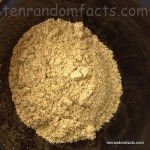
  • Cumin seeds are ridged and are a yellow-brown colour, 3 to 6 mm (0.1 to 0.23 inches) long, which are visually similar to caraway seeds, and they have a peppery, earthy and citrus flavour.
  • What is known as black cumin, comes from a different, but related plant known as Bunium bulbocastanum, or the unrelated plant, Nigella sativa, both of which have a different flavour.
  • Cumin was used in mummification processes in Ancient Egypt, and in the Middle Ages, cumin was used to symbolise love and faithfulness.

Cumin, Ground, Yellow, Powder, Ten Random Facts, spice, Cummin,

  • Approximately 70% of the world’s cumin (270,000 tonnes or 300,000 tons per year) is produced in India, and is also the main exporter of the spice, although the country also uses all but 10% of what it produces.
  • Cumin seeds are used mainly as a spice, either grounded or whole, in soups, gravies, pickles, bread products, and spice mixes, especially curry powder, as well as bird food.
  • Cumin has been used for medicinal purposes, and is sometimes used to treat muscle cramps and problems in the digestive system, such as vomiting and appetite loss.
  • Cumin has a relatively high content of iron and is a good source of manganese, calcium, vitamin B1 and phosphorus.
  • Cumin was historically very popular among the Greeks and Romans, due to it being a good replacement of pepper that was expensive at the time.
Bibliography:
Cumin, 2014, Wikipedia, http://en.wikipedia.org/wiki/Cumin
Cumin seeds, 2014, The World’s Healthiest Foods, http://www.whfoods.com/genpage.php?tname=foodspice&dbid=91

Amazon:     

Temple of Artemis at Ephesus

Temple of Artemis at Ephesus

These facts are as grand as the Temple of Artemis at Ephesus.

  • The ‘Temple of Artemis at Ephesus’ is also known as the ‘Temple of Artemis’ and the ‘Temple of Artemis at Ephesos’, and it has also been referred to as the ‘Temple of Diana’.
  • The Temple of Artemis at Ephesus was a temple built by the Ancient Greeks to honour and worship Artemis, the goddess of fertility, the hunt and moon.
  • The Temple of Artemis at Ephesus has a long history, and it is believed that in 700 BC a temple was erected on the site, and later, in approximately 550 BC, Chersiphron, an architect from Cretan, and his son Metagenes, designed and rebuilt a temple on the site, with the financial help of King Croesus (King Kroisos as he is also known) of Lydia.
  • The Temple of Artemis at Ephesus was situated in the ancient city of Ephesus, which can be found near Selçuk, a town in modern Turkey.
  • The Temple of Artemis at Ephesus was destroyed and rebuilt at least three times, notably damaged by a flood and by fire, and was finally torched by the Goths in 268 AD and was probably not fully rebuilt after that.

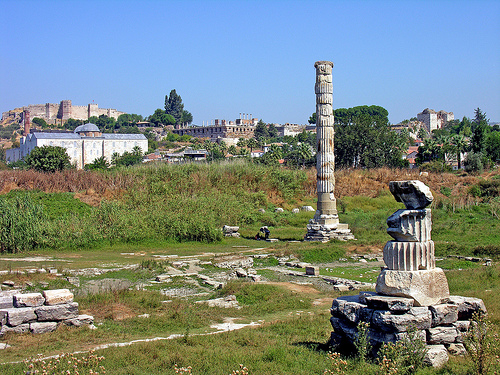
Temple of Artemis at Ephesus, Ruins, Site, Turkey, Pole, Remains, Ten Random Facts, Flickr

Ruins
Image courtesy of Dennis Jarvis/Flickr
  • The Temple of Artemis at Ephesus was larger the last time it was believed to be rebuilt in 323 BC, with the final temple measuring approximately 137 by 69 metres (450 by 226 feet) and as high as 18 metres (59 feet), with at least 127 columns.
  • The third Temple of Artemis at Ephesus is noted among the Seven Wonders of the World.
  • The remains of the Temple of Artemis at Ephesus were first discovered in 1869, on a deliberate search by John Turtle Wood, who was originally an architect and engineer from Britain.
  • The Temple of Artemis at Ephesus was made mostly of marble, with many sculptures of high relief throughout the temple, as well as carved columns.
  • Not only was the temple used to worship Artemis, it is believed the Temple of Artemis at Ephesus was also used as a marketplace.
Bibliography:
Temple of Artemis, 2011, Kusadasi.biz, http://www.kusadasi.biz/historical-places/temple-of-artemis.html
Temple of Artemis, 2014, Wikipedia, http://en.wikipedia.org/wiki/Temple_of_Artemis

Amazon:     

Speedometer

Speedometer

Do not drive over the speed limit while reading these speedometer facts.

  • ‘Speedometers’ are also known as ‘speed meters’ and historically, ‘velocimeters’, that were typically made from metal alloy materials, but are now partly or mostly made from plastics.
  • Speedometers are devices which measure the speed of a vehicle that travels on land, and most automobiles have been equipped with one since 1910.
  • In 1888, Josip Belušić, an inventor from Europe’s Croatia, invented the first electric speedometer.
  • On 7 October, 1902, eddy current speedometers were first patented by Otto Schulze, a German inventor, and these magnetically driven instruments have been the most popular speed measuring instruments in the last hundred years.
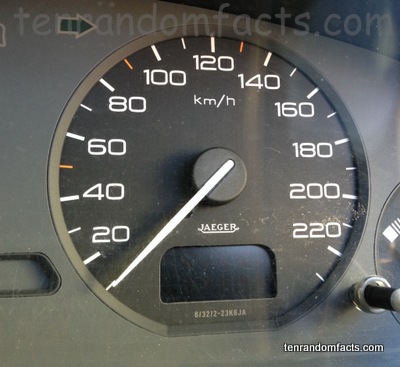
  • The ‘visible’ part of the speedometer has a moving needle surrounded by spokes and numbers, and the location of the needle on the device indicates the speed.

Speedometer, White, km/h, electric, 20 to 220, Ten Random Facts, Car

  • Eddy current speedometers have a cable that is connected to gears, usually in the transmission, that connects to a magnet which affects the needle on the instrument, that indicates the vehicle’s speed.
  • The type of speedometers in new use today are commonly electronic, invented in the 1980s and 1990s, involving sensors and electromagnetic pulses that are read by a computer.
  • Inaccuracy of speedometers most commonly occur due to faults, and differences in tyre diameters, with very minor errors occurring for reasons such as temperature.
  • Some speedometers use the Global Positioning System, or GPS, to calculate speeds, with accuracy depending on the accuracy of the GPS.
  • Leonardo da Vinci designed concepts of a speedometer type of instrument, and ancient civilisations had crude ways of measuring speed and distance.
Bibliography:
Kretschmann, Speedometer, 2014, How Products are Made, http://www.madehow.com/Volume-7/Speedometer.html
Speedometer, 2014, Wikipedia, http://en.wikipedia.org/wiki/Speedometer
Vintage Speedometers, 2013, Rare Car Relics, http://www.rarecarrelics.com/vintage_speedometers.php

Amazon:     

Related Posts Plugin for WordPress, Blogger...