Moraine Lake

Moraine Lake

How many lakes have a beautiful blue hue like Moraine Lake?

  • Moraine Lake is a lake that has an area of 0.5 kilometres squared (0.19 miles squared) and a depth of up to 14 metres (46 feet) and is easily accessible by road, although the road is closed from October to May.
  • Moraine Lake has a water source from Fay Glacier and Larch Creek, and is the source of Moraine Creek.
  • Moraine Lake is located in Banff National Park, Alberta, Canada, in the Valley of Ten Peaks, and has a surface elevation of approximately 1884 metres (6181 feet) above sea level.
  • Moraine Lake displays a beautiful blue hue when it is at full capacity, due to ‘rock flour’ or ‘glacial flour’, tiny particles of rock, in the lake refracting light.
  • The Moraine Lake area is the home to trails for hiking, as well as Moraine Lake Lodge, which has accommodation that can be rented for short getaways.
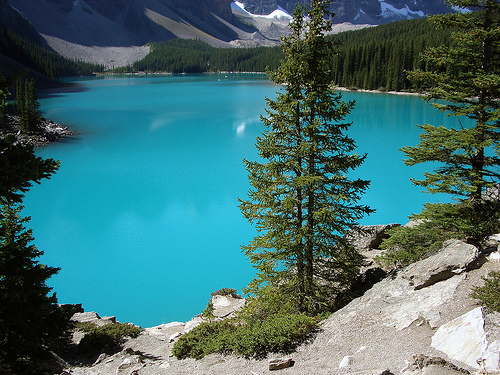
Moraine Lake, Blue, Aqua, June, Ten Random Facts, Flickr, Banff National Park, Rock powder

Moraine in June
Image courtesy of Pascal/Flickr

  • Canoeing is a popular sport performed on the surface of Moraine Lake and can be arranged through the Lodge.
  •  Moraine Lake has been featured on the Canadian $20 note in 1969 and 1979, and it is one of Canada’s most commonly photographed places.
  • Moraine Lake is quite picturesque, with the Ten Peaks, a group of ten mountains, rising above and surrounding the lake, and has been featured as background options on computers and electronic devices.
  • Moraine Lake is the home of wildlife such as grizzly bears, ground squirrels, chipmunks, marmots and pikas (small rabbit-like mammals).
  • Moraine Lake is so called due to a ‘moraine’, a pile of glacial rocks and boulders that was formed by the Wenkchemna Glacier next to the lake.
Bibliography:
Fletcher J, Moraine Lake in Banff National Park, n.d, USA Today, http://traveltips.usatoday.com/moraine-lake-banff-national-park-13242.html
Moraine Lake, 2014, Wikipedia, http://en.wikipedia.org/wiki/Moraine_Lake

Amazon:  

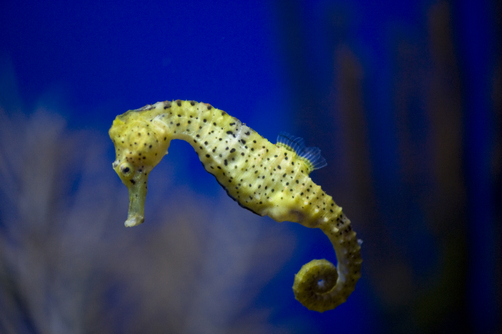
Seahorse

Seahorse

Is it a plane? A dragon? No, it is a seahorse!

  • A seahorse is a fish that is found in tropical or temperate water bodies of shallow depth, sheltered by coral reefs, mangroves or seagrass, and they can change their colour to blend into their environment and can be seen in a wide range of colours like green, red, black, white and orange.
  • Seahorses are more than 40 species that have the scientific name ‘Hippocampus’, that means ‘horse sea monster’ in Ancient Greek, and they belong to the Syngnathidae family, the family of fish with fused jaws.
  • A seahorse can range from 1.5 to 35.5 centimetres (0.6 to 14 inches) in height depending on the species and has a tail that it uses to grab onto sea grass and coral to hold itself still.
  • Seahorses are one of the two fish that swims vertically, swimming slowly by flapping its dorsal fin, with the slowest, the dwarf seahorse – Hippocampus zosterae, moving at 152 centimetres per hour (5 feet per hour) which is known as the slowest fish.
  • Seahorses have plates of bone that have a ring structure, an identifying and unique coronet (crown like structure) on their head, and have eyes that move freely of one another.

Seahorse, Colorado, America, United States, Yellow, Swimming, Denver Aquarium, Ten Random Facts, Fish, National Geograph

Seahorse
Image courtesy of National Geographic
  • After mating, seahorse males look after the up to 1500 eggs (or more) in its pouch, that hatch after around 9 to 45 days into tiny seahorses.
  • The amount of baby seahorses expelled from the male pouch ranges from 5 to 2500 depending on the species, with only 0.5% on average ever surviving.
  • Seahorses have no stomach or teeth and have a diet of little crustaceans and plankton that are sucked up with the fish’s generally long snout, and they need to eat lots due to a quick digestion process, making a clicking noise every time they eat.
  • Seahorses are sometimes kept as pets in aquariums, but can easily die if not cared for properly, and are often hunted by humans for souvenirs and food, and numerous quantities are sold and used for traditional Asian medicine.
  • Seahorses have predators of crabs, tuna and rays, and can be killed by pollution, hunting or exhaustion, particularly in storms where they can be tossed around.
Bibliography:
Seahorse, 2014, Wikipedia, http://en.wikipedia.org/wiki/Seahorse
Sydenham S & Thomas R, Seahorse, 2008, Kidcyber, http://www.kidcyber.com.au/topics/seahorse.htm

Amazon:      

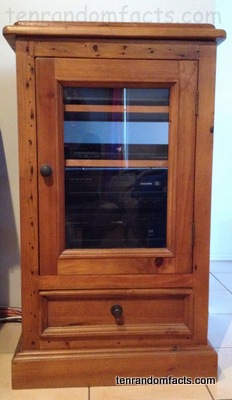
Cabinet

Cabinet

Every home needs a cabinet.

  • Cabinets are generally rectangular pieces of furniture that are primarily used to store items such as valuables, clothes and food items.
  • Cabinets are traditionally made of wood, but can be made of materials that are synthetic.
  • Cabinets are often called ‘cupboards’ and those that store clothes are also known as ‘wardrobes,’ ‘closets’ and ‘armoires’.
  • The word ‘cabinet’ in French originally meant ‘small room’ and in the 1600s, the term referred to such a room which often contained books and art, and ‘cabinets of curiosities’, rooms full of interesting collections, also emerged around this time.
  • Cabinets were originally boxes or chests, invented to store paper documents or things of value.

Cabinet, glass, speaker, wooden, Ten Random facts, Cupboard, drawers, doors

  • Until 1650, cabinets were not commonplace, and were generally owned only by the elite, due to the cost and the lack of perceived need.
  • Cabinets, during the Industrial Revolution from the 1700s through to the 1800s, entered mass production, making them more affordable and popular.
  • Cabinets usually have compartments that either have doors, drawers, or are left open.
  • Cabinet making became a favoured hobby after World War II, and those that make cabinets are known as ‘cabinet makers’.
  • Cabinets are sometimes carved with a relief pattern or design, or have a workbench at the top or side, and they can be built into a structure or stand alone.
Bibliography:
Blackburn G, A Short History of Cabinets, 2005, Fine Wood Working, https://www.finewoodworking.com/woodworking-plans/article/a-short-history-of-cabinets.aspx
Cabinetry, 2014, Wikipedia, http://en.wikipedia.org/wiki/Cabinetry

Amazon:     

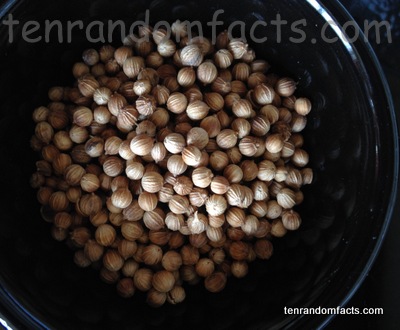
Coriander Seeds

Coriander Seeds

Coriander seeds are actually fruit!

  • Coriander seeds are used as a spice to flavour cooking, and are also known as ‘dhania’ and ‘coriandi seeds’.
  • Coriander seeds are the fruit of an annual herb that grows up to 50 centimetre (20 inch) high.
  • Coriander seeds are believed to be native to the Mediterranean and Middle East areas.
  • Coriander seeds are from the family Apiaceae, the family of carrots and parsley, and come from the plant that has the scientific name of Coriandrum sativum or common names ‘cilantro’, ‘Chinese parsley’ and ‘Mexican parsley’.
  • Coriander seeds are often used in curries, as well as in the spice mix ‘garam masala’, and is commonly found in dishes particularly from Southeast Asia to Africa to the Middle East.

Coriander Seeds, white, spice, fruit, Ten Random Facts, Bowl,

  • Coriander seeds are high in manganese, calcium, magnesium and iron.
  • Coriander seeds have the flavour of lemon citrus and nuts, and they generally help thicken the sauces that they are usually found in.
  • Coriander seeds are commonly used ground or whole, roasted, dried or fresh.
  • There are different varieties of coriander that produce different sized coriander seeds, and they range from 1.5 to 5 millimetres (0.06 to 0.2 inches) in diameter.
  • Coriander seeds have been used traditionally for medicinal purposes to treat a wide variety of ailments and they are said to have anti-diabetic properties.
Bibliography:
Coriander, 2006, OzPolitic, http://www.ozpolitic.com/gardening/coriander.html
Coriander, 2014, Wikipedia, http://en.wikipedia.org/wiki/Coriander

Amazon:     

Les Paul

Les Paul

Ever heard of Les Paul?

  • Les Paul was a guitarist that worked particularly in the areas of jazz, blues and country, and invented some music related items.
  • Les Paul’s full name is Lester William Polsfuss and was born on 9 June, 1915, in Waukesha in USA’s Wisconsin.
  • Les Paul invented one of the first solid body electric guitars in 1940, and later had one named after him.
  • Les Paul is featured in the Rock and Roll Hall of Fame and the National Inventors Hall of Fame, and won two Grammy Awards in 2006.
  • Les Paul’s first instrument to learn was the harmonica, then the piano, followed by the guitar, and later he became a semi-professional guitarist, harmonica player and country singer by age thirteen.

Les Paul, Black, White, jazz, club, 2008, New York, Live, Ten Random Facts, Guitarist

Les Paul 2008
Image courtesy of Thomas Faivre-Duboz/Flickr
  • Les Paul originally had the stage names ‘Red Hot Red’ and ‘Rhubarb Red’, and was also known as ‘Wizard of Waukesha’.
  • At a young age, Les Paul invented a hands-free holder for a harmonica, that went around his neck that could be used while he was performing.
  • Les Paul met his second wife (he divorced his first wife Virginia Webb), Iris Summers, known as Mary Ford, in 1945, whom he married in 1949, but divorced in the early 1960s, just before Paul’s retirement.
  • Les Paul semi-retired in 1965, but still performed until his death, ending his life with 40 albums.
  • Les Paul nearly electrocuted himself in 1941, survived a major car accident in 1948, had significant heart surgery in 1987, suffered from arthritis, and eventually died on 12 August, 2009, age 94, due to pneumonia complications.
Bibliography: Les Paul, 2014, Wikipedia, http://en.wikipedia.org/wiki/Les_Paul
Baker, Les Paul, So Much More Than A Guitar, 2014, The Les Paul Foundation, http://lespaulfoundation.org/about-les-paul.html

Amazon:     

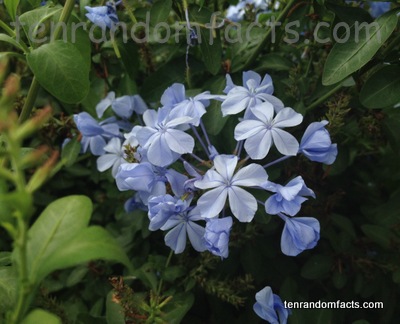
Blue Plumbago

Blue Plumbago

Pretty, pretty blue plumbagos.

  • ‘Blue plumbagos’ are also known as ‘cape plumbagos’ and ‘cape leadworts’.
  • Blue plumbagos are from the family of Plumbaginaceae, which is the family of plumbagos and leadworts.
  • Blue plumbagos are decorative perennial flowering bushes that can climb, which are native to South Africa.
  • Blue plumbagos can grow up to be 6 metres (20 feet) in height, and sunny and semi-shaded areas are the best spots for them to grow.
  • Blue plumbagos have flowers that bloom in different shades of both blue and white that mainly flower in summer and autumn, and sticky hairs that are found near the flowers.

Blue Plambago, Flower, cape, Auriculanta, Ten Random Facts, Australia, Plant, Bush, Shrub, Bundle

  • The scientific name of a blue plumbago is ‘Plumbago auriculata’, with ‘auriculata’ referring to the ear-shaped leaves.
  • Blue plumbago flowers are approximately 1.5 cm (0.6 inch) in diameter, and they grown in clusters, and have long tubes at the base of the five petals.
  • Blue plumbagos have won the Award of Garden Merit of the Royal Horticultural Society, and are popular in gardens.
  • Blue plumbagos often do not flower on the first year after the planting of its seed, from which it is readily grown.
  • Blue plumbago leaves are green and shiny and can grow up to 5 centimetres (2 inches) in length, that can attract some insect pests.
Bibliography:
Plumbago auriculta, 2013, Wikipedia, http://en.wikipedia.org/wiki/Plumbago_auriculata
Plumbago auriculta, n.d, Missouri Botanical Garden, http://www.missouribotanicalgarden.org/PlantFinder/PlantFinderDetails.aspx?kempercode=a542

Amazon:     

Related Posts Plugin for WordPress, Blogger...