Burj Khalifa

Burj Khalifa

Can you stand the height of these Burj Khalifa facts?

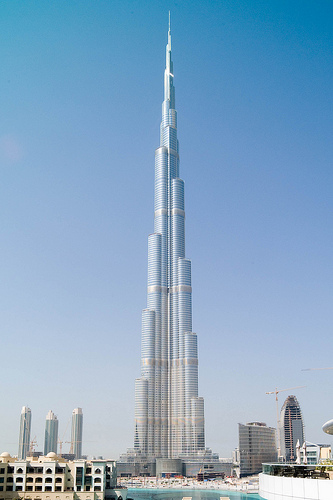
  • Burj Khalifa, located in Dubai, United Arab Emirates, Middle East, was the tallest building and man-made structure in the world at its completion in 2010.
  • The Burj Khalifa, ‘burj’ meaning ‘tower’, was originally known as ‘Burj Dubai’, but it was renamed after the United Arab Emirates’ president and ruler of Abu Dhabi, Sheikh Khalifa Bin Zayed Al Nahyan at its official opening, which is said to be the result of Abu Dhabi bailing Dubai out of a financial crisis just before the building was completed.
  • Burj Khalifa is a centrepiece of an area developed in the city of Dubai, built for a variety of purposes including tourism and fame for the city, and the building has won numerous awards.
  • Burj Khalifa has the height of 829.8 metres (2722 feet), has 163 official floors, and has a floor area of 309,473 square metres (3,331,100 square feet).
  • Burj Khalifa is said to be able to house over 35,000 people at once, has over 24,000 windows and 900 apartments, includes offices and a hotel, and when it opened it had the highest nightclub, restaurant and observation deck, and was host to the highest fireworks display.
Burj Khalifa, Tower, White, Tall, Landscape, Scale, Dubai, Middle East, Arab, Ten Random Facts, Skyscraper, Tallest in the world, Flickr
Burj Khalifa
Image courtesy of Joi Ito/Flickr
  • It is believed that the Burj Khalifa was originally going to use the scrapped Melbourne, Australia’s planned Grollo Tower design, a 560 metre (1837 feet) skyscraper, but the building was later completely redesigned by United States architect Adrian Smith from Skidmore, Owings and Merrill.
  • Burj Khalifa was constructed by South Korea’s Samsung Engineering and Construction, mostly using thousands of migrant workers from south Asia, and during the building process, there was only one reported fatality although the number of actual deaths is believed to be much higher.
  • Burj Khalifa was constructed with 330,000 cubic metres (431,600 cubic yards) of concrete and 55,000 tonnes (61,000 tons) of steel and cost approximately US$1.5 billion.
  • Work on the Burj Khalifa site started in January 2004, and the building was officially opened with 10,000 fireworks and other light and sound effects, on 4th January 2010, although the interior was not complete at that stage.
  • The Burj Khalifa is based on the design of a Hymenocallis, a desert flower, and the spire at the top of the building is said to sway 1.5 metres (4.9 feet) and is visible 95 kilometeres (60 miles) away.
Bibliography:
Burj Khalifa, 2014, The Skyscraper Center, http://www.skyscrapercenter.com/dubai/burj-khalifa/
Burj Khalifa, 2014, Wikipedia, http://en.wikipedia.org/wiki/Burj_Khalifa
Burj Khalifa, 2014, Burj Khalifa, http://www.burjkhalifa.ae/en/

Amazon:    

Komodo Dragon

Komodo Dragon

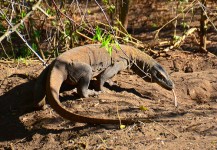
Komodo dragons do not fly.

  • ‘Komodo dragons’ are also called ‘komodo monitors’ and ‘komodo island monitors’.
  • Komodo dragons are native to some of the Lesser Sunda islands of Indonesia, Asia, and were not known to the western world until the early 1900s.
  • Komodo dragons are from the family Varanidae, the family of monitor lizards, and have the scientific name ‘Varanus komodoensis’.
  • Komodo dragons are the world’s largest species of lizard not extinct, and are vulnerably threatened, particularly by human hunting, with approximately 3000 to 5000 in the wild.
  • Komodo dragons can grow up to 3 metres (10 feet) in length and 70 kilograms (150 pounds) in weight, although some are much heavier and can be more than double this in weight.
Komodo Dragon, Lizard, Islands of Rinca, Indonesia, Brown, Scale, Ten Random Facts, Flickr
Komodo Dragon
Image courtesy of Austronesian Expeditions/Flickr
  • Komodo dragons have bluey grey scales that are hard and sturdy and a forked tongue that is yellow, and numerous bacteria in their saliva that causes death in their prey.
  • Komodo dragons have an excellent sense of smell, one ear bone causing it to have a restricted hearing range, and it can see up to 300 metres (980 feet) away.
  • Komodo dragons live in habitats of grasslands, savannahs and forests, in areas that are hot and dry.
  • A komodo dragon’s diet consists of birds, mammals, reptiles, insects and the meat of dead animals, and can, in one feeding, eat up to 80% of its own weight.
  • Komodo dragon females lay an average of 20 eggs in a mound or a hole, that generally hatch in April.
Bibliography:
Komodo Dragon, 2014, National Geographic, http://animals.nationalgeographic.com.au/animals/reptiles/komodo-dragon/
Komodo Dragon, 2014, Wikipedia, http://en.wikipedia.org/wiki/Komodo_dragon

Amazon:    

Hook and Loop Fastener

Hook and Loop Fastener

Hook into these facts about hook and loop fasteners.

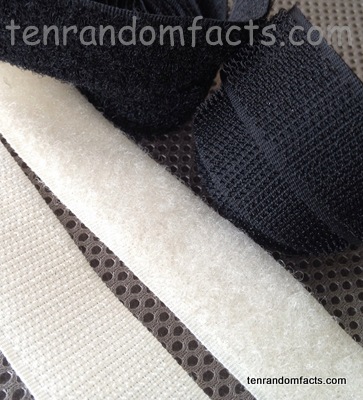
  • Hook and loop fasteners are two different textile strips or shapes that have numerous tiny hooks on one strip or shape, that grip onto tiny loops on the other strip or shape.
  • ‘Hook and loop fasteners’ are also known as ‘touch fasteners’, and are also commonly referred to by the original brand name of the product, ‘Velcro’.
  • Hook and loop fasteners hold together by pressure or can be detached from each other by force, and make a sound of ‘ripping’ when being detached.
  • Hook and loop fasteners were invented in Switzerland by native George de Mestral, an engineer, with the idea being born in 1941, although it took him ten years to produce a successful mechanical process to make the product and he applied for a patent for it in 1951.
  • Hook and loop fasteners are based on natural burr seeds, said to be from burdock plants (Arctium), that hook with strength on clothing and animal fur, and the brand name ‘Velcro’ comes from the French words ‘velours’, meaning ‘velvet’ and ‘crochet’ which means ‘hook’.

Hook and loop fastener, velcro, black, white, strips, rectangular, Ten Random Facts, Invention

  • Some brands of hook and loop fasteners can hold 79 kilograms (175 pounds) with only 26 square centimetres (4 square inches) of the material.
  • Hook and loop fasteners are generally made from nylon, usually with the addition of polyester, although they can be made from other materials like Teflon for special purposes.
  • Hook and loop fasteners sometimes have a self adhesive backing and can be attached to items with this method or other glue, or they can be sewn onto fabrics with thread, and sometimes they have hooks on one side and loops on the back.
  • Hook and loop fasteners did not become significantly popular until the 1970s and 1980s, and can now be found in most homes, on clothes, shoes and bags, although it has numerous other uses, in vehicles, toys, furniture, space shuttles, hospitals and more.
  • Hook and loop fasteners can unintentionally collect dirt, hair and fluff, and the loops and hooks can wear after excessive use.
Bibliography:
The History of Hook and Loop Fasteners, n.d, Speedtech International, Inc, http://www.speedtechinternational.com/history-of-velcro.aspx
Hook and Loop Fastener, 2014, Wikipedia, http://en.wikipedia.org/wiki/Hook_and_loop_fastener
Velcro, 2014, Wikipedia, http://en.wikipedia.org/wiki/Velcro


Amazon:  

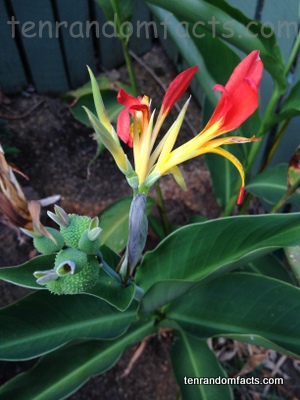
Canna Indica

Canna Indica

Canna indica can be very deadly.

  • Canna indica are perennial plants that are native to the Caribbean and American tropical habitats.
  • Canna indica is from the family Cannaceae, the family of canna lilies and is one of the 19 species in the group, and is also referred to by a number of other scientific names.
  • Canna indica is also known as ‘saka siri’, ‘canna’, ‘coyol’, ‘bandera’, ‘achira’, ‘platanillo’, ‘wild canna lily’, ‘Indian shot’ and ‘chanacle’.
  • Canna indica have small, black, spherical seeds that are dense and sink in water, and are hard enough to be used as bullets, hence one of its common names ‘Indian shot’.
  • Canna indica prefer moist, sunny conditions and are often used as an ornamental in the garden, or they can be found in swamps and wetlands, and are also able to be grown in chemically polluted water as a treatment solution.

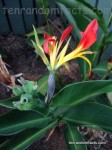
Indian Shot, Red, yellow, flower, canna indica, Ten Random Facts, australia, garden

  • Canna indica plants grow to be 0.5 to 2.4 metres (1.6 to 8.0 feet) in height, and have papery seed capsules after flowering
  • The rhizomes of Canna indica are edible and are served cooked, and they have also been used medicinally.
  • Canna indica have red or yellow coloured flowers sometimes with spots, that flower in autumn and summer and its large green leaves can be used for paper making.
  • Canna indica seeds are commonly used as beads in jewellery and rattles in some musical instruments, and a purple dye can also be made from them.
  • Canna indica are invasive in many countries including Australia, some islands in the Pacific, and South Africa, and spread easily by their rhizomes and seeds.
Bibliography:
Canna Indica – L, 2012, Plants For a Future, http://www.pfaf.org/user/plant.aspx?latinname=Canna+indica
Canna Indica (Wild Canna Lily), 2011, BioNET-EAFRINET, http://keys.lucidcentral.org/keys/v3/eafrinet/weeds/key/weeds/Media/Html/Canna_indica_(Wild_Canna_Lily).htm
Canna Indica, 2014, Wikipedia, http://en.wikipedia.org/wiki/Canna_indica

Amazon:  

The Beatles

The Beatles

The Beatles are not insects, they’re humans.

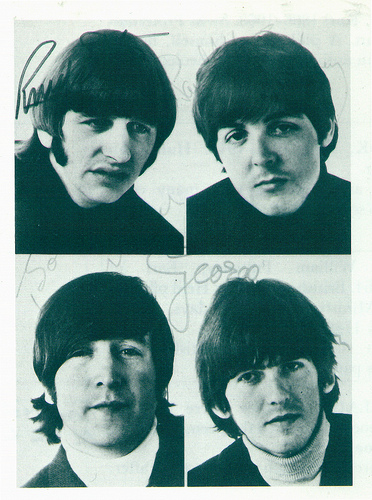
  • The Beatles was a rock and pop band from England, active in 1960 to 1970.
  • The Beatles were also known as the ‘Fab Four’ and have been said to be the greatest band in the modern era.
  • It is believed that more than 600 million records of The Beatles have been sold, and they are the record holders for the ‘most number one hits on the Hot 100 chart’.
  • The Beatles have won 10 Grammy Awards, 15 Ivor Novello Awards and a Best Original Score Academy Award.
  • The Beatles started as a skiffle group with John Lennon in 1957, at age 16, and some of his schoolmates from Quarry Bank High School, who called themselves the ‘Quarrymen’, and included Paul McCartney and George Harrison.
The Beatles, Four, Signed, Picture, Square, Ten Random facts, Rock, Flickr
The Beatles
Image courtesy of IBiAFoddoAbbarad/Flickr
  • The group became ‘The Beatles’ in 1960, and underwent a series of name changes until their final name was settled upon, with some of the school members moving on and eventually Ringo Starr joining the group in 1962.
  • The Beatles became very popular from 1963 to 1966, singing on many tours and releasing many albums, starting with the single and debut album ‘Please, Please, Me’.
  • The Beatles stopped touring in 1966 due to a number of factors, that possibly included the criticism they received from the non-deliberate offensive comments and actions they made towards the United States and Philippines earlier in that year.
  • The Beatles where influenced by singers Little Richard and Elvis Presley, among others, who helped developed the band’s music and style.
  • The Beatles used guitar, voice and drums with sound effects, loops, vari-speeds and double tracking techniques to produce their music.
Bibliography:
The Beatles, 2014, Wikipedia, http://en.wikipedia.org/wiki/The_Beatles
The Beatles, n.d, Last.fn, http://www.last.fm/music/The+Beatles

Amazon:  
           The Beatles Albulms

Macadamia Nut

Macadamia Nut

Don’t be ‘a hard nut’.  Add these macadamia nut facts to your collection.

  • ‘Macadamia nuts’ are also known as ‘macadamias,’ Queensland nuts’, ‘bush nuts’, ‘queen of nuts’, ‘maroochi nutsand ‘bauple nuts’.
  • Macadamia nuts are seeds that are from one of four species of macadamia tree, that are all native to Australia, in the eastern parts of northern New South Wales and southern and central Queensland.
  • There are two species of macadamia nut that are poisonous, but the toxin,  cyanogenic glycoside (cyanide), can be removed by parboiling the nut.
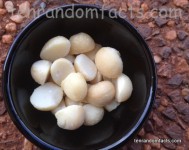
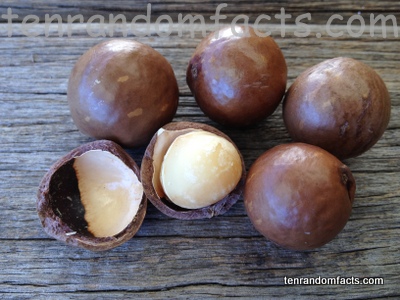
  • Macadamia nuts have a very hard, woody, brown shell which reveals a cream coloured nut when cracked open, that turns golden brown when roasted.
  • Macadamia nuts became known to the British by Alan Cunningham, a botanist from England, who discovered them in 1828 in Queensland.

Macadamia, Nut, Food, Culinary, Australia, Ten Random Facts

  • Australia is currently the top producer of macadamia nuts in the world, and the first trees grown, primarily for commercial purposes, were planted in an orchard in the 1880s, near Lismore, New South Wales, Australia.
  • Macadamia nuts are cracked open when the nut is somewhat dehydrated, and to test for its readiness, the nut will usually rattle in the shell when it’s time, due to the nut growing smaller and detaching itself from the shell.
  • Macadamia nuts are very high in thiamine, manganese and fat, and also contain quantities of many other vitamins and minerals.
  • Some people are allergic to macadamia nuts, that can sometimes cause a fatal reaction, and they are also poisonous to dogs.
  • Macadamia nuts are traditionally eaten raw or roasted, as well as being grounded into butter, covered in chocolate and included in nut mixes and baked goods, and the oil from the nuts is sometimes used in skincare products.
Bibliography:
Macadamia, 2014, Wikipedia, http://en.wikipedia.org/wiki/Macadamia
What are macadamia nuts?, n.d, WiseGEEK, http://www.wisegeek.com/what-are-macadamia-nuts.htm

Amazon:     

Related Posts Plugin for WordPress, Blogger...