Saint Patrick’s Day

Saint Patrick’s Day

The real meaning behind Saint Patrick’s Day:

  • Saint Patrick’s Day is a holiday originating from Europe’s Ireland observed on the 17 March every year, and is a public holiday in Ireland and a few other countries, but is celebrated throughout much of the world.
  • ‘Saint Patrick’s Day’ is also known as the ‘Feast of Saint Patrick’, ‘St. Patrick’s Day’, ‘Patrick’s Day’, ‘Paddy’s Day’ and ‘Patty’s Day’.
  • The 17th March, St Patrick’s Day, is believed to be the day that Saint Patrick, an important Ireland saint from the 5th century, died.
  • St Patrick’s Day celebrates Saint Patrick, who was originally from Roman Britain, and was captured and held captive by Irish pirates at age 16, eventually escaping six years later, only to return to Ireland as a Christian missionary.
  • Saint Patrick’s Day was officially declared a feast day in the 1600s and the Catholic, Eastern Orthodox, Church of Ireland (Anglican) and Lutheran churches typically honour the day.
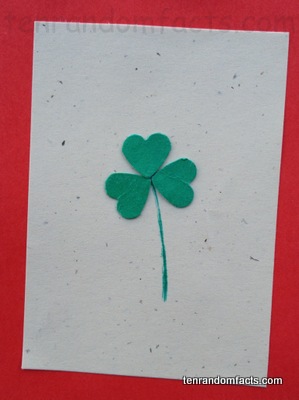
Saint Patricks Day, Card, Shamrock, Scrapbook, Green, Three leaf clover, Ten Random Facts

  • Saint Patrick’s Day is generally associated with the colour green, a colour affiliated with Ireland in general, and shamrocks (clover), which were said to be used as an illustration to explain the Holy Trinity to the Irish, by Saint Patrick.
  • A rugby league match is held during the Saint Patrick’s Day period with Ireland and the United States competing.
  • Saint Patrick’s Day parades are very popular throughout the world, and the first was believed to have been held in the United State’s city of Boston in Massachusetts in 1737, where there was a significant population of Irish.
  • Occasionally, the celebration of Saint Patrick’s Day is moved to a different date if it coincides with Holy Week, and this occurred in 1940 and 2008.
  • Saint Patrick’s Day traditions include going to church and having feasts, particularly with alcohol, and it is also commonly celebrated as a cultural Irish day.
Bibliography:
Saint Patrick’s Day, 2014, Wikipedia, http://en.wikipedia.org/wiki/Saint_Patrick’s_Day
St. Patrick’s Day, 2014, Kidzworld, http://www.kidzworld.com/article/521-st-patricks-day

Amazon:     

Green Anaconda

Green Anaconda

Constrict these facts like a green anaconda.

  • Green anacondas are constrictor snakes found in South America’s tropical swamps and creeks.
  • ‘Green anacondas’ are also known as ‘common anacondas’ and ‘water boas’, and have the collective nouns of ‘knots’ and ‘beds’.
  • Green anacondas are from the family Boidae, the family of boas that are snakes that are non-venomous.
  • Green anacondas have the scientific name of Eunectes murinus, meaning ‘good swimmer’ and ‘of mice’ from Greek and Latin respectively.
  • Green anacondas are the heaviest known snake in the world and are said to weigh up to 250 kilograms (550 pounds) and have lengths of 10 metres (33 feet) or more, rating them as the second longest snake, although these sizes are debated, and their average weight and length is generally considered less, growing on average 4.6 to 5 metres (15 to 16 feet) in length and 30 to 70 kilograms (66 to 154 pounds) in weight.

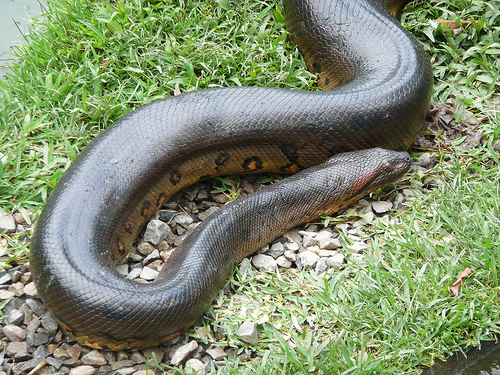
Green anaconda, half, snake, moving, boa, zoo, ground, flickr, Ten Random Facts

Green Anaconda
Image courtesy of Cristóbal Alvarado Minic /Flickr
  • Green anacondas have olive green scales spotted with black patches, and a head with an orange/yellow stripe down each side.
  • Green anacondas can be 30 cm (12 inches) or more in diameter and their jaws can stretch wide open so they can swallow their prey whole.
  • Green anacondas typically spend a lot of time in the water, and hunt at night, lurking in the water, striking at weaker animals like fish, turtles, birds, caiman and mammals, and sometimes larger animals like deer, constricting them and then consuming them.
  • Green anacondas birth between 20 to 40 live babies, that start at a length of 70 to 80 centimetres (2.3 to 2.6 feet).
  • Green anacondas have an average lifespan of 10 years in the wild and are popularly depicted in media as large snakes that swallow humans whole, although in reality, this is a very unlikely occurrence.
Bibliography:
Eunectes murinus, 2014, Wikipedia, http://en.wikipedia.org/wiki/Eunectes_murinus
Green Anaconda, 2014, National Geographic, http://animals.nationalgeographic.com.au/animals/reptiles/green-anaconda/

Amazon:   

Green Amaranth

Green Amaranth

Green amaranths: a weed here or a food there.

  • Green amaranth is an annual herb that is generally believed to be native to tropical America.
  • Green amaranth comes from the family Amaranthaceae, the family of amaranths.
  • Green amaranths have the scientific name ‘Amaranthus viridis’, and ‘amaranthus’ comes from the Greek word meaning ‘everlasting’ or ‘unfading’  and ‘viridis’ is Latin for green’.
  • ‘Green amaranths’ are also known as ‘slender amaranths’, ‘green pigweed’, and ‘Prince of Wales feathers’.
  • Green amaranths grow to be 0.3 to 1 metre (1 to 3 feet) in height, and green and yellow dye can be made from the plant.

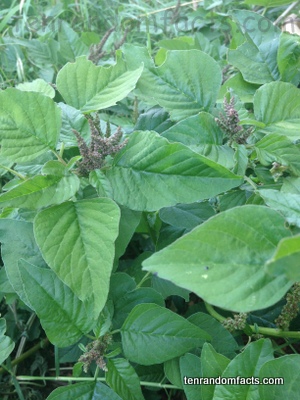
Green amaranth, plant, flower, red, leaves, weed, Ten Random Facts, Australia

  • Green amaranths have green notched leaves and tiny flowers that grow in clusters on spikes, and the flowers are a green or brown to pink colour.
  • Green amaranth fruits are small and round and do not open to release the small black seed they contain.
  • Green amaranths flower mainly during warm, summer months, however flowers can be seen throughout the year, depending on the region it is grown in.
  • Green amaranths are significant weeds in many countries, growing in gardens, cracks, disturbed areas, and in fields.
  • Green amaranths are eaten in Greece, India and Africa, as a leafy vegetable, and are also used medicinally for a variety of purposes.


Bibliography:
Amaranthus Viridus, n.d, Some Magnetic Island Plants, http://www.somemagneticislandplants.com.au/index.php/plants/42-amaranthus-viridis
Green Amaranth, n.d, Herbiguide, http://www.herbiguide.com.au/Descriptions/hg_Green_Amaranth.htm
Jansen P, Amaranthus viridus L., 2004, Plant Resources of Tropical Africa, http://database.prota.org/dbtw-wpd/exec/dbtwpub.dllAC=QBE_QUERY&BU=http%3A%2F%2Fdatabase.prota.org%2Fsearch.htm&TN=PROTAB~1&QB0=AND&QF0=Species+Code&QI0=Amaranthus+viridis&RF=Webdisplay

Amazon:  

Wrench

Wrench

Tighten your brain with these wrench facts.

  • Wrenches are gripping tools used to tighten or loosen objects by rotating them, particularly nuts and bolts.
  • ‘Wrench’, the typical American term, is also known as a ‘spanner’, especially in British English or a ‘spanner wrench’.
  • Wrenches have a long history and have been used for various purposes including the straightening of spear shafts and similar, and the term was used before 1790, while the word ‘spanner’ has been used from as early as 1630.
  • Special alloy steel is typically used to make high quality wrenches and are typically plated with chrome for corrosion prevention.
  • The first patent of a wrench is commonly attributed to Solymon Merrick in the United States in 1834, however, an earlier patent of a similar one was granted in 1832 to Henry King from Springfield, Massachusetts, in the United States, and King’s wrench was an ‘improvement in the rack wrench’.

Wrench, Silver, Monkey, Box End, Open End, Combination, Silver, Small, Big, Chrome, 14mm, 15mm, Kinchrome, ten Random Facts

  • Wrenches commonly have an end with either a c or u shaped opening and/or a notched hole, which is used to grip the nut or bolt.
  • Popular wrenches include box-end, combination, open-end, flare nut and adjustable, with the latter having a movable clamp.
  • Wrenches can cause injury, particularly by slipping, if used incorrectly such as by using on a incorrect angle or a different nut size.
  • Wrenches come in a range of sizes that have the size usually stamped on the tool, with imperial tools numbered in fractions of inches and metric tools in millimetres.
  • Wrenches with nut-shaped sockets can have 6, 8, 12 or 16 sided holes for gripping.


Bibliography:
Crawford P, Spanner Jaw Sizes, 2013, Dundee Satellite Receiving Station, http://www.sat.dundee.ac.uk/~psc/spanner_jaw.html
Wrench, 2014, Encyclopaedia Britannica, http://www.britannica.com/EBchecked/topic/649432/wrench
Wrench, 2014, Wikipedia, http://en.wikipedia.org/wiki/Wrench


Amazon:     
 

Prune

Prune

Soft and squishy prunes.

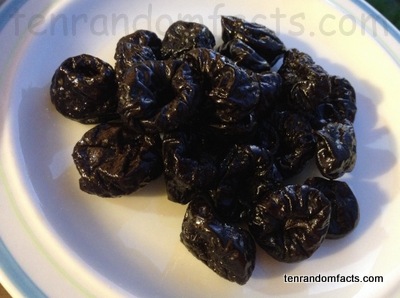
  • Prunes are the dried fruit of primarily the European plum species, although other species of plum are sometimes used, and they have a dark, sweet flavour, are sticky and a little chewy.
  • The scientific name of the fresh fruit, referred to as ‘fresh prunes’ or ‘plums’ is Prunus domestica, that belong to the family rosaceae, the family of roses.
  • Prunes generally come from fruits with easily removable pits and are sold either with or without the seed.
  • ‘Prunes’ are also known as ‘dried plums’, and this has become the more favoured term in recent years to avoid the stigma associated with the term ‘prune’.
  • There are over 1000 different varieties of plum fruit that are dried and packaged as prunes.

Prune, Black, Juicy, Sticky, Fruit, Plum, Dried, Ten Random Facts. Food, Angas Park

  • Prunes are popularly eaten in desserts, cooked in main meal dishes, eaten as a snack or as a fresh fruit, and can be made into juice or an alcohol beverage.
  • Prunes contain laxatives and sorbitol, which can be used to treat digestive related problems, and have been historically used to treat constipation.
  • Prunes are very high in vitamin K, and have a significant amount of potassium, copper, manganese, vitamin A and fibre.
  • Prunes have a high quantity of phenols that have significant antioxidant properties, that are beneficial to one’s health.
  • The process of drying plums to make prunes is said to be thousands of years old, and possibly began in the Caspian Sea area, in Europe, where the European plums are native.


Bibliography:
Prune, 2014, Wikipedia, http://en.wikipedia.org/wiki/Prune
Prunes, 2014, The World’s Healthiest Foods, http://www.whfoods.com/genpage.php?dbid=103&tname=foodspice

Amazon:     

Universal Studios

Universal Studios

“A Comcast Company” – Universal Studios slogan.

  • The Universal Studios is a major film studio that produces motion picture films, and the main production studios are located in Universal City, California in the United States.
  • ‘Universal Studios’ has also been known as ‘Universal Pictures’ and is officially known as ‘Universal Studios Incorporation’, and its parent company is ‘NBCUniversal Incorporated’.
  • Universal Studios was founded in 1912 as the ‘Universal Film Manufacturing Company’, which was a merger of a number of other studios, making it the oldest United States film studio, and it ranks fourth oldest among the studios of the world that are still producing.
  • The Universal Studios has released three films during its history that have been the top grossing film at the time: ‘Jaws’ in 1975; ‘E.T. the Extra-Terrestrial’ in 1982; and ‘Jurassic Park’ in 1993.
  • The Universal Studios was originally founded by 8 people, with Carl Laemmle as the first company president, who later bought out his partners.

Universal Studios, Earth, Blue, Logo, 100th Anniversary, 2012, Despicable Me 2, Ten Random Facts, White, Gold, New

Universal Logo from 2012
Image Courtesy of Universal Studios
  • During its hundred years, Universal Studios has been owned by or merged with many organisations, including International Pictures, Music Cooperation of America, Matsushita (now Panasonic), Seagram, Vivendi and in 2004, the National Broadcasting Company (NBC) which is now owned by Comcast Corporation.
  • The Universal Studios have studios and theme parks in California’s Hollywood and Florida’s Orlando in the United States, and Japan and Singapore in Asia, and have more planned for the future in other locations around the world.
  • In 2011, the Universal Studios had a revenue of US$4.239 billion, and its 100th anniversary was celebrated in 2012 with a new improved logo and a project of restoring and reviving thirteen of its films.
  • According to legend, the Universal Studios original name was named by the original president based on a wagon he saw with the printed words on it, ‘Universal Pipe Fittings’.
  • The Universal Studio logo in 1914 originally resembled the planet Saturn, and its concept is still used today, with the planet being Earth and the text wrapping around it.
Bibliography:
Gallagher B, Universal Pictures Celebrates 100th Anniversary with Restoration of 13 Classic Films, 2012, Movieweb, http://www.movieweb.com/news/universal-pictures-celebrates-100th-anniversary-with-restoration-of-13-classic-films
The Story Behind… The Universal Pictures Logo, n.d, My Film Views, http://www.myfilmviews.com/2012/02/16/the-story-behind-the-universal-pictures-logo/
Universal Studios, 2014, Wikipedia, http://en.wikipedia.org/wiki/Universal_Studios

Amazon:     
Universal Studios Films 

Related Posts Plugin for WordPress, Blogger...