Chipmunk

Chipmunk

Watch the chipmunks scurry over the rooftops.

  • Chipmunks are small mammals that are primarily native to North America, but one of the 24 species is native to Asia.
  • The scientific name of a chipmunk is ‘Tamias’, and they are from the family Sciuridae, the family of squirrels.
  • Chipmunks mainly eat nuts, seeds, and berries, but also other vegetation, as well as insects, worms, frogs, bird eggs and fungi.
  • Chipmunks live in burrows that can be 3.5 metres (11.5 feet) or longer, and they collect food in autumn that they store there for eating during the winter hibernation period.
  • A chipmunk has flexible cheeks that allows it to obtain a number of food items at once, and it uses them as a carrying pouch.
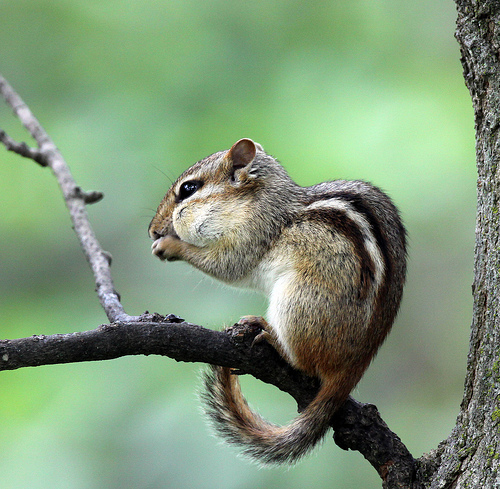
Chipmunk, brown, rodent, striped, white, black, squirrel, Ten Random Facts, Flickr
Chipmunk
Image courtesy of Dawn Huczek/Flickr
  • Chipmunks have calls that are similar in sound to chirps of a bird, and they have a lifespan generally of 2 or 3 years, and can have 2 to 8 babies in one litter.
  • ‘Chipmunks’ are rodents, and are also known as ‘striped squirrels’, ‘timber tigers’, ‘munks’ and ‘chippers’.
  • Different species of chipmunks are different colours, and range from brown, red-brown and grey in colour, and they have light and dark coloured stripes down their backs, face and tail.
  • Chipmunks are commonly found in woodland habitats, but also live in urban areas, and are preyed on by foxes, weasels, coyotes, snakes and hawks.
  • Chipmunks grow to be 10 to 18 cm (4 to 7 inches) in length, plus have a tail of 8 to 13 cm (3 to 5 inches) and weigh between 28 to 142 grams (1 to 5 ounces).
Bibliography:
Chipmunk, 2014, National Geographic, http://animals.nationalgeographic.com.au/animals/mammals/chipmunk/
Chipmunk, 2014, Wikipedia, http://en.wikipedia.org/wiki/Chipmunk

Amazon:      

Golden Rain Tree

Golden Rain Tree

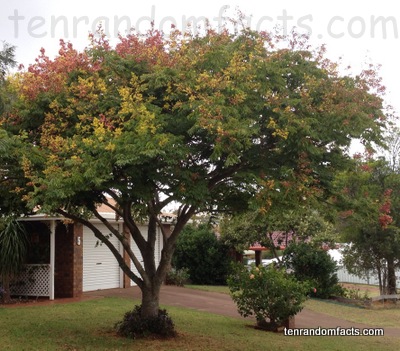
Golden rain trees are like gold.

  • Golden rain trees are ornamental flowering trees that are deciduous and useful for shade.
  • The scientific name of a golden rain tree is ‘Koelreuteria paniculata’ and it comes from the Sapindaceae family, the family of soapberries.
  • Golden rain trees are native to Korea and China and typically grow to be 7 to 12 metres (23 to 40 feet) in height.
  • ‘Golden rain tree’ is also known as a ‘china tree’, the ‘pride of India’, and ‘varnish tree’.
  • Golden rain trees have small, yellow coloured,  four petalled blossoms, that bloom in summer or autumn, which can cause golden carpets below the tree when they drop.

Golden Rain Tree, Plant, house, leaves, large, red, Australia, Ten Random Facts

  • Golden rain trees have coral or brown coloured paper-like pods that contain multiple dark coloured seeds, and ferny leaves that change colour at different stages.
  • Golden rain trees are grown decoratively in many countries, but in Florida and neighbouring states of the United States, the trees are invasive.
  • Golden rain trees grow best in sunny areas and can withstand droughts.
  • Golden rain tree seeds and leaves can be eaten, roasted or cooked respectively, although they are not commonly consumed.
  • Golden rain trees can be a source of yellow and black dye, and the seeds are sometimes used as a bead in jewellery making.
Bibliography:
Koelreuteria paniculata, 2012, Plants for a Future, http://www.pfaf.org/user/Plant.aspx?LatinName=Koelreuteria+paniculata
Koelreuteria paniculata, 2014, Wikipedia, http://en.wikipedia.org/wiki/Koelreuteria_paniculata
Koelreuteria paniculata, n.d, Missouri Botanical Garden, http://www.missouribotanicalgarden.org/PlantFinder/PlantFinderDetails.aspx?kempercode=a550

Amazon:   

Salt and Pepper Shakers

Salt and Pepper Shakers

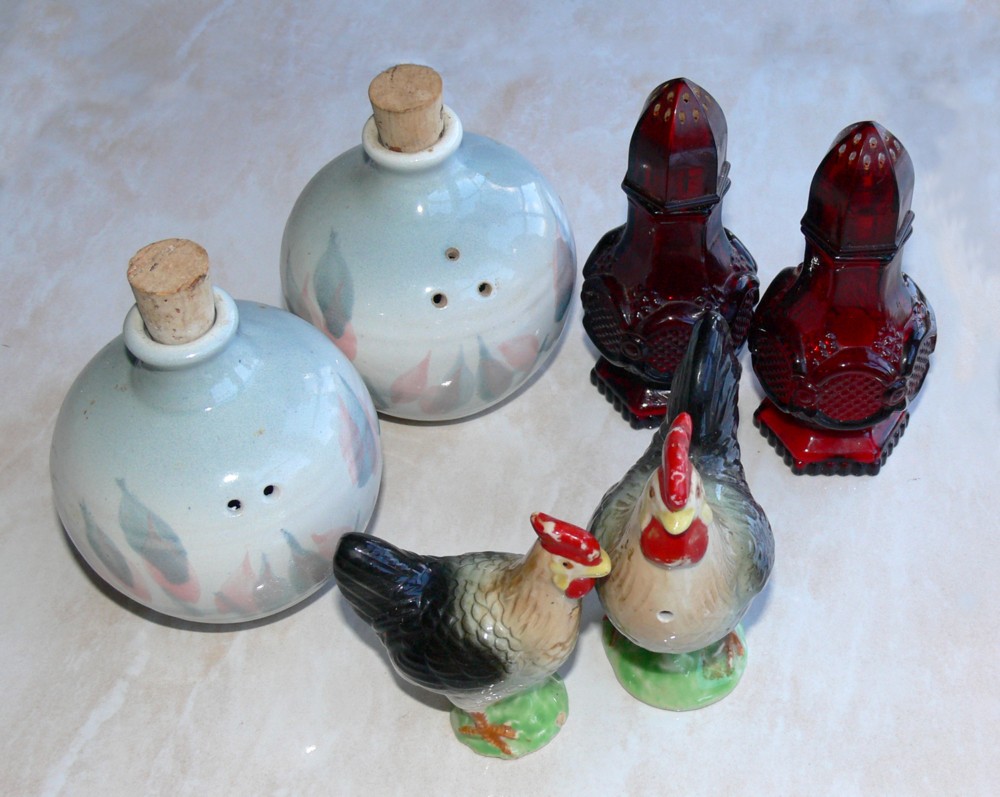
What do stamps, shells and salt and pepper shakers have in common? They are all collectables.

  • Salt and pepper shakers are small containers that hold powdered food seasonings, typically in Western countries.
  • Salt and pepper shakers typically contain ground pepper and salt, and are generally tipped upside down over a meal and gently shaken to release some of their contents.
  • ‘Salt and pepper shakers’ are also known as ‘salt and pepper pots’.
  • Salt and pepper shakers are made in many different materials, such as ceramics, plastic, glass, metal or timber.
  • It is believed that a salt shaker was first invented in 1858, by John Mason, a tinsmith from America, but it wasn’t until the 1920’s that sets of salt and pepper shakers were commonly manufactured, and later they became even more popular due to cost effectiveness of ceramic production.

Salt and Pepper Shakers, Chicken, Three, Six, Pairs, Collection, Pretty, Blue Interesting, Red

Photo courtesy of Val Laird
  • Salt and pepper shakers are commonly a set of two, sporting many different colours, shapes and sizes.
  • Salt and pepper shakers may include a grinding function to grind peppercorns and large salt crystals.
  • Salt and pepper shakers grew in popularity in the 1920s due to the addition of magnesium carbonate to the salt to prevent lumps and clumping caused by moisture, which was added by the Morton Salt company in Chicago, in the United States, making it easy to pour.
  • Salt and pepper shakers are popularly collected due to their unique shapes and historical significance and large collections exist, some of which have as many as 40,000 sets.
  • Salt and pepper shakers generally have small holes to restrict the amount of seasoning released, with salt shakers typically having the least number of holes.
Bibliography:
Bulls D, Collectable Kitchenware: Salt & Pepper Shakers, 2013, Kings River Lite Magazine, http://kingsriverlife.com/03/23/collectible-kitchenware-salt-pepper-shakers/
History of Shakers, n.d, Kim’s Salt and Pepper Shaker page, http://kimmykay.tripod.com/snppage/id1.html
Salt and Pepper Shakers, 2014, Wikipedia, http://en.wikipedia.org/wiki/Salt_and_pepper_shakers

Amazon:     

Vanilla Extract

Vanilla Extract

Do you use pure or imitation vanilla extract.

  • Vanilla extract is a flavouring mixture that largely contains vanillin, which generally comes from the vanilla bean that grows on an orchid plant called Vanilla planifolia.
  • Pure vanilla extract is made be steeping 100 grams of vanilla beans in a litre of water mixed with 35% alcohol, (for each gallon of liquid, 13.35 ounces of vanilla beans) and the final liquid is usually purchased in a small bottle.
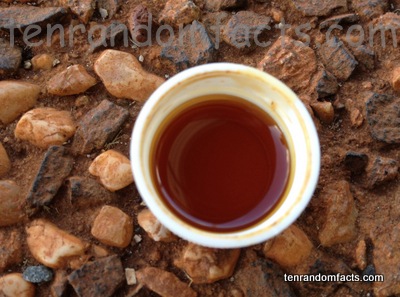
  • Vanilla extract is the most frequently used type of vanilla flavouring and is typically dark brown in colour, and pure vanilla extract has a more distinct smell and flavour than the more bitter imitations.
  • ‘Vanilla extract’ is also known as ‘vanilla essence’ and unnatural or synthetic vanilla flavouring extract or essence is known as ‘imitation’ vanilla.
  • Some people are allergic to vanilla extract and can develop migraines from it due to its vanillin content.

Vanilla Extract, Vanilla Essence, Queens, pure, Ten Random Facts, Flavour, Lid

  • Vanilla extract is popularly used in flavouring baked wheat products, sweets and desserts, particularly custard and ice cream.
  • Vanilla extract can be expensive, particularly when typhoons hit the main producing countries, causing significant losses.
  • The main producer of vanilla extract is Africa’s Madagascar, an island in the Indian Ocean, although the plant is native to Mexico.
  • Vanilla extract may vaporise when heated as a liquid, due to its alcohol content, and will generally result in the loss of some vanilla flavour.
  • Vanilla extract was first developed as a commercial liquid product in the 1847s in the United States by an American chemist Joseph Burnett, after a request from a customer.
Bibliography:
History of Vanilla, n.d, Plain Vanilla, http://www.indepthinfo.com/vanilla/history.shtml
Martinez C, What is the Origin of Vanilla Extract, n.d, http://www.ehow.com/info_12012268_origin-vanilla-extract.html
Vanilla, 2014, Joy of Baking, http://www.joyofbaking.com/Vanilla.html
Vanilla Extract, 2014, Wikipedia, http://en.wikipedia.org/wiki/Vanilla_extract

Amazon:     

Elvis Presley

Elvis Presley

“Rock and roll music, if you like it, if you feel it, you can’t help but move to it. That’s what happens to me. I can’t help it.” – Elvis Presley.

  • Elvis Presley was a singer, actor and musician from America, who was very popular in the rock and roll genre.
  • ‘Elvis Presley’ was also known as ‘the King of Rock and Roll’ and ‘The King’, and had the full name of ‘Elvis Aaron Presley’ and his middle name was originally spelt ‘Aron’.
  • Elvis Presley was born on 8 January, 1935, in Mississippi’s Tupelo in the United States, as a twin, although his older identical brother was stillborn, making Elvis an only child.
  • Elvis Presley had been a good singer since childhood, despite some people not liking his style, although bullying and shyness contributed to stage fright and failed grades for music.
  • Elvis Presley first recorded himself in 1953, at Sun Records, trying to gain recognition, later forming a trio with Bill Black and Winfield ‘Scotty’ Moore brought together by Sun Record’s founder, Sam Phillips.

Elvis Presley, Cover, Elvis is Back, Music, C, RGA Victor, Ten Random Facts, Flickr

Elvis Presley
Image courtesy of Brett Jordan/Flickr
  • Elvis Presley started to become popular in 1955 and his popularity grew until 1958 when he joined the US Army, but his producers kept his music coming and he was able to quickly slot back into his music career two years later, with a number one hit in 1960.
  • Elvis Presley performed in genres of rock and roll, pop, rockabilly, R&B, gospel, country and blues, and was initially thought to be an African American by some who had only heard him, due to the style of his voice and music.
  • Elvis Presley married Priscilla Wagner on 1 May, 1967, and they had a daughter, Lisa Marie, but divorced in 1973, and it was only a few years later that he died on 16 August, 1977, aged 42, in Tennessee’s Memphis, in the United States, prior to just starting a tour, likely due to heart attack that was possibly caused by drugs.
  • Elvis Presley was entombed at Forest Hill Cemetery, Memphis, two days after his death, with 80,000 people lining the streets in the area, and he was later buried at his Graceland estate, also in Memphis, even though some believe Presley actually faked his death.
  • Elvis Presley had 70 albums, more than 100 singles, featured in 33 films, achieved 90 gold album awards, a total of 77 platinum and multi-platinum album awards, and is the ‘best selling solo albums artist’ in the United States ever, and won three Grammy awards in his lifetime.
Bibliography:
Elvis Presley, 2013, Bio.com, http://www.biography.com/people/elvis-presley-9446466
Elvis Presley, 2014, Wikipedia, http://en.wikipedia.org/wiki/Elvis_Presley

Amazon:     
Elvis Presley’s Albums

Cliffs of Moher

Cliffs of Moher

The Cliffs of Moher is a place of legends.

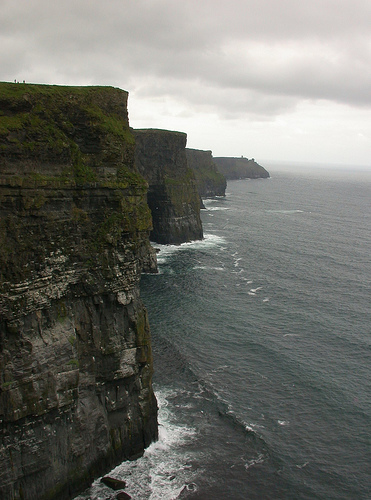
  • The Cliffs of Moher are cliffs found in County Clare in the Burren area, on the coast of Europe’s Ireland, that look out over the Atlantic ocean.
  • The ‘Cliffs of Moher’ are also known as ‘Aillte an Mhothair’ in Irish.
  • The Cliffs of Moher range 120 to 214 metres (390 to 702 feet) in height from water level, and spread for 8 kilometres (5 miles).
  • The Cliffs of Moher is one of Ireland’s most popular sights, seen by nearly a million visitors annually.
  • The Cliffs of Moher are made mainly of sedimentary rock, particularly shale and sandstone.
Cliffs of Moher, Overhang, Misty, Dark, Black, Mystery, Ten Random Facts, ireland, land, rock, sedimentary, flickr
Cliffs of Moher
Image courtesy of German Poo-Caamano/Flickr
  • The Cliffs of Moher are home to 20 species of bird, with seabirds numbering over 30,000 pairs, including puffins, razorbills, guillemots and others, including some endangered species including peregrine falcons.
  • The Cliffs of Moher have been featured in multiple films and music videos, and has been mentioned in literature.
  • The Cliffs of Moher contains a large amount of fossils, including trails left by sea creatures.
  • The Cliffs of Moher are eroded by wind, wave, rain and ice, and this has created caves, and isolated landforms in the ocean.
  • The Cliffs of Moher are a section of the Burren and Cliffs of Moher Geopark that became a member of the Global Geoparks Network in 2011, that is supported by UNESCO.
Bibliography:
About the Cliffs, n.d, Cliffs of Moher, http://www.cliffsofmoher.ie/about-the-cliffs/
Cliffs of Moher, 2014, Wikipedia, http://en.wikipedia.org/wiki/Cliffs_of_Moher

Amazon:     

Related Posts Plugin for WordPress, Blogger...