New York City

New York City

“I ♥ New York City.”

  • New York City is a city located in the New York State, in the United States of America, and it is the home of many well known places, notably Times Square; the Statue of Liberty; the World Trade Centers; New York Stock Exchange; the Unisphere; Brooklyn Bridge; and Central Park.
  • ‘New York City’ is also known as ‘New York’, ‘City of New York’, ‘NYC’, ‘NY’, ‘Big Apple’ and ‘The City’.
  • During 1785 to 1790, New York City was the capital of the United States of America, and since then, it has had the greatest city population in the US , with an estimated 8.4 million people living in the city itself in 2013 and approximately 20 million in the metropolitan area,
  • New York City was visited by an explorer from Italy, Giovanni da Verrazzano, for the French monarchy, in 1524, which was the first recorded visit by Europeans.
  • New York City itself covers a total area of approximately 1,214 square kilometres (469 square miles), and the metropolitan area extends to 34,490 square kilometres (13,318 square miles).
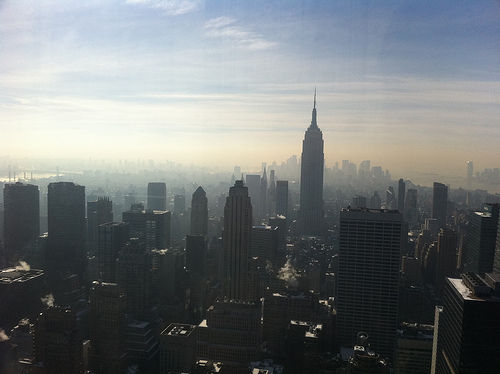
New York City, Skyline, sky, High, Skyscraper, Highrise, United States of America, Ten Random Facts, Flickr,

Skyline
Image courtesy of Rakkhi Samarasekera/Flickr
  • In 2011, New York City was the home to 5,937 high rises,including the new One World Trade Center, the highest building in the Western hemisphere.
  • New York City has five districts, or boroughs, and is the home to 500 galleries of art, 1,200 schools, four of the costliest sporting stadiums on earth and 113 square kilometres (43.75 square miles) of parkland.
  • It is estimated that more than 800 languages are spoken in New York City, and the city is popularly known for its bagels, pizza and cheesecake, as well as other foreign cuisine.
  • Fifty-two percent of New York City’s families do not own a car, and therefore the city has numerous taxis, the largest and one of the most used subways of rapid transit in the world,  and some of the busiest airline and ferry services.
  • New York City is visited by approximately 55 million people every year, is one of the most significant centres for commerce and business in the world, and in 2010 it had a GMP (gross metropolitan product) of US$1.28 trillion.
Bibliography:
New York City, 2014, History, http://www.history.com/topics/new-york-city
New York City, 2014, Wikipedia, http://en.wikipedia.org/wiki/New_York_City

Amazon:      

Brown Bear

Brown Bear

Be wary around those brown bears!

  • Brown bears are large mammals native to northern Europe, Asia and North America, and along with polar bears, are the largest bears and land predators.
  • Brown bears have the scientific name Ursus arctos, meaning ‘bear’ in Latin and Greek respectively, and they are from the family Ursidae, the family of bears.
  • Brown bears have a formal subspecies count of 16, although there is debate about this number and others suggest between 5 and 90 exist.
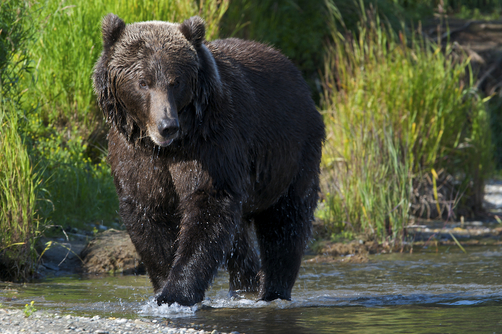
  • Brown bears typically have a fur colour of a variety of brown shades, depending on the subspecies, with the fur in winter growing up to 11 to 12 centimetres (4 to 5 inches) long.
  • Brown bears are generally 1.5 to 2.5 metres (5 to 8 feet) in height and can weigh 55 to 680 kilograms (121 to 1500 pounds) depending on the subspecies and the environment in which they live, and they can weigh twice as much as they would normally before winter when they store fat on their bodies, so that they can semi-hibernate in dens during the cold season.

Brown Bear, Fur, Water, Stalking, Grass, Mammal, Alaska, Ten Random Facts, America, National Geographic

Brown Bear
Image courtesy of National Geographic
  • Some subspecies of brown bears are extinct or endangered, but the species is classified as a ‘least concern’, and they have a population of approximately 200,000 bears in the wild.
  • Brown bears are mostly nocturnal, and are typically found in forests with open land areas, as well as mountainous environments.
  • Brown bears do not often attack humans, but leading causes include surprise or curiosity, and they can run at speeds of 48 kilometres per hour (30 miles per hour).
  • Female brown bears give birth in their den in winter, and litters range from one to four cubs.
  • Brown bears can live up to 37 years in the wild, although longer in captivity, and their diet mainly consists of vegetation such as berries, roots and grass, small mammals and salmon, but sometimes larger animals are preyed upon.
Bibliography:
Brown Bear, 2014, National Geographic, http://animals.nationalgeographic.com.au/animals/mammals/brown-bear/
Brown Bear, 2014, Wikipedia, http://en.wikipedia.org/wiki/Brown_bear

Amazon:      

Tape Measure

Tape Measure

What would you do with out a tape measure?

  • Tape measures are rulers that are flexible and are used for measuring.
  • ‘Tape measures’ are also known as ‘measuring tapes’.
  • Tape measures are primarily very long rectangles made of metal, plastic, cloth or fibreglass, or sometimes paper, that include markings in increments according to a specific system of measurement.
  • Tape measures are typically used in tailoring or construction, the latter often using metal tapes.
  • Tape measures are typically stored rolled in a circle, and sometimes they retract into small containers, and these types of tape measures were originally referred to as ‘spring-click tapes’ and are now commonly called ‘retractable tape measures’.

Tape measure, Metric, yellow, White, Metal, Construction, Tailor, Blue, Purple, Fibreglass, Ten Random Facts, Measuring Tape, Three

  • Metal tape measures used for construction purposes are semi rigid when extended, typically have a perpendicular metal tab to hook onto objects, and sometimes they include specific markings to mark out trusses and studs in house construction.
  • Englishman, James Chesterman from Sheffield, invented, or improved upon, the retractable tape measure in 1829, which was successfully patented, and then later improved upon by Alvin Fellows in Connecticut’s New Haven, in the United States, on 14 July, 1868.
  • The longest tape measure in the world is gold plated and was made in 1956 by a surveyor and tape-maker, Justus Roe, and it measures 180 metres (600 feet).
  • Tape measures are often double sided, with metric measurements on one side, and imperial on the other.
  • Retractable tape measures usually have a stop mechanism so that they tape can be extended and held into position, and then released with the press of a button.


Bibliography:
Tape measure, 2014, Wikipedia, http://en.wikipedia.org/wiki/Tape_measure
What is a Tape Measure?, 2014, WiseGEEK, http://www.wisegeek.org/what-is-a-tape-measure.htm

Amazon:     

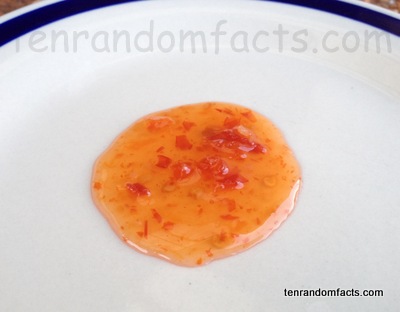
Sweet Chilli Sauce

Sweet Chilli Sauce

These facts are both sweet and hot, like sweet chilli sauce.

  • Sweet chilli sauce is a sauce popular among Asian communities, particularly in Thai and Malaysian cultures, and is also commonly used in western countries, like Australia.
  • Sweet chilli sauce is usually a thick, lumpy sauce that is red or orange in colour.
  • Sweet chilli sauce is typically made with chilli and sweet fruit or sugar.
  • Sweet chilli sauce is typically available in supermarkets and restaurants due to high popularity, and is generally purchased in a bottle, although there are many recipes for the condiment.
  • Sweet chilli sauce is commonly used with Asian spring rolls as a dipping sauce, and is added to various meat and vegetable dishes to add flavour.

Sweet chilli sauce, red, liquid, splotch, plat, blob, Orange, Mae Ploy, Ten Random Facts, Food

  • Sweet chilli sauce sometimes includes extra spices and liquid, like vinegar or water, to add flavour and to create volume.
  • Sweet chilli sauce is a good source of antioxidants, manganese, vitamin A and vitamin C.
  • Sweet chilli sauce is often used as a replacement in western diets, for sauces such as tomato or barbeque.
  • Sweet chilli sauce may contain vegetables, particularly tomato, to reduce the heat of the chilli and thicken the sauce.
  • Sweet chilli sauce is usually made with mild chilli peppers, like Jalapeño or Serrano.


Bibliography:
Sweet Chilli Sauce, 2013, Wikipedia, http://en.wikipedia.org/wiki/Sweet_chilli_sauce
Sweet Chilli Sauce, n.d, Tarladalal.com, http://www.tarladalal.com/glossary-sweet-chilli-sauce-1306i
What is Sweet Chilli Sauce?, 2014, WiseGEEK, http://www.wisegeek.com/what-is-sweet-chilli-sauce.htm

Amazon:      

Wolfgang Amadeus Mozart

Wolfgang Amadeus Mozart

“I pay no attention whatever to anybody’s praise or blame. I simply follow my own feelings.” – Wolfgang Amadeus Mozart.

  • Wolfgang Amadeus Mozart was a musician that helped shape the classical music era, and is commonly referred to as ‘Mozart’.
  • Wolfgang Amadeus Mozart was born as the youngest of seven children, on 27 January, 1756, in Austria’s Salzburg, in Europe, to Leopold Mozart, a violinist, and Anna Maria Pertl, although Mozart was only one of their two children to survive past their first year.
  • Wolfgang Amadeus Mozart was baptised in the St. Rupert’s Cathedral, a Catholic church, as Johannes Chrysostomus Wolfgangus Theophilus Mozart, and was commonly called by various names throughout his life, and had a preference for the Latin word Amadeus, meaning ‘to love God’, as his middle name, rather than the Greek word ‘Theophilus’, that had the same meaning.
  • Wolfgang Amadeus Mozart was originally educated only by his father, and was skilled on the piano and violin and composing at five years of age.
  • Wolfgang Amadeus Mozart’s first performance was in Munich, Germany, in the Prince-elector Maximilian III’s court at age six.

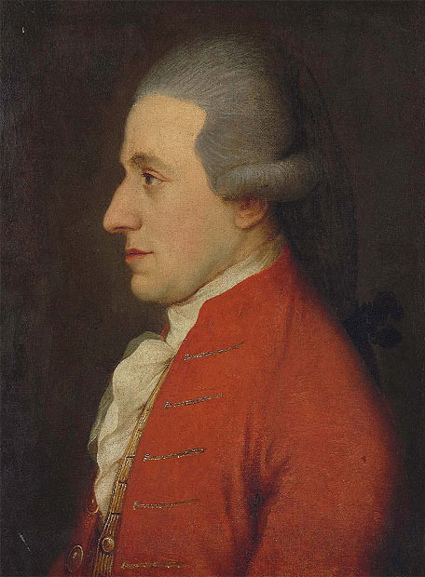
Wolfgang Amadeus Mozart, Portrait, Red, Coat, White, Grey, Old, Ten Random Facts, Flickr, Joseph Hickel

Portrait of Mozart by Joseph Hickel
Image courtesy of WCFsymphony/Flickr
  • Wolfgang Amadeus Mozart was the official musician of the Salzburg Prince-Archbishop of the time, Hieronymus Colloredo, from 1773 to 1777, and later moved to Vienna, in Austria, in 1781.
  • Wolfgang Amadeus Mozart married Constanze Weber on 4 August, 1782, and had six children; although only two survived past the age of one year.
  • At 35 years old, Wolfgang Amadeus Mozart died on 5 December 1791 in Vienna, Austria, after a period of illness, with his death cause unconfirmed.
  • Wolfgang Amadeus Mozart significantly influenced the great classical musician Ludwig van Beethoven, although it is uncertain as to whether they met, and Mozart’s music has long been studied by musicians around the world, having influenced many.
  • Wolfgang Amadeus Mozart is said to have learnt 15 languages as the result of much travelling, and produced more than 600 works of music, in every genre of the day.
Bibliography:
Wolfgang Amadeus Mozart, 2014, Encyclopaedia Britannica, http://www.britannica.com/EBchecked/topic/395455/Wolfgang-Amadeus-Mozart
Wolfgang Amadeus Mozart, 2014, Wikipedia, http://en.wikipedia.org/wiki/Wolfgang_Amadeus_Mozart
 Wolfgang Amadeus Mozart, Composer, 2014, DSO Kids, http://www.dsokids.com/listen/by-composer/wolfgang-amadeus-mozart.aspx

Amazon:      
                        Mozart’s Music

Spear Thistle

Spear Thistle

Spear thistles are not used as weapons… but can hurt!

  • Spear thistles are a biennial or annual thistle plant native to Europe, Asia and Northern Africa.
  • Spear thistles have the scientific name Cirsium vulgare and they are from the family Asteraceae, the family of asters, sunflowers and daisies.
  • ‘Spear thistles’ are also known as ‘bull thistles’, ‘black thistles’,  ‘scotch thistles’  ‘Fuller’s thistles’, ‘swamp thistles’ and ‘common thistles’ among others.
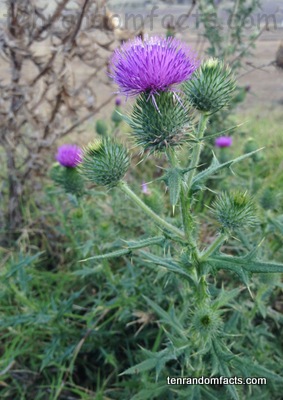
  • Spear thistles grow to be 1 to 1.5 metres (3.3 to 5 feet) in height, with flower stems at the end of the branches, and look similar to the well known Scotch thistle or cotton thistle, although they are a different species of plant and have the scientific name Onopordum acanthium.
  • Spear thistles have flower heads that are bristle like and are coloured pink to purple, and the plant has green, sharp spiny leaves.

Spear Thistle, Green, Purple, Pink, Flower, Dead, Green, Ten Random Facts, Australia, Plant, Weed, Spiky, Prickly,

  • Spear thistles are classified as a noxious and an environmental weed in some countries, and is a particular problem in Australia, parts of the United States and the United Kingdom.
  • Spear thistles typically grow in sunny open areas, such as paddocks and fields.
  • Spear thistle stems, flowers, roots, and seeds can be eaten and the stems and leaves can be peeled and then steamed or boiled.
  • Spear thistles flower during spring to autumn, but only in their second year of growth.
  • Spear thistle plants have been used medicinally and parts of the plant can be made into paper.
Bibliography:
Bull Thistle, 2014, King Country, http://www.kingcounty.gov/environment/animalsAndPlants/noxious-weeds/weed-identification/bull-thistle.aspx
Cirsium vulgare, 2014, Wikipedia, http://en.wikipedia.org/wiki/Cirsium_vulgare

Amazon:      

Related Posts Plugin for WordPress, Blogger...