Wadden Sea

Wadden Sea

Appear to walk on water at Wadden Sea.

  • Wadden Sea is a large body of shallow water in the North Sea, off the coast of Northwest Europe.
  • Wadden Sea is the home of many islands called the same name that are also known as ‘Frisian Islands’.
  • Wadden Sea is an intertidal zone, and the “largest unbroken system of intertidal sand and mud flats” on earth, and it includes kilometres of mud flats, channels, sand banks and salt marshes.
  • Wadden Sea is located on the coast of three countries – Germany, Denmark and the Netherlands; and the countries cooperatively protect the area.
  • Ever since 2009, Wadden Sea has been a UNESCO World Heritage Site.
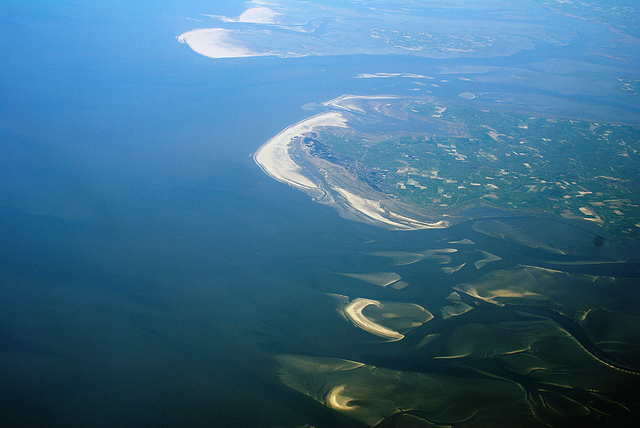
Wadden Sea, Aeroplane, view, Overtop, Large, Netherlands, Ten Random facts, Water, Flickr

Netherlands part of Wadden Sea
Image courtesy of Eutrophication & Hypoxia /Flickr
  •  Wadden Sea has an area totalling just under 10,000 square kilometres (3,861 square miles), and covers a distance of 400 km (248 miles).
  • Wadden Sea is the migration site of up to 12 million birds of more than 30 species, and is a significant nesting area, and moulting area for numerous birds.
  • Wadden Sea is popular for beach activities, including swimming, as well as bird watching, boating, cycling, seal watching, and mudflat hiking site.
  • The Wadden Sea area is home to more than 5,000 different species of animals and plants, with some being seals, porpoises and, historically, whales.
  • The name ‘Wadden Sea’, comes from the Dutch word ‘wad’, meaning ‘mudflat’.
Bibliography:
Wadden Sea, 2014, UNESCO World Heritage, http://whc.unesco.org/en/list/1314
Wadden Sea, 2014, Wikipedia, http://en.wikipedia.org/wiki/Wadden_Sea
About the Wadden Sea, 2013, Common Wadden Sea Secretariat, http://www.waddensea-worldheritage.org/wadden-sea-world-heritage/unique-its-kind

Amazon:      

Cheetah

Cheetah

These cheetah facts do not cheat like a cheater.

  • Cheetahs are a large feline, or ‘big cat’ found in Africa and the Middle East, and were once found in India.
  • A cheetah is from the family Felidae, the family of cats, and its scientific name is Acinonyx jubatus, a group that can be divided into six accepted subspecies.
  • Cheetahs, being the fastest land animals, can run at speeds up to 120 kilometres per hour (75 miles per hour), and can accelerate to a top speed in three seconds.
  • ‘Cheetah’ comes from the Hindi word for leopard, ‘cītā‘, that has its origins in the Sanskrit word ‘citrakāyah’, that literally means ‘variegated body’.
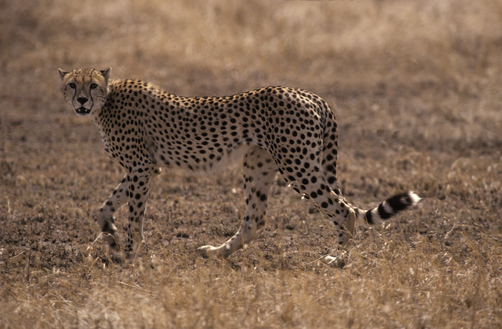
  • Cheetahs grow to be 1.1 to 1.5 metres (3.6 to 4.9 feet) in length and 21 to 72 kilograms (46 to 159 pounds) in weight, have light tan coloured fur decorated with black 2 to 3 centimetre (0.8 to 1.2 inch) diameter spots, black rings on the end section of their tail, and keen eyesight.
A Cheetah on patrol in the vast grassland plains hunts for Gazelles.
Cheetah
Image courtesy of National Geographic
  • Cheetahs have a typical lifespan in the wild of up to 12 years, although as many as nine out of ten cheetah cubs become food for hyenas, lions, and other animals.
  • Male cheetahs generally live in groups of 2 or 3, although they often live alone, while females are solitary, and give birth to 4 cubs on average, and up to 9 is possible.
  • A cheetah’s diet consists of mammals like gazelles and other antelopes, as well as smaller animals, and they hunt by stalking and chasing their prey which they usually do during early morning and early evening.
  • Cheetahs were historically tamed for hunting purposes in Ancient Egypt, Persia and India, and are currently illegally hunted for their fur, as well as being a vulnerable species, endangered with habitat loss.
  • Cheetahs can go without water for three or four days, as their prey supplies some of the moisture they require, and they communicate through various noises including chirps, purring, growling, hissing and yowling, among others.
Bibliography: Cheetah, 2014, San Diego Zoo, http://animals.sandiegozoo.org/animals/cheetah
Cheetah, 2014, Wikipedia, http://en.wikipedia.org/wiki/Cheetah

Amazon:      

Black Box Flight Recorder

Black Box Flight Recorder

Black box flight recorders are a great help for determining the cause of an accident.

  • Black box flight recorders are devices located in aircraft to record data in case of an accident, and are made to survive at least 1000°C (1832°F) and a g-force of 3400.
  • ‘Black box flight recorders’ are also known as ‘black boxes’ and ‘flight recorders’, usually refers to two separate containers; one a ‘flight data recorder’ or FDR, and the other, a ‘cockpit voice recorder’ or CVD, although sometimes they are held in the same sealed container.
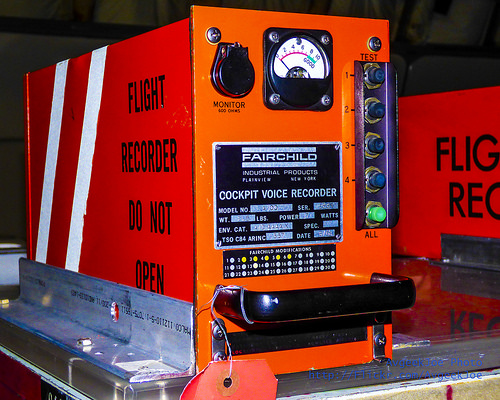
  • It is not known for certain why black box flight recorders are referred to as ‘black boxes’, as they are generally coloured in special bright orange or yellow reflective paint, so that they are more visible in search situations, and they are usually labelled with a warning: ‘FLIGHT RECORDER DO NOT OPEN’ in English and French. 
  • Two of the first innovators of black box flight recorders were François Hussenot and Paul Beaudouin of France, in 1939, and their recorders used a photographic film process.
  • Black box flight recorders have the function of recording aircraft performance, voice and audio signals, and sometimes visual footage, although this is not common.

Black Box Flight Recorder, Orange, Cockpit Voice Recorder, CVD, DO NOT OPEN, Two, Ten Random Facts, Flickr

CVD Flight Recorder
Image courtesy of Joe Kunzler/Flickr
  • The first black box flight recorders to include both flight data recorders and cockpit voice recorders were invented in the 1950s, in Melbourne by Australian David Warren, a chemist, and a prototype was completed in 1958.
  • Black box flight recorders were originally included in the front of an aircraft, but later placed near the tail, as they are more likely to survive damage in that section of the plane.
  • Black box flight recorders include an underwater locator beacon (ULB) that is automatically activated in water and sends an ultrasonic signal, known as a ‘ping’, that can be transmitted from up to 6,000 metres (20,000 feet) under water, for approximately 30 days – the duration of its battery life.
  • In 1960, black box flight recorders were required to be on all commercial planes in Australia, the first country in the world to have such a law, and these laws now extend to most aircraft in the world that can carry at least 20 passengers.
  • It is suggested that black box flight recorders may become obsolete, as live streaming of information from aircraft via satellites to a base station would provide a much easier means of retrieving the information in a crash situation, and this technology is already used on some aircraft.
Bibliography:
Flight Recorder, 2014, Wikipedia, http://en.wikipedia.org/wiki/Flight_recorder
What is a Black Box?, 2014, National Geographic Channel, http://natgeotv.com/uk/air-crash-investigation/black-box

Amazon:     

Oregano

Oregano

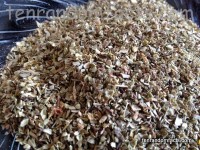
Oregano can flavour your food or restore your health.

  • Oregano is a herb, or the leaves, of a typically perennial plant that grows to be 20 to 80 centimetres (8 to 31.5 inches) in height.
  • Oregano has the scientific name of Origanum vulgare and is from the family Lamiaceae, the family of mint, that also includes many other common herbs.
  • ‘Oregano’ is also known as ‘wild marjoram’, although is not true marjoram, and it is native to the Mediterranean and parts of Asia.
  • Oregano is typically used as a fresh or dried herb, although its flavour can be quite overpowering when used fresh, so it is recommended that it be removed from the food after cooking, or use dried oregano instead.
  • Oregano has a fragrant flavour of warmness and slight bitterness.

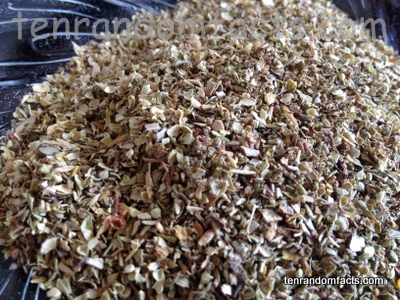
Oregano, Herb, Dried, leaves, lots, pile, black, Ten Random Facts, Food

  • Due to World War II, oregano became more popular in the United States, due to the soldiers returning, having experienced the flavour in Italy.
  • Oregano is typically eaten as a seasoning on meat, vegetables, pizza and other dishes, or included in sauces, tea or oils.
  • Oregano is a great source of vitamin K, a good source of iron, fibre, manganese and calcium, and very high in antioxidants.
  • Oregano is a leafy herb, and is green when used fresh, and when dried, the leaves are crushed and are a brown-green colour.
  • Oregano can be used to treat respiratory, nervous and digestive problems, often in the form of ointment or tea, and was historically used as an antiseptic.


Bibliography:
Oregano, 2014, The World’s Healthiest Foods, http://www.whfoods.com/genpage.php?tname=foodspice&dbid=73
Oregano, 2014, Wikipedia, http://en.wikipedia.org/wiki/Oregano

Amazon:    

Malabar Spinach

Malabar Spinach

Malabar spinach is not spinach at all.

  • Malabar spinach is eaten like a leafy vegetable, and is a perennial vine, although it is often grown as an annual in cooler climates as frost affects the plant.
  • ‘Malabar spinach’ is also known as ‘creeping spinach’,  ‘climbing spinach’, ‘Indian spinach’, ‘Chinese spinach’, ‘vine spinach’, ‘Vietnamese spinach’ and ‘Ceylon spinach’.
  • Malabar spinach has the scientific name of Basella alba, a white flowering, green stem variety, or Basella rubra, a plant that has red stems.
  • Malabar spinach is from the family Basellaceae, the family of some flowering plants including a number of other vines, with edible leaves and roots.
  • In a tropical environment, a Malabar spinach vine can grow up to a height of 10 metres (33 feet).

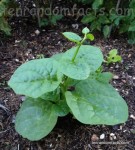
Malabar Spinach, Green, Glossy, Plant, Compost, Leaf, Vegetable, Food, Ten Random Facts

  • Malabar spinach has thick, green glossy leaves that can grow quite large, and berries that contain a red liquid that can be used as dye.
  • Malabar spinach leaves are commonly used in Asian cuisine, either cooked or raw, and they are said to have pepper and citrus flavours when raw, as well as being high in iron, calcium, vitamin C, vitamin A, fibre and other vitamins and minerals.
  • Malabar spinach, although named ‘spinach’, is not from the spinach family at all, although it tends to resemble spinach when it is cooked.
  • Malabar spinach is a great thickener for soup and other dishes, due to the mucilage (glutinous carbohydrate) content in the plant, that tends to cause the leaves to become slimy if they are cooked for more than a short time.
  • Malabar spinach grows best in a sunny area and warm climate, and is a great summer vegetable.
Bibliography:
Basella Alba, 2014, Wikipedia, http://en.wikipedia.org/wiki/Basella_alba
Malabar Spinach, 2013, Survival Food Plants, http://www.survivalfoodplants.com/malabar-indian-spinach-basella-alba/
Stunning (Malabar) Spinach, 2013, A Farm of Your Home, http://www.afarmofyourhome.com/stunning-malabar-spinach/

Amazon:     

Comb

Comb

A comb equals tidiness.

  • Combs are grooming tools with long, thin spokes called ‘teeth’, that are particularly used in hair styling.
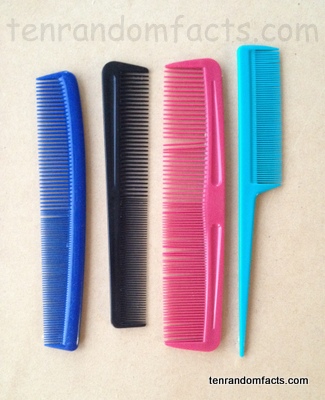
  • Combs are typically made of metal, plastic or wood and have numerous teeth evenly spaced apart, although many combs have half of the teeth spaced closely together, and the other half spaced in a more open arrangement.
  • Combs have been used for thousands of years, and the earliest known time is in Ancient Persia, 5000 years ago.
  • Combs are commonly used for styling, decorating, securing and separating hair or textile strands, and to neaten hair.
  • Combs can be used as a simple instrument, with the spokes able to produce a musical sound when picked.

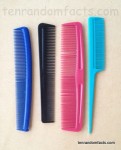
Comb, Pink, Black, Blue, Pale, Handle, Hairdresser, Ten Random Facts

  • Combs were originally made of wood, bone, ivory and shell, and later tin, silver and brass, and were commonly made as decorative hair accessories.
  • A comb with fine teeth can be used to catch or kill parasitic animals such as fleas or lice.
  • Combs come in many shapes, sizes and colour, but are commonly flat and rectangular.
  • Sharing combs can transfer infections, parasites or diseases from one’s head to another’s.
  • Combs are generally cheap items that are commonly purchased from grocery or department stores, and are sold singularly, or in packets of two or more.
Bibliography:
Comb, 2014, Wikipedia, http://en.wikipedia.org/wiki/Comb
History of Comb, n.d, Lifestyle Lounge, http://lifestyle.iloveindia.com/lounge/history-of-comb-7186.html
Jackson-Arnautu N, History of the Comb, n.d, EHow, http://www.ehow.com/about_4661215_history-comb.html

Amazon:     

Related Posts Plugin for WordPress, Blogger...