Taipei 101

Taipei 101

Taipei 101, a record holder.

  • Taipei 101 is a blue-green coloured skyscraper that was the tallest building in the world from 2004 to 2010.
  • ‘Taipei 101’ is also known as the ‘Taipei World Financial Center’ or ‘Taipei Financial Center’.
  • Taipei 101 is located in the city of Taipei, in east Asia’s Taiwan, and it cost US$1.76 billion to build.
  • When the building was finished, Taipei 101 was the tallest sundial in the world, it contained the largest and heaviest tuned mass damper sphere (like a pendulum to keep the building more stable), the largest countdown clock, and had the fastest elevator.
  • Taipei 101 is made to withstand severe typhoons and earthquakes, using its tuned mass damper sphere, 380 foundation piles rammed 80 metres (262 feet) into the earth, and other features.
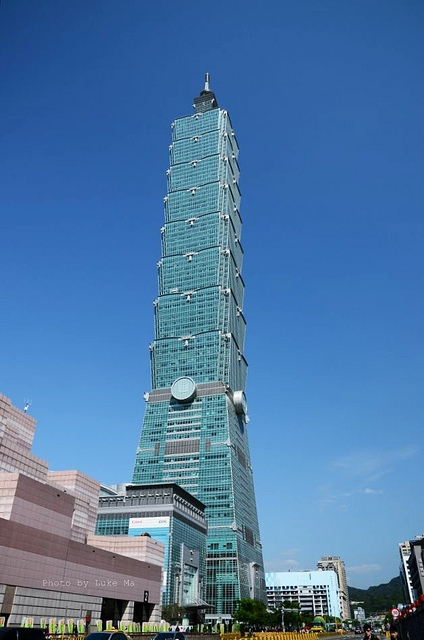
Taipei 101, Green, Tower, skyscraper, Taiwan, Financial center, World Record, asia, Ten Random Facts, Ground

Taipei 101
Image courtesy of Luke Ma/Flickr
  • Taipei 101 has 101 floors, symbolising a new century, the coming of new years, and perfection, and it contains 8 sections, referring to the symbolic Chinese number for prosperity.
  • Taipei 101 is the home to apartments, observatories, offices, meeting centres, a club and restaurants, and has an attached shopping mall.
  • Since its construction, Taipei 101 has been the home to New Years Eve firework displays each year, with the longest display lasting 288 seconds in 2010/2011, and in 2011/2012 it is said that 30,000 rocket fireworks were launched.
  • Taipei 101’s architect was the Chinese company, C.Y. Lee & Partners, and planning started in 1997, construction began in 1999/2000, and the building opened on New Years Eve, 2004.
  • Taipei 101 boasts a height of 509 metres (1,670 feet), surpassing the 1998 built Petronas Towers in Malaysia on completion, and being surpassed by Burj Khalifa in Dubai in 2010.
Bibliography: Clancy R, The Building of the Taipei 101 Skyscraper, 2009, Property Forum, http://www.propertyforum.com/emerging-property-markets/230-the-building-of-the-taipei-101-skyscraper.html
Taipei 101, 2014, Wikipedia, http://en.wikipedia.org/wiki/Taipei_101

Amazon:     

Alpaca

Alpaca

Not quite a llama…

  • Alpacas are grazing mammals native to South America, especially the Andes mountain regions, that have been domesticated and are not known of or found in the wild.
  • Alpacas have the scientific name of Vicugna pacos and come from the family Camelidae, the family of camels, and are related to llamas.
  • Alpacas are commonly kept in agricultural herds, particularly in South America, up to altitudes of 5000 metres (16000 feet), for fibre and meat.
  • Adult alpacas grow on average to be 81 to 100 centimetres (2.7 to 3.3 feet) from the shoulder in height and in total grow to be 1.2 to 2.2 metres (3.9 to 7.2 feet) and weigh 48 to 84 kilograms (106 to 185 pounds).
  • Alpacas spit the contents of their stomach and use their hooves to protect themselves against predators like coyotes, lions and bears, and they also spit at displeasing peers, as well as vocalise with hums, clicks, whines and clucks, and others.

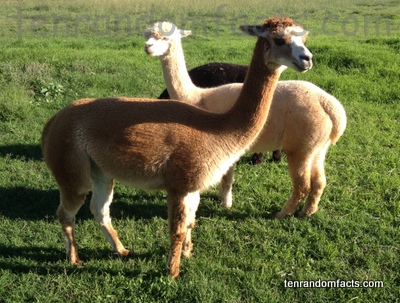
Alpaca, Brown, Black, White, Three, Graze, Shade, Grass, Green, Ten Random Facts, Animal, Domestic, Australia

  • Alpacas live in small herds and can live to be 20 to 25 years old.
  • Alpacas have a diet that mainly consists of grass, hay and some other foliage.
  • The fibre of alpacas is soft, warm, strong and silky, as well as hypoallergenic, and it is considered a high quality fibre that is typically used in textiles, for projects such as clothing or blankets.
  • Alpacas only require an acre (0.4 hectare) of land to support between six to ten of the animals, and they generally toilet in the one area, known as a communal dung pile.
  • Alpacas have around 22 official natural fibre colours, ranging from blacks, browns, whites and greys.


Bibliography:
Alpaca, 2014, Wikipedia, http://en.wikipedia.org/wiki/Alpaca
Alpaca Facts, n.d, Aragon Alpacas, http://www.aragonalpacas.com/alpaca_info.html

Amazon:      

Computer Mouse

Computer Mouse

Click, click, click-click, click; goes the computer mouse.

  • A computer mouse is a technology input device, generally used to move a pointer on a computer screen, although the technology is also used for some game consoles.
  • A computer mouse typically has two buttons, one on the left and one on the right, and a small wheel in the middle, known as a ‘scroll wheel’, and in some designs, it can also be pressed like a button, but it is generally used to scroll through information on a computer screen.
  • A computer mouse typically fits underneath one’s hand, with a finger on each of the left and right buttons, and was named so, because it originally resembled a mouse, with the cord as its tail.
  • The plural of computer mouse is ‘computer mice’, and ‘computer mouses’ is also an acceptable plural, often used by a person to distinguish it from the rodents.
  • Computer mice were invented by American Douglas Engelbart, an engineer, in the United States, in 1963, and were proven to be one of the most efficient cursor moving devices, although they were not commonly available for personal computer use until the early 1980s.

Computer mouse, blue, microsoft, logitech, wireless, wire, USB, Black, Silver, Ten Random Facts, Three

  • A computer mouse can perform actions via clicks of the buttons, with single and double clicks performing different actions depending on the button, and holding or moving the mouse with a button held activates different responses on the computer screen.
  • A computer mouse is typically connected to a device via cord, such as a USB, or wireless, often with a USB or serial receiver that plugs into the computer.
  • The outer layer of a computer mouse was originally made of wood, but are now typically made of plastic, and are found in all shapes, sizes and colours.
  • A computer mouse movement is measured in mickeys, as in ‘Mickey Mouse’,  which refers to the number of pixels the cursor has moved, compared to how many inches or centimetres the mouse has moved.
  • A modern computer mouse generally contains optical sensors like light-emitting diodes and photodiodes, and sometimes laser diodes, that track movement of the device.
Bibliography:
1963: Douglas Engelbart invents the Mouse, 2014, Berkley Engineering, http://coe.berkeley.edu/about/history-and-traditions/1963-douglas-engelbart.html
Mouse (computing), 2014, Wikipedia, http://en.wikipedia.org/wiki/Mouse_(computing)

Amazon:     

Coconut Cream

Coconut Cream

Coconut milk, coconut cream and cream of coconut – so many coconut extracts!

  • Coconut cream is an extract from coconut that is thick and creamy.
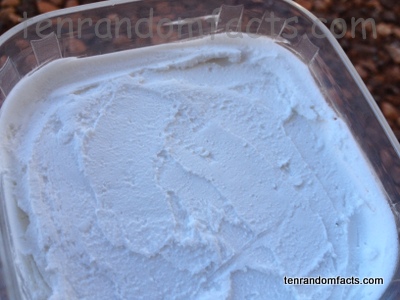
  • Coconut cream is commonly purchased as a thick liquid, however, if it is stored in a fridge, the cream will separate from the liquid, resulting in a more paste-like consistency, although it will become less solid if left at room temperature.
  • Coconut cream can be sweetened for use as a dessert or drink ingredient, and when sweetened it is known as ‘cream of coconut’.
  • Coconut cream is used in cooking, typically in Asian cuisine in main dishes like curry, in baked goods or to make ice cream, and is often used as a dairy substitute.
  • Coconut cream has a slightly sweet taste with the flavour of cream and coconut.

Coconut Cream, Thick, Container, Clear, White, Spread, Ten Random Facts, Food

  • Coconut cream is generally made from shredded coconut and water, although it sometimes contains thickeners and other additives.
  • Coconut cream is white in colour and can be whipped like dairy cream.
  • Coconut cream is typically bought in cartons or cans from supermarkets or Asian grocery stores.
  • Homemade coconut cream can be made by simmering a ratio of 1:4, of water to shredded coconut and then strained through a cloth.
  • Coconut cream is extremely high in manganese and fat, and is high in copper, phosphorus and iron.
Bibliography:
Coconut Cream, 2013, Wikipedia, http://en.wikipedia.org/wiki/Coconut_cream
Coconut Cream, 2014, Bon Appétit, http://www.bonappetit.com/test-kitchen/ingredients/article/coconut-cream

Amazon:     

Cyclamen

Cyclamen

Cyclamen… a hardy but beautiful plant.

  • Cyclamens are flowering perennial plants, that grow from tubers and are also called ‘sowbread’, as the tubers have been commonly eaten by wild pigs.
  • Cyclamens are native to parts of Europe, north Africa and west Asia.
  • Cyclamens were originally considered to belong to the family Primulaceae, the family of primroses, but are now considered to be part of the family Myrsinaceae, the family of myrsine.
  • Cyclamens develop flowers with five petals that point upwards, in various shades of white, red, pink or purple colours.
  • There are approximately 20 species of cyclamens, and they have different flowering seasons, depending on the species.

Cyclamen, Red, Green, Flower, Plant, Large, Fence, Decorative, Ten Random Facts, Australia

  • Cyclamens can be found in woody or rocky areas, and are generally hardy plants, although some species do not cope with frost.
  • Cyclamens prefer shady conditions and are popularly used as a decorative house or garden plant, and are often grown in pots.
  • Cyclamen leaves are are often heart shaped, and typically green with sometimes a red coloured underside, and the leaves usually have a distinctive pattern in a lighter colour.
  • Cyclamens grow to be 15 to 25 centimetres (6 to 10 inches) in height and the flowers usually sit above the leaves of the plant on thin stems.
  • Some cyclamens go dormant in summer and appear to be dead, however, they will generally re-sprout leaves in autumn.
Bibliography:
Cyclamen, 2014, Burke’s Backyard, http://www.burkesbackyard.com.au/factsheets/Flowering-Plants-and-Shrubs/Cyclamen/1296
Cyclamen, 2014, Wikipedia, http://en.wikipedia.org/wiki/Cyclamen
Perry L, Considering Cyclamen, n.d., University of Vermont Extension, http://perrysperennials.info/articles/cyclamen.html

Amazon:     

Barbecue Grill

Barbecue Grill

“Throw another shrimp on the barbie” – Paul Hogan

  • Barbecue grills are generally large appliances used for cooking food outdoors, with direct or indirect heat, depending on its design.
  • Barbecue grills’ are also known as ‘barbeques’, ‘barbeque grills’, ‘barbecues’, ‘BBQs’ and ‘barbies’.
  • Barbecue grills have a heating source generally derived from gas, electricity, charcoal or wood.
  • The word ‘barbecue’ is believed to be derived from the Caribbean Taíno word ‘barbacòa’ or ‘barbakoa’, meaning ‘framework of sticks’.
  • Barbecue grills can cook almost anything, but are generally used to cook vegetables and meat, and are common in America and are particularly popular in Australia.

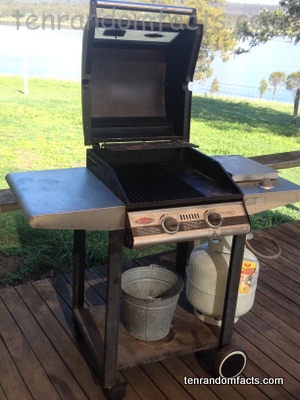
Barbeque Grill, Barbecue, BBQ, Rectangle, Gas, Black, Grey, Bench, Ten Random Facts, Cook, Food,

  • One of the first modern barbecue grills was invented by American George Stephan, a welder, in 1952, that used half a steel buoy attached to legs as the base, with a dome shaped lid, that famously became known as the ‘Weber’, or ‘Weber kettle’.
  • Barbecue grills typically have the shape of a rectangular prism, hemisphere or semicylinder, although they come in a variety of shapes, sizes and colours.
  • Gas barbecue grills were invented in the late 1950s or early 1960s, and usually use bottled gas, and have now become one of the commonly available barbecues.
  • Barbecue grills typically consist of a heat source and a cooking grill or plate and depending on the type of barbecue and its design, it may also have a heat shield, temperature controls, hood or cover, rotisserie, racks, thermometer, trolley, wheels, cabinet, and so on.
  • The largest barbeque grill made, was for the Discovery Channel in 2004, measuring 4.7 metres (15.3 feet) in height, 6.2 metres (20.2 feet) in length and 2.4 metres (8 feet) in depth.


Bibliography:
Barbecue Grill, 2014, Wikipedia, http://en.wikipedia.org/wiki/Barbecue_grill
Green A, A Brief History of the BBQ Grill, 2014, Popular Mechanics, http://www.popularmechanics.com/technology/gadgets/news/a-brief-history-of-the-bbq-grill-11000790

Amazon:     

Related Posts Plugin for WordPress, Blogger...