Mount Kilimanjaro

Mount Kilimanjaro

Mount Kilimanjaro… not for the faint and weary!

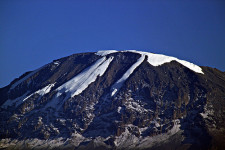
  • Mount Kilimanjaro is a volcano mountain with three volcanic peaks, Mawenzi, Shira and Kibo, and the first two are extinct, while Kibo is dormant, and is located in Kilimanjaro National Park in Tanzania, Africa.
  • At 5,895 metres (19,341 feet), Mount Kilimanjaro is the highest African mountain and highest mountain that is free-standing on earth, as well as one of the largest volcanoes.
  • The name ‘Kilimanjaro’ of ‘Mount Kilimanjaro’ is often regarded to mean ‘Mountain of Greatness’, although ‘Kilima’ means ‘hill’,  while it also could be called ‘Mountain of Caravans’ or ‘Mountain of Light’, and is often spelt incorrectly as ‘Mount Kilamanjaro’.
  • The summit of Mount Kilimanjaro was first climbed successfully by German Hans Meyer, a geologist, and Austrian Ludwig Purtscheller, a mountaineer, and their team in 1889.
  • Mount Kilimanjaro covers an area of around 388,000 hectares (958,000 acres), and its summit can be reached by 7 official paths, taking around 5 to 8 days.

Mount Kilimanjaro, kibo peak, Africa, second mountain, ice, snow, volcano, Ten Random Facts
Mount Kilimanjaro
Image courtesy of Pius Mahimbi/Flickr
  • It is said that 6 to 8 people die on Mount Kilimanjaro every year, often caused by heart attacks, hypothermia, or altitude sickness.
  • Mount Kilimanjaro is the native home of the giant groundsel plant, among other vegetation found on the mountain, and in the forest areas, although seen rarely, there are honey badgers, primates, leopards, bush pigs, rodents, birds and bugs.
  •  Mount Kilimanjaro’s peak was originally covered by a glacier, although over 80% has melted, and it is said that the ice will possibly disappear by 2022 to 2033.
  • Mount Kilimanjaro is visited by approximately 35,000 people every year, and while no special skills are necessary to climb the mountain, many thousands never reach the summit due to altitude sickness, not being properly equipped, and lack of fitness.
  • In 2010, Spanish 22 year old Kilian Jornet became the record holder for the fastest two way climb of Mount Kilimanjaro, and completed the round trip in 6 hours and 29 minutes.
Bibliography:
Background Information on Kilimanjaro, n.d, Climb Mount Kilimanjaro, http://www.climbmountkilimanjaro.com/kilimanjaro-conquered.html
Mount Kilimanjaro, 2014, Wikipedia, http://en.wikipedia.org/wiki/Mount_Kilimanjaro

Amazon:      

African Buffalo

African Buffalo

African buffalo are too unpredictable, so they have never been tamed.

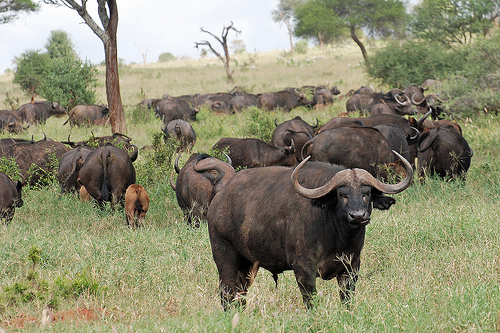
  • African buffalo are stocky mammals, that look similar to cattle, and are native to areas south of Africa’s Sahara Desert.
  • ‘African buffalo’ are also known as ‘Cape buffalo’, ‘Congo buffalo’, ‘savanna buffalo’, ‘widowmakers’ and ‘black deaths’, and are included in Africa’s ‘big five’ game animals that are the most dangerous and difficult animals to hunt, and are considered more dangerous than African lions, leopards and elephants, and black rhinoceros that make up the other ‘big five’.
  • African buffalo have the scientific name of Syncerus caffer, being the only species in the genus, and are from the family Bovidae, the family of cloven hoofed (split into two toes) ruminants with non branching horns.
  • African buffalo can grow up to 1.7 metres (5.6 feet) in height, up to 3.4 metres (11.2 feet) in length, and depending on habitat, have a weight of 250 to 900 kilograms (600 to 2000 pounds).
  • There are four or five subspecies of African buffalo, and they typically have brown, black, brown-red or, if juveniles, red fur colour.

African Buffalo, Herd, Bull, Calf, Brown, Ten Random Facts, Grassland, Africa, Cape Buffalo

African Buffalo
Image courtesy of Harvey Barrison/Flickr
  • The inward curving horns of African buffalo can grow up to 150 centimetres (5 feet) long, although forest buffalo, the smallest of the buffalo subspecies, have horns half that length, and on the male buffalo, the base of the horns extend across the head to form a shield, called a ‘boss’.
  • The African buffalo diet consists mainly of grass, and they live in marshlands, savannahs, mountains, plains, grasslands and forests, in herds of 50 to 500 animals in savannah areas, and under 20 in forests.
  • African buffalo are preyed on by lions, cheetahs, crocodiles, leopards hyenas, and humans, although they are only hunted by the experienced, as they are highly dangerous when threatened or attacked, and many people are killed each year by the buffalo.
  • African buffalo make sounds of grunts, growls and other deep cow sounds.
  • African buffalo typically have litters of one calf, and have a life span in the wild of around 20 years, although they can live up to 29 years.
Bibliography:
African buffalo, 2014, Wikipedia, http://en.wikipedia.org/wiki/African_buffalo
Quick Facts, 2013, Ultimate Ungulate, http://www.ultimateungulate.com/Artiodactyla/Syncerus_caffer.html

Amazon:      

Typewriter

Typewriter

Tap, tappety, tap-tappety tap.

  • Typewriters are machines that print carbon or ink characters on paper, requiring input from a person by pressing buttons, and are mechanically or electro-mechanically driven.
  • Most typewriters were replaced by word processors and computers by the late 1980s, although they are still in use in developing countries, as well as in prisons due to the ban of computers.
  • Typewriters were commonly used in offices and sometimes in homes, for the purpose of typing letters, documents, and other information.
  • The first typewriter ever invented was possibly by Englishman Henry Mill in 1714, for which he received a patent, and other early typewriters include inventions by Pelligino Turri, an Italian, in 1808 who also invented carbon paper, and William Austin Burt, an American who is most commonly credited for the invention of the typewriter, in 1829.
  • Fast typists can type around 100 words a minute on a manual typewriter, although records have been set for more than 150 words a minute.

Typewriter, Black, Old, QWERTY, Museum, Ten Random Facts, Invention

  • Typewriters generally require the manual insertion of a sheet of paper, and when the end of a page is reached, it is removed, and a new piece of paper is inserted into the machine.
  • Due to the permanency of the printing, typewriters would require a high level of typing accuracy, with competitions deducting points for inaccuracy, although mistakes could be erased with an abrasive hard rubber, or correction fluid, and various other means were also employed.
  • Thomas Edison invented the first electric style typewriter in 1870, which used an electrical input to type remotely, however the technology was not widely used until decades later.
  • The typically used English QWERTY keyboard layout on typewriters, known as the ‘Sholes’ or ‘Universal’ keyboard, were originally arranged by Sholes & Glidden typewriters in 1874, and are said to be laid out so that the most commonly used keys were separated to decrease the likelihood of jamming from fast typing.
  • The word ‘typewriter’ is generally considered the longest English word (10 letters), that only uses one row of the QWERTY keyboard layout, although a flower, ‘rupturewort’ can beat that record (11 letters).


Bibliography:
Typewriter, 2014, Wikipedia, <http://en.wikipedia.org/wiki/Typewriter>
Typewriters, 2014, Mary Bellis, http://inventors.about.com/od/tstartinventions/a/Typewriters.htm

Amazon:     

Pomegranate

Pomegranate

“Your cheeks are like halves of a pomegranate behind your veil.” Song of Solomon 4:3

  • Pomegranates are fruit that grow on small trees or shrubs that reach approximately 5 to 8 metres (16 to 26 feet) in height, and are native to the Middle East’s Iran.
  • Pomegranates have the scientific name Punica granatum, that are from the family Lythraceae, the family of flowering herbs, although they were originally classified as part of the Punicaceae family.
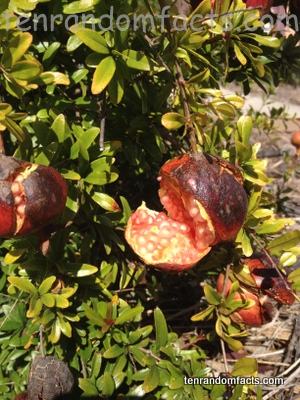
  • Pomegranates are large, red coloured, roughly spherical berries with diameters of around 5 to 12 centimetres (1.9 to 4.7 inches).
  • Pomegranates contain white membranes and edible red arils (commonly called seeds), that contain a sweet to sour juicy flesh and a seed; with approximately 200 to 1400 seeds in a single berry.
  • ‘Pomegranate’ comes from the words ‘pōmum grānātum’ in Medieval Latin, that mean ‘apple with many seeds’.

Pomegranate, Red, Open, Plant, Two, Arils, Ten Random Facts, Fruit

  • Pomegranate arils are easily accessed by scoring the fruit with a knife, breaking it open, and banging the fruit or placing the fruit in water, where the arils will separate from the membranes.
  • Pomegranates can be eaten raw, and are used in Middle Eastern cuisine as well as Greek dishes, and are made into beverages including alcohol or juice, or used as a flavouring.
  • Pomegranates are sometimes recognised as a symbol of fertility, prosperity and ambition, or in Greek mythology, death.
  • Pomegranates have been used in traditional medicine to treat digestive problems, as well as internal parasites.
  • Pomegranates are very high in vitamin K, vitamin C and fibre, and are high in folate, potassium, copper and manganese.
Bibliography:
The Fruit, 2008, Pomegranates 101, http://www.pomegranates.tv/information.html
Pomegranate, 2014, Wikipedia, http://en.wikipedia.org/wiki/Pomegranate

Amazon:     

Maidenhair Fern

Maidenhair Fern

Keep up the water to your maidenhair ferns.

  • Maidenhair ferns are a group of ferns of which there are approximately 200 species.
  • Maidenhair ferns are from the family Pteridaceae, the family of ferns, and has the scientific name Adiantum.
  • Maidenhair ferns have soft textures and lacy appearances, although textures and appearance vary among the species.
  • Maidenhair ferns are generally green in colour with black or brown leaf stems, although the colours of the leaves can be variegated.
  • Maidenhair ferns are deciduous, grow from rhizomes, and reach up to 1 metre (3 feet) in height.

Maidenhair Fern, Green, Plant, Vegetation, Genus, Adiantum, Ten Random Facts, Australia

  • Maidenhair ferns are typically used as an ornamental plant, both indoors and outdoors, and are often grown in pots, terrariums and hanging baskets.
  • Maidenhair ferns prefer a shady position in the garden, and if kept inside, then need to be grown in a well lit area.
  • ‘Adiantum’, the scientific name of maidenhair ferns, is from the Greek word ‘adiantos’, meaning ‘unwettable’, referring to the foliage of the plant that repels water.
  • Maidenhair ferns dry out quickly if not watered, but can be resurrected by cutting off dead branches and keeping the soil moist, and are not technically dead until green growth has not been seen for 18 months.
  • Maidenhair ferns are native to all continents except Antarctica, and grow best in moist habitats, particularly among rocks or near water features.
Bibliography:
Adiantum, 2013, Wikipedia, http://en.wikipedia.org/wiki/Adiantum
Maidenhair Fern, 2006, Burke’s Backyard, http://www.burkesbackyard.com.au/factsheets/Indoor-and-Potted-Plant/Maidenhair-Fern/2156

Amazon:      

Binder Clip

Binder Clip

Binder clips are binding necessities.

  • Binder clips are small stationery items that can grip onto other objects or hold objects together, typically paper, and can be easily removed.
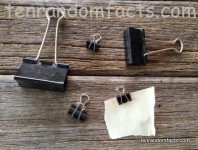
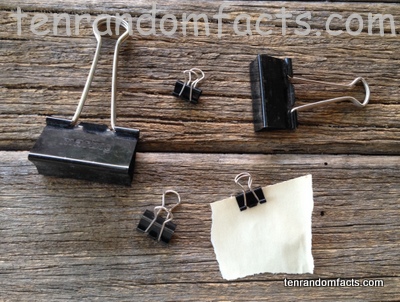
  • A binder clip’s body is generally a triangular prism shape made of spring steel, with attached metal wire loops that are used as handles for opening and closing the body.
  • Binder clips typically range from 0.5 to 5 centimetres (0.2 to 2 inches) in body size.
  • Binder clips are typically used for temporarily grouping many sheets of paper together, but they can also be used as bookmarks, money clips, and holding objects in place, among others.
  • It is believed that binder clips were originally invented by American Louis E Baltzley, for his father who was a writer, in USA’s Washington D.C. in 1910, and he received a patent for the invention in 1915.

binder Clip, black, large, small, assorted, Bulldog, Ten Random Facts, Stationary

  • Binder clips’ bodies are typically black in colour, but can range in colours and styles, and can include coloured patterns.
  • The original 1910 clip design is very similar to the one used today, and it is said that the first company to manufacture binder clips were the L.E.B Manufacturing Company.
  • ‘Binder clips’ are also known as ‘banker’s clips’, ‘foldback clips’, ‘foldover clips’, ‘bulldog clips’ and ‘handbag clips’.
  • Binder clip handles typically can face upwards or downwards, or they can be removed to make the clip more permanent.
  • Binder clips are often used as a paperclip alternative as they have a better grip and are rust resistant, and with one handle up, the clip can hang papers from a hook.


Bibliography:
Binder Clip, 2014, Wikipedia, http://en.wikipedia.org/wiki/Binder_clip
Pash A, Our Favourite Office Objects: The Endlessly Versatile Binder Clip, 2010, Life Hacker, http://www.lifehacker.com.au/2010/09/our-favourite-office-objects-the-endlessly-versatile-binder-clip/

Amazon:      

Related Posts Plugin for WordPress, Blogger...