Feathertop Grass

Feathertop Grass

Tickle, tickle. Feathertop grass can tickle.

  • Feathertop grass is perennial grass native to northern Africa and part of the Middle East.
  • Feathertop grass has the scientific name of Pennisetum villosum.
  • Feathertop grass is from the family Poaceae, the family of true grasses, and the family is also referred to as the Gramineae family.
  • ‘Feathertop grass’ is also known as ‘feathertop’, ‘long-style feather grass’, ‘white foxtail’ and ‘purple squirrel tail grass’.
  • Feathertop grass grows to be 15 to 70 centimetres (6 to 27.5 inches) tall, and has thin green leaves.
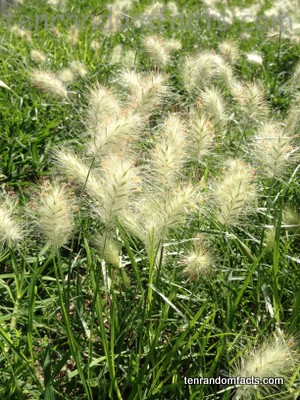
Feathertop grass, white, clumps, invasive, Ten Random Facts, Australia

  • Feathertop grasses have soft looking feathery flower spikes that are white to green coloured, and sometimes have a touch of purple, that turn a creamy yellow or white colour when they age.
  • Feathertop grasses are classified as weeds in some countries and states, including states of Australia, and can often be seen growing en masse in fields or paddocks, along the roadside and in other areas.
  • Feathertop grasses bloom mainly in summer, although the flower spikes can also be seen in spring and autumn.
  • Feathertop grasses grow from rhizomes and spread via underground root systems, cuttings, and seed dispersal through water and waste systems and wind, among others.
  • Feathertop grass is grown as a decorative plant in non-invasive areas, and prefer sunny conditions and warm climates.
Bibliography:
Feathertop, 2011 Weeds of Australia, http://keyserver.lucidcentral.org/weeds/data/03030800-0b07-490a-8d04-0605030c0f01/media/Html/Pennisetum_villosum.htm
Pennisetum villosum, 2013, Wikipedia, http://en.wikipedia.org/wiki/Pennisetum_villosum

Amazon:      

Great Barrier Reef

Great Barrier Reef

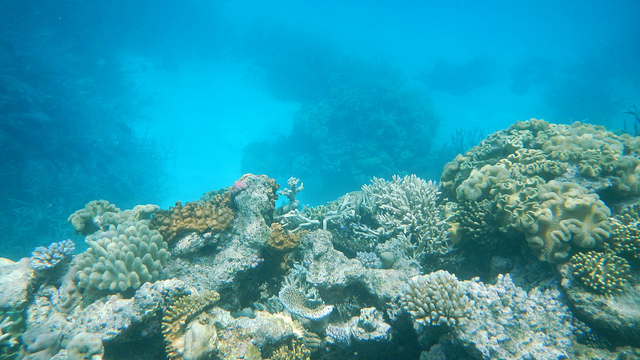
The Great Barrier Reef – a place bursting with life and colour.

  • The Great Barrier Reef is a coral reef located along the coast of Australia’s Queensland, in the Coral Sea.
  • The Great Barrier Reef covers an area of 344,400 square kilometres (133,000 square miles) and spans a distance of 2300 kilometres (1400 miles).
  • The Great Barrier Reef is the home to approximately 3000 separate coral reefs and approximately 900 islands and cays (an island made of sand and coral deposits), some of which contain resorts for tourists.
  • The Great Barrier Reef is the largest coral reef, as well as the largest biological built structure on earth.
  • The Great Barrier Reef is the home to numerous marine species, including approximately 600 coral species, 30 dolphin and whale species, 500 worm species, 133 ray and shark species, 3000 mollusc species, 1625 fish species and 100 jellyfish species, as well as crocodiles, dugongs, marine turtles and sea snakes.
Agincourt Reef, Great Barrier Reef, Australia, Coral, Blue, Scene, Ten Random Facts, SmallPart of the Great Barrier Reef
Image courtesy of Family MWR/Flickr
  • Since 1985, it is believed that half of the coral in the Great Barrier Reef has been destroyed, and it is said that climate change, over-fishing, pollution, tourism, diseases and shipping mishaps continue to cause damage.
  • The Great Barrier Reef is of significant importance to numerous tribes of indigenous Australians and Torres Strait Islanders who have lived in the area for thousands of years.
  • The Great Barrier Reef is visited by approximately 2 million people annually, with an estimated tourism value of $6.4 billion.
  • The Great Barrier Reef became a UNESCO World Heritage Site in 1981, and has been part of the Great Barrier Reef Marine Park ever since it was established in 1975.
  • Visitors to the Great Barrier Reef commonly engage in activities like snorkelling, sailing, fishing and scuba diving, and other activities include viewing the reef through glass bottomed boats, whale watching and scenic tours.
Bibliography:
About the Reef, 2014, Australian Government Great Barrier Reef Marine Park Authority, http://www.gbrmpa.gov.au/about-the-reef
Great Barrier Reef2014, Trishan’s Oz, http://panique.com.au/trishansoz/barrier/great-barrier-reef.html
Great Barrier Reef, 2014, Wikipedia, http://en.wikipedia.org/wiki/Great_Barrier_Reef

Amazon:      

Passionfruit

Passionfruit

What is a fruit with passion? A passionfruit!

  • Passionfruit are fruit that grow up to 4 to 7.5 centimetres (1.5 to 3 inches) in diameter, and are native to South America.
  • ‘Passionfruit’ are also known as ‘passion fruit’, ‘granadilla’ and ‘purple granadilla’, and some of the varieties are ‘purple’, ‘yellow’, ‘panama’ and ‘banana’.
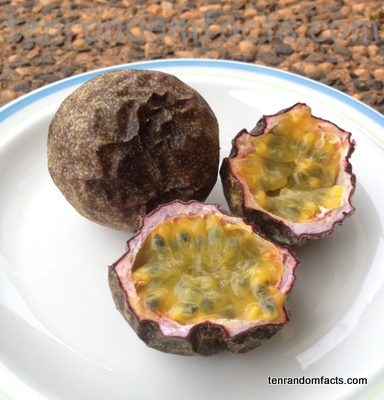
  • Passionfruit is roughly spherical or ovoid in shape, with skin coloured purple, pink or yellow when ripe, that is either smooth, or slightly wrinkled.
  • Passionfruit have yellow to orange pulp containing juice and many black edible seeds, and they generally have sweet flavoured juice and tart flavoured seeds.
  • Passionfruit can be eaten raw, added to fruit salad, used as a dessert topping and flavouring, made into a variety of beverages and used as a flavouring in icing or cream for baked goods.

Passionfruit, Halve, Whole, Yellow, Pulp, Black, Ten Random Facts, Australia

  • Passionfruit grow on vines that have the scientific name of Passiflora edulis and are from the family Passifloraceae, a family of approximately 530 flowering plant species.
  • Passionfruit are often found in home gardens grown on fences or trellises, and are commercially grown in warm climates that are frost free.
  • Passionfruit, before ripening, have softer, green coloured skin, and when ripe, it is best to choose heavy fruit as they will contain more pulp and seeds.
  • ‘Passionfruit’ were named by Spanish missionaries in South America as the flowers were interpreted to symbolise ‘Christ’s passion (suffering) on the cross’.
  • Passionfruit are very high in vitamin C, vitamin A and dietary fibre, and also contain iron, potassium and other vitamins and minerals.


Bibliography:
Passiflora edulis, 2014, Wikipedia, http://en.wikipedia.org/wiki/Passiflora_edulis
Passionfruit, 2011, Fresh for Kids, http://www.freshforkids.com.au/fruit_pages/passionfruit/passionfruit.html
Passionfruit, 2014, Purdue Agriculture, https://www.hort.purdue.edu/newcrop/morton/passionfruit.html

Amazon:      

Stencil

Stencil

Versatile stencils!

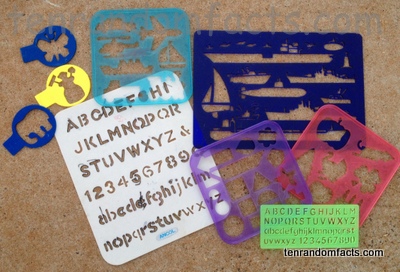
  • Stencils are art, craft or stationery items used to imprint designs on a surface with the use of paint or other medium, and are generally made from plastic, paper or metal sheets, although other materials can be used.
  • Stencils are typically reusable, as long as they can be removed from surfaces and don’t break.
  • Stencil designs often have an inner section to the design, called an ‘island’, that will be a loose piece, unless attached by a small portion of stencil material, known as a ‘bridge’.
  • Stencils are an ancient innovation, and hands or other objects were painted over in cave paintings thousands of years ago.
  • Home-use stencils are common, often used for neat painting and decorating features on walls or furniture, and are commonly used in craft related hobbies for embossing, painting and decorating, or lettering.

Stencil, Lettering, Used, White, Blue, Vehicles, Red, Green, Single, Lots, Template, Ten Random Facts

  • Stencils are used by government, business and military organisations, often to letter objects, signs or vehicles.
  • Stencils for children are commonly available, which enables them to draw basic or more detailed shapes or letters, and gives them the opportunity to be creative by filling in more details, or colouring the shape.
  • Stencils were historically used by Eskimos and Ancient Egyptians, Romans, Chinese, Greeks and Japanese, while some of the materials used were cloth, leaves and animal skin.
  • Throughout history, stencils were commonly used for mass production, for clothing, religious art and wall designs among others.
  • Today, stencils are often used professionally by artists especially for screen printing and airbrushing, and some graffiti artists use them for their unique and ‘political’ look.


Bibliography:
Gilbert M, The History of Stencilling, 2014, EHow, http://www.ehow.com/about_5380158_history-stenciling.html
History of Stencilling, 2011, Royal Design Studio Stencils, http://www.royaldesignstudio.com/blogs/how-to-stencil/3763542-history-of-stenciling
Stencil, 2014, Wikipedia, http://en.wikipedia.org/wiki/Stencil

Amazon:      

Spotted Hyena

Spotted Hyena

“Cackle, cackle,” laughs the spotted hyena.

  • Spotted hyenas are mammals native to areas south of the Sahara Desert in Africa, and are found in woodland, desert and savannah habitats.
  • ‘Spotted hyenas’ are also known as ‘laughing hyenas’, and have the scientific classification of Crocuta crocuta and are from the family Hyaenidae, the family of hyenas.
  • Spotted hyenas grow to be 86 to 150 centimetres (34 to 59 inches) in length and weigh around 40.5 to 86 kilograms (89 to 190 pounds), and can run at speeds of 60 km per hour (37 miles per hour).
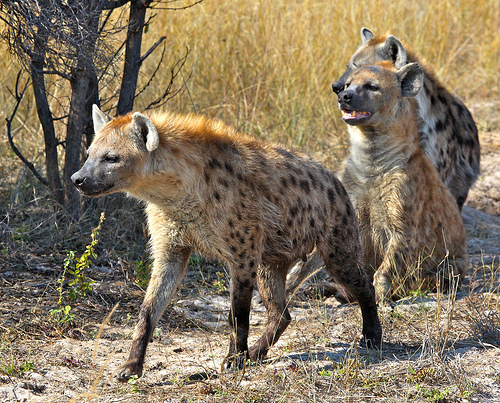
  • Spotted hyenas have short manes and fur coats of grey-brown to yellow-grey in colour, spotted with darker coloured spots.
  • Spotted hyenas can live up to 25 years in the wild, and females typically have litters of two cubs, sometimes three, and the cubs are born eyes opened and may attack fellow cubs at birth.

Spotted Hyena, Black, Hunt, Multiple, Three, brown, Africa, Ten Random Facts

Spotted Hyenas
Image courtesy of Steve Jurvetson/Flickr
  • Spotted hyenas live in clans of up to 80, living in dens often made by other animals and later deserted, and commonly with multiple adults and their cubs in a single den.
  • A spotted hyena’s diet mostly consists of animals of all shapes and sizes, and they are typically hunters, although they may occasionally scavenge, often hunting in small to medium sized groups.
  • Spotted hyenas typically compete for food with lions, with lions sometimes stealing their hunted food, and they may attack humans, out of threat or desperateness, but it is not common.
  • Spotted hyenas vocalise with sound including laughing, grunts, whines, squeals and whoops, among others.
  • Spotted hyenas generally consume all parts of an animal, including bones, horns, hooves, teeth, skin and fur, most of which is broken down by their internal organs.
Bibliography:
Spotted Hyena, 2014, National Geographic, http://animals.nationalgeographic.com.au/animals/mammals/hyena/
Spotted Hyena, 2014, Wikipedia, http://en.wikipedia.org/wiki/Spotted_hyena

Amazon:      

Hibiscus

Hibiscus

The hibiscus genus.

  • Hibiscus are perennial and annual flowering small trees and shrubs of the same-named genus, of which there are approximately 300 different species.
  • Hibiscus are from the family Malvaceae, the family of mallows, and they generally have glossy green leaves, and a distinct long stamen.
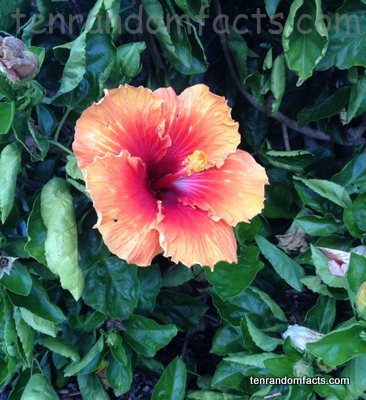
  • Hibiscus often have brightly coloured flowers that are sometimes variegated and can have double petals, in colours of pink, purple, white, yellow, orange and/or red.
  • Hibiscus flowers have at least 5 petals forming a trumpet, and spread 4 to 18 centimetres (1.5 to 7 inches) in diameter.
  • The word ‘hibiscus’ comes from ‘hibískos’, a Greek word named for the plant, and they are also known as ‘rose mallows’, with different species having other common names.

Hibiscus, flower, red, australia, orange, Decorative, Single, Ten Random Facts

  • Hibiscus plants grow to be around 1.5 to 3 metres (5 to 10 feet) in height, although there are some species that grow taller than this, and they are commonly used for ornamental or landscaping purposes in gardens.
  • Hibiscus flowers are commonly dried and can be made into tea, cold drinks, used as food colouring, added to salads, or be cooked and eaten, typically in Mexican cuisine.
  • Hibiscus are native to mainly warm areas around the world, with different species being native to specific areas, including Asia, Australia and the Pacific islands.
  • Hibiscus is the recognised national flower of Malaysia, South Korea and the Republic of Haiti.
  • Hibiscus can be made into shampoo and has been used medicinally, notably for lowering blood pressure.
Bibliography:
Hibiscus, 2002, Burke’s Backyard, http://www.burkesbackyard.com.au/factsheets/Flowering-Plants-and-Shrubs/Hibiscus/107
Hibiscus, 2014, Wikipedia, http://en.wikipedia.org/wiki/Hibiscus

Amazon:     

Related Posts Plugin for WordPress, Blogger...