Red Panda

Red Panda

These facts shed some light on the mysterious red panda.

  • Red pandas are mammals that generally live alone in trees of forest habitats in Asia, particularly south-west China and eastern Himalayas.
  • ‘Red pandas’ are also known as ‘red cat-bears’ and ‘lesser pandas’, and they are a red-brown colour, with dark legs, ringed tails and white faces.
  • There are two subspecies of red panda, and the animal’s scientific name is Ailurus fulgens, from the family Ailuridae, and it is the only living member of the family.
  • The diet of red pandas mainly consists of bamboo, as well as other vegetation, eggs, insects, small birds and small mammals.
  •  Red pandas grow to be 50 to 65 centimetres (20 to 26 inches) in length and range from 3 to 9 kilograms (6.6 to 20 pounds) in weight.
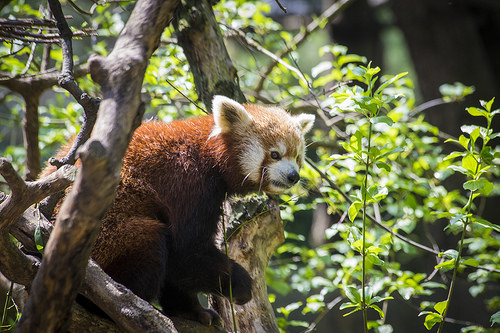
Red Panda, Zoo, New York, Ten Random Facts, Animal, Mammal, Cute
Red Panda
Image courtesy of Davejoe/Flickr
  • Red pandas generally sleep during the day, and are active during dawn and dusk periods as well as during the night.
  • Female red pandas make nests for their young in tree hollows or crevices using vegetation, and later give birth to one to four cubs.
  • Red pandas can live up to 15 years of age, although they generally live 8 to 10 years, and they are preyed upon by snow leopards and martens.
  • Red pandas are threatened by loss of habitat by deforestation and poaching for their fur coat, while some are kept as pets.
  • Two red pandas escaped from two different zoos, one in England, in Europe in 2005, and another in the United States of America’s Washington DC in 2013, although they were both recaptured.
Bibliography:
Red panda, 2014, National Geographic, http://animals.nationalgeographic.com.au/animals/mammals/red-panda/
Red panda, 2014, Wikipedia, http://en.wikipedia.org/wiki/Red_panda

Amazon:      

Nutcracker

Nutcrackers have many uses: nut cracking, displaying, starring in ballets…

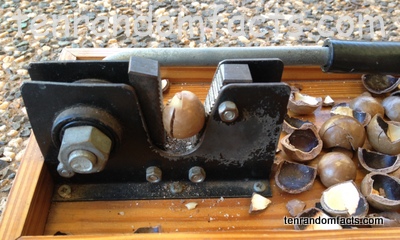
  • Nutcrackers are items used to break nut shells to access the nut, using combined mechanical and human power.
  • A nutcracker in ancient times was a partially hollowed stone that held the nut, and another stone was used to crack the nut shell.
  • The oldest nutcracker known to the world and made from metal, was found in the Taranto area in Italy, Europe, and dates back to 300 to 200 BC.
  • Modern nutcrackers are generally similar to pliers, except the ends near the nut are pivoted, causing a different lever action, and they are typically made of metal or wood, but ivory, china, bone, silver, and brass have been used.
  • From the 1400s, nutcrackers were very decorative, resembling a person or fictional character, and were commonly made in France and England.

Nutcracker, Old, Black, Macadamias, Ten Random Facts, Invention, Culinary, Food, Tool

  • Nutcracker figurines today are used more often ornamentally, notably during the Christmas season, and for this reason they are becoming a Christmas symbol.
  • The nutcracker has been depicted in the famous book and ballet of the same name, and the English term was in use as early as 1481.
  • Some nutcrackers have a screw type mechanism which is wound down on to the nut to force the shell to crack, and these can be useful to crack very hard shelled nuts like macadamia nuts.
  • In the early years of German nutcrackers, the crackers were believed to be protectors based on their appearance and stature.
  • Decorative nutcrackers are popular items to be collected, particularly those from the remote mountainous region of Sonneberg, in Thuringia, Germany.

Bibliography:

History of Nutcrackers, 2014, Leavenworth Nutcracker Museum, http://www.nutcrackermuseum.com/history.htm
Nutcracker, 2014, Wikipedia, http://en.wikipedia.org/wiki/Nutcracker

Amazon:     

Baked Beans

Baked Beans

Do you delight in baked beans?

  • Baked beans are a culinary dish that includes both stewed, or less commonly baked, beans and a sauce.
  • Baked beans are most commonly made of white navy or haricot beans, that are one of the many varieties of Phaseolus vulgaris, which includes common beans, and others.
  • Baked beans are a popular quick-preparation meal, and for this reason, are often eaten at camps or rural areas.
  • Baked beans are commonly eaten for breakfast, along with other meals, and are popular with toast, chips, pork or waffles, among others.
  • Baked beans were canned and sold as early as 1861 in the United States, and they often contained pork and molasses, and of all convenience foods to become popular in the Western world, beans were among the first.

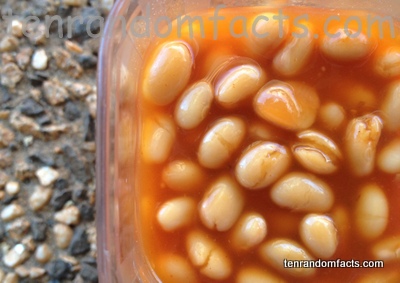
Baked Beans, Red, White, Sauce,Container, Ten Random Facts, Food, Convenience,

  • Baked beans have a savoury-sweet taste, and are typically coloured red, orange or brown, and they are typically sweetened by sugar, molasses or maple syrup, and the sweetener varies by country.
  • Traditionally, baked bean products have been high in salt and sugar, although some producers have lowered the quantities to make a healthier product.
  • Baked beans are very high in fibre, and are high in phosphorus, magnesium, zinc, thiamine, copper and protein, and they contain significant quantites of other vitamins and minerals.
  • Baked beans are sometimes homemade, although they are commonly sold commercially in a can, and a notable manufacturer is Heinz.
  • Baked beans originated as a mixture of British and, particularly, American bean dishes, with the notable Boston variety.
Bibliography: Baked Beans, 2014, Wikipedia, http://en.wikipedia.org/wiki/Baked_beans
O Thring, 2011, Consider Baked Beans, http://www.theguardian.com/lifeandstyle/wordofmouth/2011/feb/22/consider-baked-beans

Amazon:      

Papaya

Papaya

No fruit salad is complete without papayas!

  • Papayas are fruit that grow on plants native to the American tropics, with the ‘trees’ that they grow being as tall as 5 to 10 metres (16 to 33 feet).
  • A ‘papaya’ is also known as a ‘pawpaw’ and a ‘papaw’.
  • Papayas come from a plant that has the scientific name Carica papaya and are from the family Caricaceae, a family of small trees and shrubs.
  • The largest producers of papayas in the 2008 to 2010 period, was India, producing approximately 38.6% of the world production.
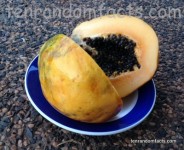
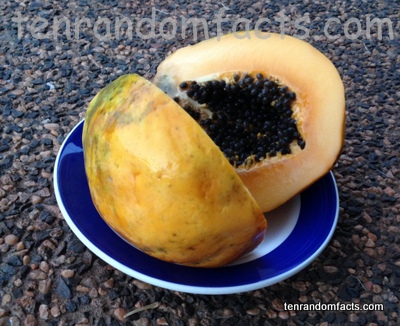
  • Papayas commonly have green coloured skin that turns yellow or orange when ripe, and the flesh is either yellow, orange or red, depending on the species.

Papaya, Yellow, Fruit, Black, Half, Australia, Ten Random Facts

  • Papayas have soft and sweet musky flavoured flesh and are popularly eaten raw or cooked, in salads, curries or soups, and the black seeds can be used as black pepper replacements.
  • Papayas, when unripe, contain latex, which can cause allergic reactions and possibly miscarriages.
  • Papayas can grow up to 51 centimetres (20 inches) in length and are generally pear or round shaped.
  • Papayas are very high in vitamin C, and are high in folate, vitamin A and dietary fibre.
  • Papaya has been used in traditional medicine and in some hair products, and is commonly made into ointment for the treatment of cuts, rashes, burns and other skin conditions.


Bibliography:
Papaya, 2014, Wikipedia, http://en.wikipedia.org/wiki/Papaya
Papaya, 2014, The World’s Healthiest Foods, http://www.whfoods.com/genpage.php?tname=foodspice&dbid=47

Amazon:     

Silo

Silo

While silos may be dangerous, these facts are not.

  • A silo is a large storage facility used to store and/or ferment large volumes of loose materials, often in the agricultural industry, and they are most commonly used to store grain, wood chips, food products, cement, coal and sawdust.
  • ‘Silo’ comes from the word ‘siros’, a Greek word, meaning ‘a pit to keep corn in’, and there are three modern types of silos, called ‘bunker’, ‘tower’ and ‘bag’, that store materials below ground, above ground, and in small quantities respectively.
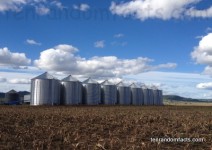
  • Tower silos are shaped as a cylinder, and are typically made of materials of wood, concrete and/or steel and are unloaded by slides or grain elevators.
  • Bag silos are typically strong plastic bags that are long and laid on the ground and are significantly cheaper and less dangerous than a tower or bunker model.
  • Bunker silos are trenches or pits in the ground, sometimes with concrete walls, that are filled with the material to be stored, and then covered in durable plastic that is often held down with weights.

Tower Silo, Steel, Row, store, 8, Farm, Ten Random Facts, Australia

  • Tower silos are approximately 10 to 84 metres (30 to 275 feet) in height and 4 to 30 metres (10 to 90 feet) in diameter, while bags are around 2.4 to 3.7 metres (8 to 12 feet) in diameter and can reach lengths of 30 to 91 metres (100 to 300 feet).
  • There is evidence of bulk storage buildings, or silos, being used in Ancient cultures, including Greece and Israel.
  • Tower silos typically have ventilation to replace the toxic methane gas produced by fermenting materials.
  • American Fred Hatch, the son of a farmer, and his father Lewis Hatch are commonly believed to have invented the first modern tower silo in 1873, in the McHenry County of the United State’s Illinois, that quickly became popular throughout the United States.
  • Silos are highly dangerous, and people are killed annually, due to poisoning, suffocation or crushing due to gases and grain or machinery collapsing, with an average of 16 people each year in the United States, dying from grain entrapment.


Bibliography:
Silo, 2014, Wikipedia, http://en.wikipedia.org/wiki/Silo
What is a Grain Silo?, 2014, WiseGEEK, http://www.wisegeek.org/what-is-a-grain-silo.htm

Amazon:      

Snowshoe Hare

Snowshoe Hare

Snowshoe hares do have ‘snow shoes’.

  • Snowshoe hares are mostly nocturnal mammals native to forestry areas of northern parts of North America.
  • ‘Snowshoe hares’ are also known as ‘snowshoe rabbits’ and ‘varying hares’ and have smaller ears than most other hares.
  • The snowshoe hare’s scientific name is Lepus americanus and it comes from the family Leporidae, the family of rabbits and hares.
  • The name ‘snowshoe hare’ comes from the animal’s very large and furry back feet that allows the hare to move across snow more easily, and they can reach up to speeds of 43.5 km/hr (27 miles per hour).
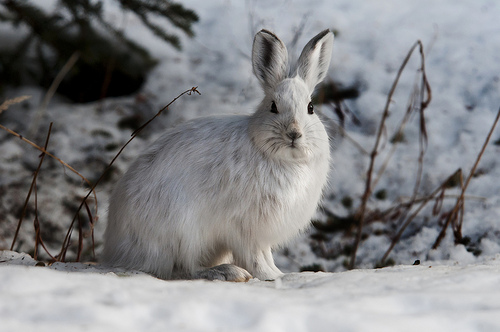
  • Snowshoe hares have brown coloured fur during summer, that changes to white in winter, with the change occurring over a 10 week period.

Snowshoe hare, winter, alert, single, one, coat, Ten Random Facts

Snowshoe hare during winter
Image courtesy of Denali National Park and Preserve/Flickr
  • A snowshoe hare’s diet mainly consists of vegetation, with leaves and grass eaten during summer and bark, twigs and buds eaten during winter.
  • Snowshoe hares generally have litters of 2 to 4 young, known as leverets, up to 4 times a year.
  • Snowshoe hares are preyed on by dogs, cats, large birds, lynxes, foxes and weasels, among others.
  • Snowshoe hares grow to be 41 to 52 centimetres (16 to 20 inches) in length and range from 0.9 to 1.8 kilograms (2 to 4 pounds) in weight.
  • Snowshoe hares have a relatively short lifespan, typically a year, due to being a main food source for a number of predators, but they can grow to be 5 years old.
Bibliography:
Shefferly N, Lepus americanus, 2007, Animal Diversity Web, http://animaldiversity.ummz.umich.edu/accounts/Lepus_americanus/
Snowshoe hare, 2014, National Geographic, http://animals.nationalgeographic.com.au/animals/mammals/snowshoe-hare/
Snowshoe hare, 2014, Wikipedia, http://en.wikipedia.org/wiki/Snowshoe_hare

Amazon:      

Related Posts Plugin for WordPress, Blogger...