Monument Valley

Monument Valley

Monument Valley is a symbol of the American Wild West.

  • Monument Valley is an area that contains a group of tall cliff like individual formations, known as ‘buttes’ and ‘towers’, made of sandstone, found in the Colorado Plateau, in the south western area of the United States of America, on the border of Arizona and Utah.
  • Monument Valley includes the valley’s Navajo Tribal Park that covers an area of approximately 37,110 hectares (91,700 acres), and is part of the Navajo Nation territory.
  • Monument Valley has been home to the native American Navajo people for hundreds of years, and rock engravings, as well as other cultural points of interest, can be seen with a tourist guide.
  • Monument Valley’s buttes reach heights of up to 300 metres (1000 feet) and are coloured red or blue-grey due to the different oxides they contain.
  • The Najavo name for Monument Valley is ‘Tsé Biiʼ Ndzisgaii’ and means ‘valley of the rocks’.
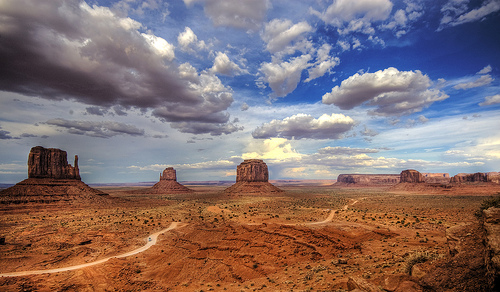
Monument Valley, America, Arizona, Utah, Rocks, Sandstone, Road, Ten Random Facts, Flickr, Formation, Landscape

Part of Monument Valley
Image courtesy of Wolfgang Staudt/Flickr
  • Parts of Monument Valley were mined from 1948 to 1967, mainly for large quantities of uranium, and it has caused significant controversy due to the radiation and contamination hazard it has left in some areas.
  • Monument Valley temperatures range from -18°C to 38°C (0°F to 100°F) with desert like conditions, and sometimes it snows.
  • Monument Valley is popularly used in media due to its prominent symbol of the Wild West, and numerous films have featured the valley and monuments, as well as artwork, music media, television, video games, advertising and print media.
  • Monument Valley’s buttes were most likely formed by large rock erosions and volcanic activity.
  • Monument Valley is a popular tourist destination and is easily accessible via car, accessed by the US Highway 163, and guided tours are available for a fee.
Bibliography:
Phillips C & C, History/Geology/Culture, Monument Valley, http://www.monumentvalley.com/Pages/english_infopage.html
Monument Valley, 2014, Wikipedia, http://en.wikipedia.org/wiki/Monument_Valley

Amazon:     

Nonpareils

Nonpareils

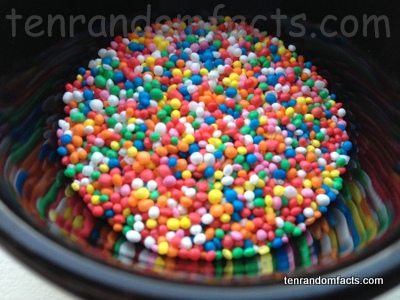
Nonpareils are not just decorative, but fun too!

  • Nonpareils are edible, ornamental items used typically on confectionery and sweet food items, and are popular on desserts and children’s party foods, such as buttered bread or cupcakes.
  • ‘Nonpareils’ are also known as ‘sprinkles’, ‘hundreds and thousands’ and ‘100s & 1000s’, particularly in Australia, New Zealand and the United Kingdom.
  • Nonpareils are very small, spherical in shape, and coloured brightly in numerous colours.
  • ‘Nonpareils’ sometimes describes confectionery items, like chocolate discs, or ‘freckles’, that are covered with hundreds and thousands.
  • Nonpareils originated as early as the 1690s, and are used in a recipe from the United States in the early 1700s, for the purpose of decorating a wedding cake.

Nonpareils, Hundreds and Thousands, 100s & 1000s, Sprinkles, Gluten Free, Colourful, Color, Assortment, Many, Reflection, Ten Random Facts, Food, Confectionery, Decoration

  • Nonpareils are generally made from sugar, starch and colour, and are difficult to replicate in household kitchens, requiring much skill and equipment.
  • Nonpareils were originally a neutral white in colour and coloured ones were available in the early 1800s in the United States.
  • Nonpareils became less popular in the mid 1900s, due to the introduction of the softer, rounded rectangular prism replacements called ‘sprinkles’ or ‘jimmies’.
  • The word ‘nonpareils’ originates from the French word meaning ‘having no equal’ and the confectionery has its origins in sugar coated seeds and nuts known as ‘comfits’.
  • Nonpareils are commonly available in supermarkets and grocery stores, though they have been available commercially as early as the 1840s.


Bibliography:
Nonpareils, 2014, Wikipedia, http://en.wikipedia.org/wiki/Nonpareils
What are nonpareils?, 2014, WiseGEEK, http://www.wisegeek.com/what-is-a-nonpareil.htm
I. Day, Sugar-Plums and Comfits, 2003, Historic Food, http://www.historicfood.com/Comfits.htm

Amazon:       

Spotted Salamander

Spotted Salamander

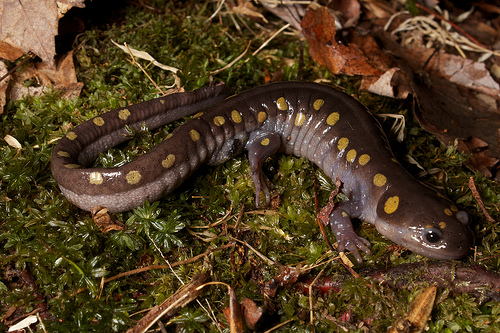
Did the spotted salamander lose a body part? No problem! It can be regenerated.

  • A spotted salamander is an amphibian that moves through a metamorphosis process, from a water dwelling creature to one that spends its time on land, except for breeding purposes.
  • Adult spotted salamanders can grow to lengths of 15 to 25 centimetres (5.9 to 9.8 inches), and they look similar to a lizard due to their short legs and tail.
  • Spotted salamanders are native to the United States and Canada, in North America, and are also known as ‘yellow-spotted salamanders’ and have the scientific name Ambystoma maculatum.
  • Spotted salamanders are nocturnal and live among rocks, logs, leaves, or in abandoned burrows in forest habitats, that contain temporary water sources during the rainy season, and they usually stay hidden unless it is damp or raining.
  • Spotted salamanders have the family name Ambystomatidae, the family of mole salamanders, and are one of the 32 species of the genus Ambystoma, the only genus in the family.
Spotted Salamander, Lizard, Orange, Black, Flickr, Ten Random Facts, Animal,
Spotted Salamander
Image courtesy of Brian Gratwicke/Flickr
  • Spotted salamanders are primarily coloured black, but they can also be dark blue, brown, grey or green , and they are patterned with yellow to orange spots.
  • Female spotted salamanders lay an average of two hundred eggs in temporary freshwater ponds that lack much wildlife, like fish, during the rainy season, typically breeding in the same hole annually, reached by the same route.
  • When threatened, spotted salamanders release a poisonous substance on enemies, although they generally prefer to stay out of danger by hiding.
  • Spotted salamanders can regrow body parts, from organs to limbs, and while they only have up to a 10% survival rate in the pool of water, once they change to their adult form they can live to 20 or 30 years.
  • Spotted salamanders’ diet mainly consists of spiders, insects, bugs, worms and slugs that they catch with their sticky tongue, and they are preyed upon by snakes, birds, raccoons and other creatures.
Bibliography:
Spotted Salamander, 2014, National Geographic, http://animals.nationalgeographic.com.au/animals/amphibians/spotted-salamander/
Spotted Salamander, 2014, Wikipedia, http://en.wikipedia.org/wiki/Spotted_salamander
Stout, N. and G. Hammond, Ambystoma maculatum, 2007, Animal Diversity Web, http://animaldiversity.ummz.umich.edu/accounts/Ambystoma_maculatum/

Amazon:     

Highlighter

Highlighter

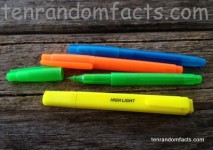
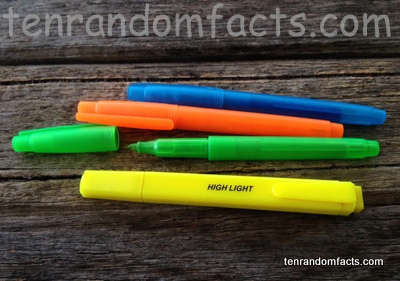
Only the highlights appear in these highlighter facts!

  • Highlighters are stationery items in the form of a pen, used to highlight, or mark, text.
  • Highlighter ink is typically brightly coloured, often fluorescent, and see-through.
  • Highlighters typically come in colours of yellow, blue, green, pink, orange and purple, although the most prevalent colour is yellow.
  • Highlighters are similar to a felt-tip pen, except they contain a different ink.
  • Highlighters are believed to have been invented by the United States’ Carter’s Ink Company in 1963, and were called a Hi-Liter, soon after Yukio Horie, from Japan, had invented the water-based marker the year prior.

Highlighter, multiple, colourful, Pen, Yellow, Green, Blue, Orange, Ten Random Facts, Stationary, Invention

  • Yellow coloured highlighters are generally not visible on a photocopied document of a highlighted original.
  • Different colours of highlighters can be used to organise groups of ideas or texts.
  • Highlighters can be stacked together, waxy, retractable, three in one, take the form of a pencil, or have non-seeping ink.
  • A dry line highlighter is a tape that is applied to the page, and has the advantage that it can be erased without much difficulty.
  • Digital documents can be highlighted by selecting text, in a similar way to standard highlighting.


Bibliography:
Highlighter, 2014, Wikipedia, http://en.wikipedia.org/wiki/Highlighter
Greenbaum H & Rubinstein D, The Hand-held Highlighter, 2012, The New York Times, http://www.nytimes.com/2012/01/22/magazine/the-hand-held-highlighter.html?_r=1

Amazon:     

Salina Turda

Salina Turda

Salina Turda is a salt mine, theme park and museum – all underground!

  • Salina Turda is the world’s deepest underground entertainment park and museum, and has its origins as a salt mine.
  • Salina Turda is located in Cluj County, in the region of Transylvania, in Europe’s Romania.
  • Salina Turda was mined from as early as 1075 AD, in Medieval Europe, until its closure in 1932, for table salt.
  • Salina Turda underwent an improvement program costing €5.8 million, that began in 2008 and was completed in 2010.
  • Salina Turda has four main mines and a number of other rooms, that either contain historic equipment, or are impressively shaped, and some feature large stalactites and other salt formations.
Salina Turda, Theme Park, Entertainment, underground, lake, entertainment, Salt mine, Romania, Europe, Ten Random Facts, Flickr, Interesting, Top
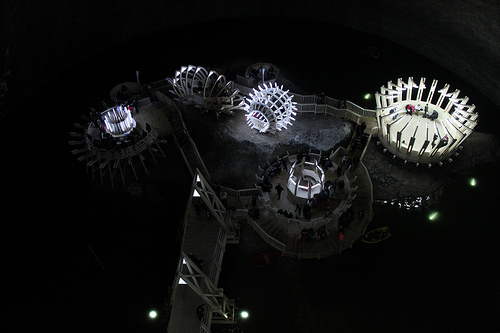
Part of Salina Turda
Image courtesy of Cristian Bortes/Flickr
  • Salina Turda contains constructions that are strange in appearance, often compared with science fiction architecture, with the tube lighting adding to the effect.
  • Salina Turda is said to have very clean air and limited bacteria, as well as a constant temperature of 11°C to 12°C (52°F to 53.5°F), and its environment therefore does not trigger asthmatic reactions.
  • Salina Turda mines are as deep as 120 metres (394 feet), and others are 108 metres (354 feet) and 42 metres (138 feet) deep, and they are connected by narrow corridors.
  • Salina Turda is a popular tourist destination, and it has an underground lake that can be travelled on via boat, a Ferris wheel, mini golf course, bowling lanes, sports field, amphitheatre, billiard tables, table tennis, a spa treatment room and more.
  • At different times in the 20th century, Salina Turda was used as an antiaircraft shelter and a cheese storage facility, and it opened for tourism in 1992.
Bibliography:
Ryan R, Salina Turda salt mine in Romania is now an underground theme park, 2014, News, http://www.news.com.au/travel/world-travel/salina-turda-salt-mine-in-romania-is-now-an-underground-theme-park/story-e6frfqai-1227016762579
Turda Salt Mine, 2013, Salina Turda, http://salinaturda.eu/salt-mine-turda/?lang=en
Salina Turda, 2014, Wikipedia, http://en.wikipedia.org/wiki/Salina_Turda
Salina turda salt mines turned subterranean history museum, 2013, Designboom Architecture, http://www.designboom.com/architecture/salina-turda-salt-mines-turned-subterranean-history-museum-11-30-2013/

Amazon:   

Candied Fruit

Candied Fruit

Candied fruit prevents fruit from spoiling – and tastes good too!

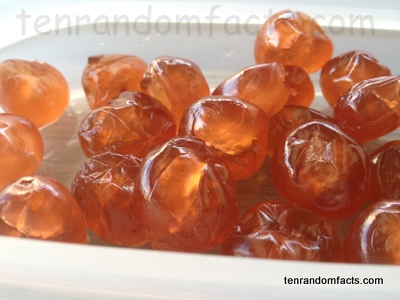
  • Candied fruits are food items, in particular fruit, that have been preserved by a sweetener, usually sugar.
  • ‘Candied fruit’ is also known as ‘crystallised fruit’, ‘frosted fruit’, ‘glacé fruit’ and ‘glazed fruit’, although the candying processes may vary among the terms.
  • Candied fruit is typically candied by letting fresh or rehydrated fruit boil, and then sit in sugar syrup, and the sugar content of the syrup is gradually increased each day.
  • Candied fruit can take from a few days to many months to become completely candied, and dried fruit will achieve this outcome faster.
  • The candied fruit method causes the water to be extracted from the fruit and replaced with sugar, and this creates a type of pressure that repels some microorganisms that helps to preserve the fruit.

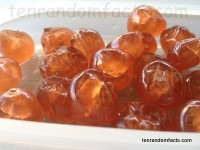
Candied Fruit, Cherries, Glacé, Homebrand, Berry, Confectionery, Red, Sugar, Ten Random Facts, Culinary, Food

  • Cherries are the most commonly candied fruit, and other fruits include oranges and their peel, mandarins, figs, melons, and pineapples, and lemon peels, chestnuts and ginger are also often candied.
  • Candied fruit is typically sold and stored in airtight containers, so moisture cannot spoil the fruit, and it is popularly used in desserts and baked goods, most notably in fruitcake.
  • Candied fruit is said to have originated from the Middle Eastern Arabs, as an important banquet food, which spread into Europe most likely in the 1500s.
  • Of all candied fruits, limes are one of the most difficult to successfully candy due to the chemicals in the rind, and usually the process is only achieved in commercial settings.
  • Candied fruit is approximately 80% sugar, and usually contains small amounts of fibre and manganese.
Bibliography:
Candied Fruit, 2011, Cooks Info, http://www.cooksinfo.com/candied-fruit
Candied Fruit, 2013, Wikipedia, http://en.wikipedia.org/wiki/Candied_fruit
What is Candied Fruit?, 2014, WiseGEEK, http://www.wisegeek.com/what-is-candied-fruit.htm

Amazon:     

Related Posts Plugin for WordPress, Blogger...