Western Gorilla

Western Gorilla

Western gorillas are endangered giants.

  • Western gorillas consist of two primate subspecies and are found in the tropical woodlands of western to central parts of Africa.
  • Western gorillas have the scientific name Gorilla gorilla and are from the family Hominidae, the family of great apes.
  • Western gorillas typically have black or grey coloured hair, and the upper head is generally brown.
  • Western gorillas can grow to be 1.4 to 1.7 metres (4.7 to 5.5 feet) in length and generally weigh between 80 to 200 kilograms (220 to 440 pounds).
  • Western gorillas move at speeds of 40 kilometres per hour (25 miles per hour) and they show capabilities of tool using.
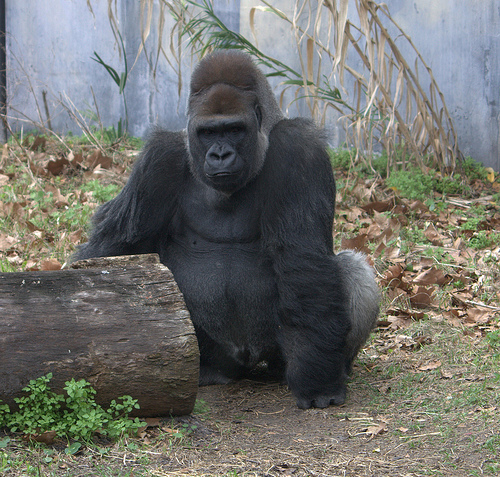
Western Gorilla, Black, Seated, Male, Zoo, Ten Random Facts, Flickr, Primate, Ape, Critically Endangered
Western Gorilla
Image courtesy of LaggedOnUser/Flickr
  • Western gorillas have a slow rate of reproduction, usually only having a single offspring per birth; the mother cares for the young for three to four years; and fatalities are common in the early years.
  • The diet of western gorillas primarily consists of vegetation including leaves, bark, fruit and nuts, as sometimes insects, rodents and lizards are consumed, and they are sometimes preyed on by leopards and crocodiles.
  • Western gorillas usually reside in troops of two to twenty gorillas, and have a lifespan of approximately 35 to 40 years in the wild, and up to 54 years in captivity.
  • Western gorillas are critically endangered due to poaching, habitat removal and viruses, and the population of the western lowland gorilla subspecies is said to be less than 200,000 and the Cross River gorilla subspecies is believed to have 300 or less.
  • Western gorillas use vegetation to make nests on the ground or in trees, that they sleep in, and they usually build a new nest each day.
Bibliography:
Csomos R, Gorilla gorilla, 2008, Animal Diversity Web, http://animaldiversity.ummz.umich.edu/accounts/Gorilla_gorilla/
Western Gorilla, 2013, A-Z Animals, http://a-z-animals.com/animals/western-gorilla/
Western Gorilla, 2014, Wikipedia, http://en.wikipedia.org/wiki/Western_gorilla

Amazon:        

Soup Ladle

Soup Ladle

Soup ladles are a relatively new invention.

  • Soup ladles are spoons used primarily for serving liquid-based foods, such as soup, sauce, stew or beverage.
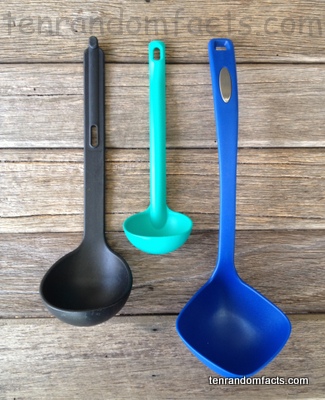
  • Soup ladles have deeper bowls than spoons, as well as a notably long handle.
  • ‘Soup ladles’ are also known simply as ‘ladles’.
  • Some soup ladles have a pouring lip on the bowl edge, that allows a steadier flow of food from the utensil.
  • Soup ladles are typically made of stainless steel, plastic or wood, but also silver, aluminium, and bamboo are sometimes used.

Ladle, Invention, Soup, Spoon, Culinary, Ten Random Facts, Kitchen, Many, Few, Three, Black, Plastic, Green, Blue

  • Soup ladles come in sizes that range from approximately 12 to 38 centimetres (5 to 15 inches) in length, and the bowl size is usually proportionate to the length of the handle, and they are used for different food items, depending on their size.
  • Soup ladles are not only used to serve liquid foods, but they can be also used during the cooking process, as well as to stir food.
  • Some soup ladle bowls have volume measurement markings to determine the amount of liquid in the bowl.
  • The term ‘ladle’ is derived from the word ‘hladan’, meaning ‘to load’ in Old English.
  • Soup ladles were most likely invented in the 1800s, and an early style utensil with a similar purpose, known as a ‘cup holder’, was patented in 1876, that was invented by Joseph Scherer from Buffalo, New York in the United States, and was a wire frame with a wooden handle that was designed to hold a teacup or similar item for the purpose of scooping soup or other food.
Bibliography:
Ladle (Spoon), 2014, Wikipedia, http://en.wikipedia.org/wiki/Ladle_(spoon)
Scherer, J 1876, ‘Cup-holder’, US178963, 20 June, pp. 1, Patents, Google
What is a Soup Ladle, 2014, WiseGEEK, http://www.wisegeek.com/what-is-a-soup-ladle.htm

Amazon:     

Puffed Rice Cereal

Puffed Rice Cereal

“Snap, Crackle, Pop” – notable slogan accompanying Kellogg’s puffed rice cereal.

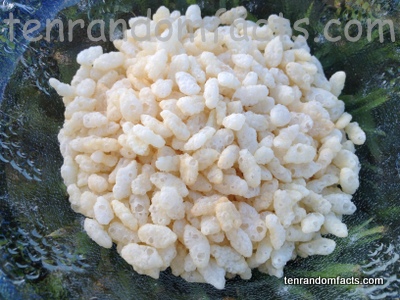
  • Puffed rice cereal is a crunchy cereal made primarily of rice that has been expanded, often using a combination of steam and heating methods, including an oven, or via the use of pressure.
  • ‘Puffed rice cereal’ is also known as ‘rice pops’, ‘Rice Krispies’, ‘Rice Bubbles’, ‘pori’, and ‘muri’, depending on its use, origin and brand.
  • Although it is a popular breakfast cereal in western countries, like the United States, Australia and the United Kingdom, puffed rice cereal is commonly adapted as a snack in many Asian countries, where it has been eaten for centuries in various forms.
  • Puffed rice cereal was created and commercialised as a breakfast cereal in 1927, by either Clayton Rindlisbacker or Eugene McKay, both employees of Kellogg’s.
  • The puffed rice cereal’s thin walls become weak when milk or other liquid is added, and this makes the popular noises ‘snap’, ‘crackle’ and ‘pop’ that the cereal is noted for.

Puffed Rice Cereal, Bowl, Ten Random Facts, Australia, Rice Pops, Rice Bubbles, Rice Krispies, Homebrand, White

  • Puffed rice cereal is primarily made of rice, sugar and salt ingredients, and depending on the brand and its use, some flavourings and preservatives may be added.
  • Puffed rice cereal has been released in numerous different flavours, and chocolate is particularly popular.
  • Puffed rice cereal can be adhered together using other ingredients to make snack bars or party style food.
  • In India, a version of puffed rice cereal is used traditionally as an ingredient in a snack for Hindu god offerings.
  • Puffed rice cereal has little nutritional value, so vitamins and minerals are often added back in to improve the nutrition content of the product.


Bibliography:
Puffed Rice, 2014, Wikipedia, http://en.wikipedia.org/wiki/Puffed_rice
Rice Krispies, 2014, Wikipedia, http://en.wikipedia.org/wiki/Rice_Krispies

Amazon:     

Tianzi Mountain Nature Reserve

Tianzi Mountain Nature Reserve

The Tianzi Mountain Nature Reserve is quite mystical.

  • Tianzi Mountain Nature Reserve is a reserve that primarily contains numerous stone pillars, and is found in Asia’s China, in the Hunan Province, in the Zhangjiajie area.
  • Tianzi Mountain Nature Reserve covers an area of 67 square kilometres (25.87 square miles).
  • ‘Tianzi Mountain Nature Reserve’, also called ‘Tianzishan’, was named after Xiang Dakun, a Chinese man who took on the name ‘Tianzi’, meaning ‘son of heaven’, after leading a successful rebellion some time between 1127 and 1279.
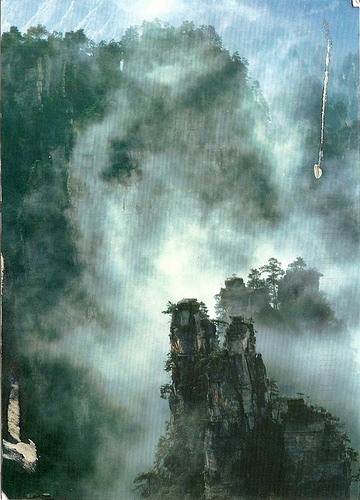
  • Tianzi Mountain Nature Reserve’s pillars are mostly very tall and narrow, and the highest peak reaches 1,262 metres (4,140 feet).
  • Tianzi Mountain Nature Reserve is most picturesque during April, May, September and October.

Tianzi Mountain Nature Reserve, Painting, Illustration, Mist, China,  Park, Scenic, Ten Random Facts, Flickr

Illustration of Tianzi Mountain Nature Reserve
Image courtesy of Stephanie/Flickr
  • Tianzi Mountain Nature Reserve is full of valleys, waterfalls and erect rock peaks, and the area is said to have inspired some of the scenery from the popular 2009 Avatar film.
  • Tianzi Mountain Nature Reserve peaks can be seen via cable cars, which span a distance of 2.1 kilometres (1.3 miles).
  • Tianzi Mountain Nature Reserve rock pillars are made primarily of quartzite sandstone.
  • Tianzi Mountain Nature Reserve is part of the Wulingyuan Scenic and Historic Interest Area, that was designated as a UNESCO World Heritage Site in 1992.
  • Many pine trees grow on the top of the rock peaks of Tianzi Mountain Nature Reserve.
Bibliography:
Tianzi Mountain, 2014, Wikipedia, http://en.wikipedia.org/wiki/Tianzi_Mountain
Tianzi Mountain Nature Reserve, 2014, China Travel, http://www.chinatravel.com/zhangjiajie-attraction/tianzi-mountain-nature-reserve/
Tianzi Mountain Nature Reserve, 2014, TravelChinaGuide.com, http://www.travelchinaguide.com/attraction/hunan/zhangjiajie/tianzi-mountain.htm

Amazon:      

Chinchilla

Chinchilla

Chinchillas are cute and soft but endangered.

  • Chinchillas are a genus of two extant species of medium sized rodent mammals that move around mostly during twilight hours, and the animal lives in herds of 14 to 100.
  • Chinchillas live at elevations of up to 4,270 metres (14,000 feet) in South America’s Andes Mountains, and they belong to the family Chinchillidae, a family of squirrel-like rodents.
  • The term ‘chinchilla’ is said to have derived from ‘Chincha’, the name of the Andes Mountains indigenous people who wore garments made from their fur, however, it is also believed the term means ‘little bug’.
  • Chinchillas have become critically endangered, and one species is extinct, due to human hunting for its very soft fur.
  • Chinchillas grow to be 25 to 35 centimetres (10 to 14 inches) in length; weigh 400 to 500 grams (14 to 18 ounces); and can jump lengths of 1.8 metres (6 feet) in a single bound.
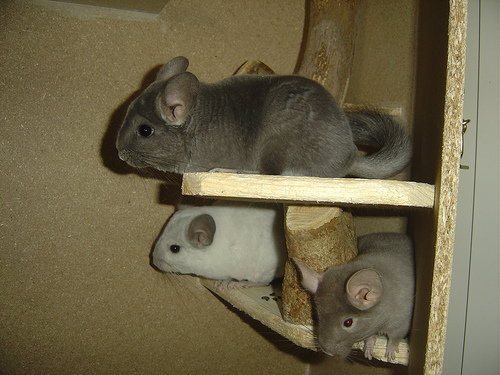
Chinchilla, Animals, pets, rodents, black, grey, white, Captive, Ten Random Facts
Chinchillas
Image courtesy of Ph!L!s/Flickr
  • Female chinchillas have litters averaging two or three, giving birth to young that have a body full of fur and open eyes, and they live on average 10 to 12 years, although they can live to age 20.
  • A chinchilla’s diet mainly consists of seeds, fruit, leaves and nuts, and they are preyed upon by birds like owls and hawks, snakes, foxes and other animals.
  • Chinchillas can be kept as pets, although the animal requires a specific diet and habitat, including a relatively cool environment.
  • The fur of chinchillas has been sold since the 1500s, while today the animal is bred commercially for their fur.
  • The fur colour of chinchillas is typically grey, although humans have bred them so that they produce different colours, including white, black, blue or beige.
Bibliography:
Chinchilla, 2013, A-Z Animals, http://a-z-animals.com/animals/chinchilla/
Chinchilla, 2014, Wikipedia, http://en.wikipedia.org/wiki/Chinchilla
The Chinchilla, 2014, Chinchilla Chronicles, http://www.chinchillachronicles.com/the_chinchilla.html

Amazon:      

Padlock

Padlock

Everything is secure with a padlock.

  • Padlocks are security devices used to keep items secure, that can usually be opened via a code or key, and are portable.
  • Padlocks commonly have a cylindrical ‘U’ shaped top, called a shackle, typically attached to a rectangular base or body, and sizes vary greatly, with different sizes used on proportionate objects.
  • To use a padlock, the shackle is placed over or through a latch, and the shackle is then closed.
  • Padlocks have been used for thousand of years by Ancient Egyptians and Babylonians, and they were in use from 1000 BC in Asia’s China, and they became more widespread via travelling merchants.
  • Padlocks are typically made of steel or brass, or a combination of both, and they were originally made from wood, although silver, brass and bronze were later used.

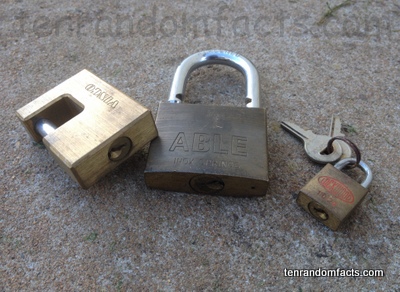
Padlock, Three, Some, Secure, Key, Black, Rectangle, Traditional, Ten Random Facts

  • A ‘padlock’ is said to have been named so, between the 9th and 11th century, when the invention was used to secure paddocks.
  • In the 1800s, padlocks become more commercially viable, were manufactured in mass production processes, and the security of the locks were improved.
  • Padlocks typically are locked by the shackle catching on an internal mechanism in the body of the device, and they are often self-locking by a person pushing the shackle closed, but occasionally they require a key for assistance.
  • Padlocks are often unlocked by using a key or entering a number or letter combination, and they can be illegally unlocked by using a lock pick or a heavy tool, such as a hammer, chisels or bolt cutters.
  • Pictures of padlocks are used as a popular symbol for securing, and are used universally on the internet and online world.
Bibliography:
History of Padlocks – Who Invented Padlock?, n.d., History of Keys, http://www.historyofkeys.com/padlocks-history/history-of-padlocks/
Padlock, 2014, Wikipedia, http://en.wikipedia.org/wiki/Padlock

Amazon:      

Related Posts Plugin for WordPress, Blogger...