Dill

Dill

Isn’t dill play-on-words fun!?

  • Dill is a leafy herb that reaches heights of 40 to 60 centimetres (16 to 24 inches) and the plant is grown as an annual in full sun.
  • Dill is native to Europe’s east, Russia’s south, Africa and the Mediterranean, and it is the only species in the Anethum genus; its scientific name is Anethum graveolens.
  • Dill is from the family Apiaceae, that is also known as the Umbelliferae family, and it is the family of celery, parsley and carrots, and other hollow stem plants.
  • ‘Dill’ is derived from the Norse word ‘dilla’, meaning ‘to lull’ or the Old English word ‘dile’, and the names are a reference to the plant’s medicinal purposes.
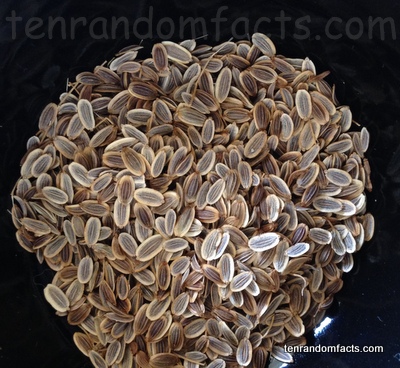
  • Dill leaves are often used in seafood or soup dishes, as well as pickled items like cucumbers, and the seeds are used as a spice for flavouring.
Dill, Food, Seeds, Culinary, Spice, Brown, Bowl, Many, Flavour, Ten Random Facts, AustraliaSeeds
  • Oil can be obtained from the dill plant, which can be used to produce soap.
  • Dill has been used for thousands of years, and in England in the 5th to 11th centuries it was used to treat headaches, stomach illness, boils and nausea, and other sickness.
  • Fresh dill leaves are delicate and feathery and are typically coloured a bright green, while seeds are mustard to brown in colour.
  • Dill has a taste described typically as mild and warm, with a slight anise flavour, and the leaves have a milder flavour than the seeds.
  • Dill leaves are a very good source of vitamin C and vitamin A, and they contain many other vitamins and minerals, while the seeds are high in calcium.
Bibliography:
Dill (Anethum graveolens), 2014, Gourmet Garden, http://www.gourmetgarden.com/en/herb/252/dill
Dill, 2014, The World’s Healthiest Foods, http://www.whfoods.com/genpage.php?tname=foodspice&dbid=71
Dill, 2014, Wikipedia, http://en.wikipedia.org/wiki/Dill

Amazon:     

Lençóis Maranhenses National Park

Lençóis Maranhenses National Park

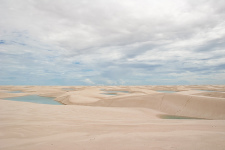
Lençóis Maranhenses National Park has water in a ‘desert’ – who knew?

  • Lençóis Maranhenses National Park is a national park in northern Brazil’s state of Maranhão, in South America.
  • Lençóis Maranhenses National Park is a sandy area with sloping dunes that incorporates lagoons, and while it appears to be a desert, due to the lack of any obvious vegetation across much of the area, it receives too much rain to be classed as one.
  • Lençóis Maranhenses National Park covers an area of 1550 square kilometres (600 square miles) and includes approximately 70 kilometres (43.5 miles) of coastline and stretches as far as 50 kilometres (31 miles) inland.
  • Lençóis Maranhenses National Park became a national park in 1981 and in 2014, it was managed by the Brazilian Chico Mendes Institute for Conservation of Biodiversity (ICMBio – Instituto Chico Mendes de Conservação da Biodiversidade).
  • Lençóis Maranhenses National Park cannot be entered by any vehicle type except 4-wheel drives, and tours are available for a fee.
Lençóis Maranhenses National Park, Desert, Water, Amazon, South America, Natural, Wonder, Flickr, Ten Random Facts
Part of Lençóis Maranhenses National Park
Image courtesy of Danielle Pereira/Flickr
  • The blue-green freshwater lagoons of Lençóis Maranhenses National Park are formed by the 1194 to 1524 millimetres (47 to 60 inches) of rain that falls each year.
  • Lençóis Maranhenses National Park is a popular tourist destination, and the best time to visit is said to be from July to September when the lagoons are full, and during this time, fish inhabit the ponds, including the mud-dwelling wolf fish.
  • Even though Lençóis Maranhenses National Park receives significant rain, due to persistent winds it has only small quantities of vegetation in certain areas.
  • Fisherman, during the wet season, fish in Lençóis Maranhenses National Park, but work in agricultural sites during the dry season, when most of the lagoons have dried up.
  • Lençóis Maranhenses National Park sand dunes can reach heights of 40 metres (131 feet), and there are no public facilities like toilets and food outlets in the park.
Bibliography:
Geiling N, How Do Thousands of Clear Blue Lagoons End Up In These Brazilian Sand Dunes?, 2014, Smithsonian, http://www.smithsonianmag.com/travel/Lencois-maranhenses-brazil-thousands-clear-blue-lagoons-in-sand-dunes-180951756/?no-ist
Tours in Lencois Maranhenses, n.d, Parque Lençóis, http://www.parquelencois.com.br/english/lencois_maranhenses_passeios.php
Lençóis Maranhenses National Park, 2014, Wikipedia, http://en.wikipedia.org/wiki/Len%C3%A7%C3%B3is_Maranhenses_National_Park
Murano G & Wilkinson J, Coastal Dunes, Lençóis Maranhenses, Brazil, 2014, Coastal Care, http://coastalcare.org/2011/06/coastal-dunes-lencois-maranhenses-brazil/
National Park of Lençóis, n.d, ICMBio, http://www.icmbio.gov.br/parnalencoismaranhenses/guia-do-visitante.html

Amazon:     

Black Widow Spider

Black Widow Spider

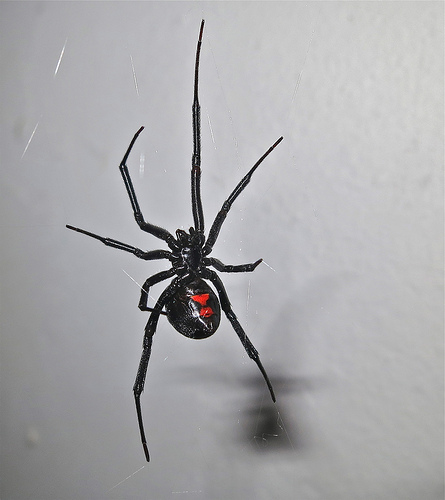
Black widow spiders are fascinating but highly dangerous creatures.

  • Black widow spiders are highly dangerous, poisonous spiders, native to urban and forest North American habitats.
  • Black widow spiders range 1.3 to 3.8 centimetres (0.5 to 1.5 inches) in length, and males are typically a quarter or half the female’s size.
  • Black widow spiders are notable for the red hourglass marking on the brown to black abdomen in females, while males are coloured brown-yellow and often have light coloured stripes.
  • ‘Black widow spiders’ are also known as ‘black widows’, with three species using the same name, and these species have the scientific names Latrodectus variolus, L. mactans, and L. hesperus, and are found in northern, southern, and western North America respectively.
  • Black widow spiders are closely related to the Australian redback spiders, and they are from the family Theridiidae, the family of tangle-web or cobweb spiders.
Black Widow Spider, Female, Wed, Web, Urban, Inside, Epic, Scary, Ten Random Facts, Arachnid, Spider, Flickr
Black Widow Spider
Image courtesy of Steve Jurvetson/Flickr
  • The venom glands of black widow spiders are large, and the venom is said to be more toxic than fifteen doses of rattlesnake venom.
  • While black widow spiders are placed in the list of the ten most dangerous spiders in the world, their bites do not often cause human fatalities, and symptoms include muscle pain, breathing difficulties and nausea.
  • After mating, the female black widow spider may eat the male, hence the spider’s name; and females produce a cocoon like sac of 100 to 400 eggs, four to nine times a year.
  • Black widow spiders have a life span ranging one to three years, and they are preyed on by birds and wasps.
  • Black widow spiders eat insects including flies, beetles, caterpillars, mosquitoes and grasshoppers, that they catch in their random shaped webs, and once their prey is killed, the spiders inject an enzyme that breaks down and liquefies the insects.
Bibliography:
Black Widow Spider, 2013, A-Z Animals, http://a-z-animals.com/animals/black-widow-spider/
Black Widow Spider, 2014, National Geographic, http://animals.nationalgeographic.com.au/animals/bugs/black-widow-spider/
Latrodectus, 2014, Wikipedia, http://en.wikipedia.org/wiki/Latrodectus

Amazon:     

Barrel of Monkeys

Barrel of Monkeys

It is ‘more fun than a barrel of monkeys’.

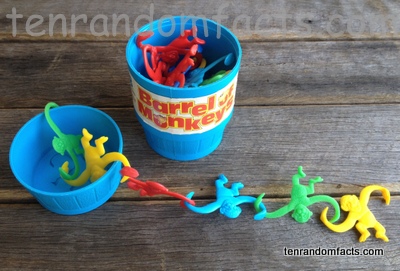
  • Barrel of Monkeys is a game or toy that contains plastic linkable monkeys and a container that they are held in.
  • The main object of the Barrel of Monkeys game is to make the longest monkey chain by linking the arms, before dropping any.
  • Barrel of Monkeys was invented in 1965 by Leonard Marks, who came from New York’s Roslyn, in the United States, who is said to have sold the game to Lakeside Toys around that time.
  • Barrel of Monkeys was most likely an improvement on a similar form of entertainment of detachable hooks and links, that was possibly first invented in 1953 by Lawrence Reed from the United States, and was patented in 1955.
  • It is believed that ‘Barrel of Monkeys’ was originally to be named ‘Barrel of Fun’, but due to copyright issues it was named after a well known phrase.

Barrel of Monkeys, chain, coloured, blue, red, green, yellow, assorted, plastic, game, Milton Bradley, Ten Random Facts, Australia

  • The monkeys in the Barrel of Monkeys game were originally, until 1968, stored in cardboard cylinders, but this was changed to a plastic barrel.
  • Barrel of Monkeys traditionally contains twelve monkeys, though twenty-four is the barrel’s capacity, and the monkeys are generally coloured similar to the barrel – red, blue, green or yellow.
  • Barrel of Monkeys is manufactured by the Milton Bradley Company, which in 2014 was owned by the game and toy corporation Hasbro.
  • Two Barrel of Monkeys’ monkeys are said to be able to be linked in eighty different ways, using arms, legs, heads and the like, and they can been used in 3D models to create polyhedral chemical structure models of viruses and proteins.
  • In 2011, Barrel of Monkeys was given the 53rd place in the ‘All-TIME 100 Greatest Toys’ list.
Bibliography:
Barrel of Monkeys: One of the All-TIME 100 greatest toys, n.d., Answers, http://invent.answers.com/toys-and-games/barrel-of-monkeys-one-of-the-all-time-100-greatest-toys
Barrel of Monkeys (Game), 2014, Wikipedia, http://en.wikipedia.org/wiki/Barrel_of_Monkeys_(game)
Leonard, M 1968, ‘Interconnectable toy elements having hook members’, Google Patents, no. US3414265, 5 July, accessed 10 September 2014, <http://www.google.com/patents/US3414265>
Reed, L 1955, ‘Detachable link and hook game-piece’, Google Patents, no.US2712444, 5 July, accessed 10 September 2014, <http://www.google.com/patents/US2712444>

Amazon:     

Buckwheat

Buckwheat

Buckwheat is not wheat but instead a wheat alternative.

  • Buckwheat is a seed grain that is obtained from the plant with the scientific name Fagopyrum esculentum, and is classified as a pseudocereal, as it is not a species of grass.
  • ‘Buckwheat’ is also known as ‘beech wheat’, and this name is a reference to the similar triangular shaped appearance it has to beech nuts that are significantly larger, and its common use as a wheat replacement.
  • Buckwheat is not related to wheat, instead it comes from the family Polygonaceae, the family of knotweed, that rhubarb also belongs to.
  • ‘Buckwheat’ s comes from the word ‘boecweite’ that means ‘beech wheat’ in Middle Dutch, and when the seed is roasted, it is known as ‘kasha’.
  • In 2011, Russia was the leading producer of buckwheat, with 800,380 tonnes (882,000 tons), China with 720,000 tonnes (793,700 tons) and Ukraine boasting 281,600 tonnes (310,400 tons).

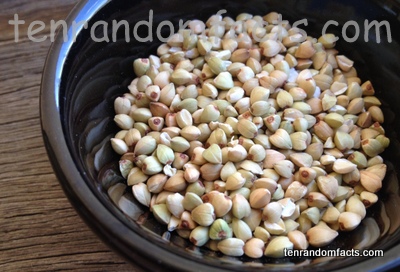
Buckwheat, Grain, Seed, Cream, Multi, Ten Random Facts, Australia, Gluten Free

  • The outer buckwheat layer is typically a dark tan when roasted, or light green or brown in colour when raw, while the inner starch is coloured white, and is approximately 3 to 4 millimetres (0.12 to 0.16 inch) in diameter and approximately 5 millimetres tall.
  • Buckwheat can be eaten raw or roasted, and is commonly ground into flour, which in turn is used in pancakes, noodles, bread and porridge; although some people are allergic to it, causing a rash, and anaphylaxis cases have occurred.
  • Buckwheat is a grain that does not contain wheat or gluten, and therefore is a common replacement for those with coeliac disease, or who are intolerant or have an allergy to wheat.
  • A buckwheat seed is called a ‘groat’, and its triangular shape has led to unique equipment to hull the seed.
  • Buckwheat is very high in fibre, niacin, riboflavin, copper, magnesium, phosphorous and manganese.


Bibliography:
Buckwheat, 2014, The World’s Healthiest Foods, http://www.whfoods.com/genpage.php?tname=foodspice&dbid=11
Buckwheat, 2014, Wikipedia, http://en.wikipedia.org/wiki/Buckwheat
Murray, J, What is Buckwheat? Buckwheat Defined, 2014, About Food, http://vegetarian.about.com/od/glossary/a/What-Is-Buckwheat.htm

Amazon:     

Metéora

Metéora

Metéora is a mystical location of amazing architecture.

  • Metéora is a group of six remaining monasteries, of the 24 that were built in the area, located on the outskirts of the Plain of Thessaly, in central Greece.
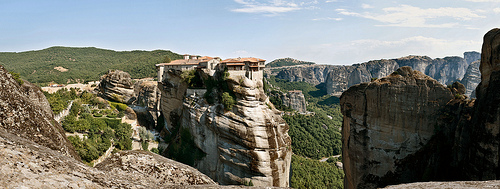
  • The monasteries in Metéora are built atop sandstone rock cliffs that reach up to 400 metres (1312 feet) in height.
  • The first residents of Metéora were hermit monks, most likely in the 11th century, who sought refuge from Turkish armies in the caves during this period.
  • The Metéora monasteries were mostly constructed during the 1300 and 1400s, as a safe haven for monks and nuns who felt threatened by the political instability that was apparent in the area at the time.
  • Lengthy ladders, and ropes or nets were originally used to access the monasteries at Metéora, and there is now cable car access to some sites, although it wasn’t until the early 1900s that steps carved from rock were added for convenience.
Meteora, Rocks, Pillars, Religion, Monastery, Greek, Ten Random Facts, Flickr, Place,
Part of Metéora
Image courtesy of Antonio Picascia/Flickr
  • Metéora’s rock pillars are believed to have been formed by tectonic movement and erosion by wind and water.
  • ‘Metéora’ means ‘suspended in the air’ or similar, in Greek, and the monasteries and the cliffs they sit upon have been used in. or inspired literature, music and film.
  • Metéora covers an area of 2.72 square kilometres (1.05 square miles) and became a UNESCO World Heritage Site in 1988.
  • Metéora has a large temperature range that varies from very cold to very hot, and has significant quantities of rain throughout the year.
  • Metéora is a popular tourist destination, visited by thousands annually, and to access the sites, steps or rock climbing are the two main options.
Bibliography:
Meteora, 2014, UNESCO WHC, http://whc.unesco.org/en/list/455
Meteora, 2014, Wikipedia, http://en.wikipedia.org/wiki/Meteora
Meteora: The most photogenic spiritual site in Greece, 2014, Visit Greece, http://www.visitgreece.gr/en/destinations/meteora_the_most_photogenic_spiritual_site_in_greece

Related Posts Plugin for WordPress, Blogger...