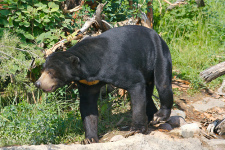
Sun Bear

Sun Bear

Sun bears are not bright and happy when threatened.

  • Sun bears are mammals native to Southeast Asian tropical forests that typically live by themselves in trees, where they make themselves nests that they rest in.
  • Sun bears have the scientific name Helarctos malayanus and are from the family Ursidae, the family of bears, and there are two subspecies – Herlarctos malayanus malayanus (Malayan) and Herlarctos malayanus euryspilus (Bornean).
  • ‘Sun bears’ are also known as ‘dog bears’, due to their facial features resembling those of a dog, ‘honey bears’ and ‘Malay bears’.
  • A sun bear’s fur is typically coloured black, and it can also have grey, brown, red, orange or yellow markings, especially on the upper body under the neck, where there is crescent which is interpreted as a sunrise.
  • Sun bears are the smallest species of bear, and they range from 120 to 150 centimetres (4 to 5 feet) in height and grow to be 27 to 70 kilograms (60 to 150 pounds) in weight.
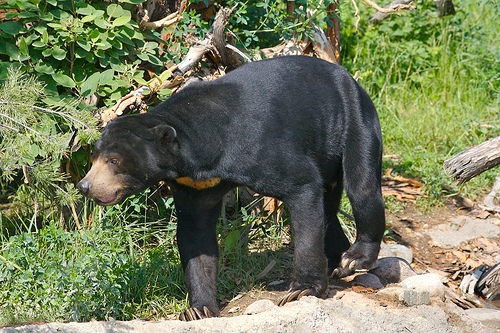
Sun Bear, Foraging, Moving, Black,  Ten Random Facts, Animal, Mammal, Fours,
Sun Bear
Image courtesy of Ryan Poplin/Flickr
  • The diet of sun bears mainly consists of insects including ants and termites, as well as fruit, but they also consume birds, eggs, larvae, rodents, nuts, reptiles and honey, while smaller foods are reached via a 20 to 25 centimetre (7.9 to 9.8 inch) long tongue.
  • Sun bears have litters of one or two cubs that are born blind and without hair, and they have a lifespan that ranges from 15 to 30 years.
  • Sun bears are classified as vulnerable due to logging illegally in forest habitats and poaching.
  • Sun bears are preyed on by snakes, some large mammals from the cat family and birds of prey.
  • Sun bears can move at speeds of 48 kilometres per hour (30 miles per hour) and are very fast climbers.
Bibliography:
Sun Bear, 2013, A-Z Animals, http://a-z-animals.com/animals/sun-bear/
Sun Bear, 2014, National Geographic, http://animals.nationalgeographic.com.au/animals/mammals/sun-bear/
Sun Bear, 2014, San Diego Zoo, http://animals.sandiegozoo.org/animals/sun-bear
Sun Bear, 2014, Wikipedia, http://en.wikipedia.org/wiki/Sun_bear

Amazon:      

Hair Dryer

Hair Dryer

Be careful not to mess up your hair with a hair dryer.

  • Hair dryers are electrical machines used to dry and evaporate water molecules in hair or other materials, using air flow.
  • A ‘hair dryer’ is also known as a ‘blowdryer’ and a ‘blow dryer’.
  • Hair dryers typically contain a motor that runs a fan, that blows air across hot, electricity-powered wires to produce a warm flow of air.
  • Hair dryers were first invented in 1888 by French hairstylist Alexandre Godefroy, and although his invention produced heat, it did not blow air.
  • Hair dryers are often made with attachments that may spread air, that helps to maintain hair shape; or focus air, which allows quicker drying.

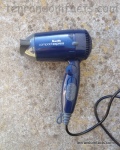
Hairdryer, BVreville, Compact Express, Black, Wire, Blue, Navy, Ten Random Facts, Electronics, Device, Machine, Mechanical, Hair, Beauty

  • Early hair dryers were typically large and long, in an upside-down bowl shape, and were used by placing one’s head underneath the air-blowing opening.
  • Vacuum cleaners are said to have been used for hair drying purposes, before the introduction of hair dryers.
  • Hair dryers were originally designed from heavy materials including metal, but they became more practical and lightweight with the introduction of plastic.
  • A handheld hair dryer was invented by Gabriel Kazanjian, an inventor from America, in 1908, that used heated air flow with a fan, which is the basis of our modern devices.
  • Hair dryers resulted in hundreds of annual electrocutions up until significant legislation was set up in the 1970s and the 1990s, and due to the safety regulations, they are now considered a safe appliance to use with very few related deaths occurring.


Bibliography:
Gross J, Who made that hair dryer?, 2013, The New York Times, http://www.nytimes.com/2013/07/21/magazine/who-made-that-hair-dryer.html?_r=0
Hair Dryer, 2014, Wikipedia, http://en.wikipedia.org/wiki/Hair_dryer

Amazon:     

Hazelnut Chocolate Spread

Hazelnut Chocolate Spread

Spreadable chocolate and nuts is hazelnut chocolate spread.

  • Hazelnut chocolate spread, also known as ‘chocolate spread’, is a cocoa flavoured substance that is typically known by the famous brand name ‘Nutella’.
  • Hazelnut chocolate spread typically contains oil, sugar, cocoa, milk powder and hazelnuts, as well as a few other ingredients, and is usually made by extracting the cocoa and processing the hazelnuts, then mixing the items with the other ingredients, into a paste.
  • Hazelnut chocolate spread was first invented by Italian confectioner Pietro Ferrero, in Italy’s Piedmont, after World War II, to give people an affordable chocolate treat.
  • The first invented hazelnut chocolate spread was originally solid, known as ‘Pasta Gianduja’, which was first sold in 1946, and later altered so that it became spreadable, which was known as ‘Supercrema’ in 1951.
  • Hazelnut chocolate spread is commonly used on wheat-based items, such as bread, waffles, crumpets and scones.

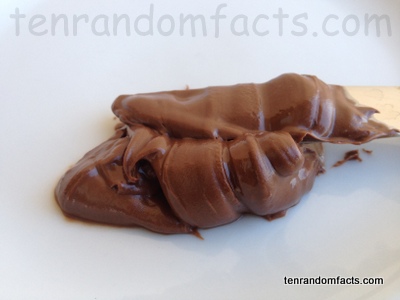
Hazelnut Chocolate Spread, Nutella, Brown, Hoembrand, Australia, Paste, Condiment, Dollop, Ten Random Facts, Foods, Culinary

  • In 1964, ‘Supercrema’ was improved and released as ‘Nutella’, by Michele Ferrero, Pietro’s son, which is the original, and leading hazelnut chocolate spread brand.
  • Hazelnut chocolate spread has been previously marketed as a healthy item, due to the healthy hazelnuts, but generally the product actually contains a large quantity of sugar and fat.
  • Hazelnut chocolate spread was originally targeted at all ages, but later primarily at children, who are one of the main consumers of the spread.
  • Hazelnut chocolate spread is high in fat, sugar, and manganese and is a good source of vitamin E, copper and iron.
  • Although hazelnut chocolate spread originated in Italy, it entered the market in the United States of America in 1983, and it is now sold around the world under different names, recipes and brands, by different companies.


Bibliography:
History of Hazelnut Chocolate Spread, 2013, Nutilight, http://www.nutilight.com/#!HISTORY-ON-HAZELNUT-CHOCOLATE-SPREAD/cqpw/6136BBEF-617B-4315-9DA2-818B42B7439D
Mitzman D, Nutella: How the world went nuts for a hazelnut spread, 2014, BBC News Magazine, http://www.bbc.com/news/magazine-27438001
Nutella, 2014, Wikipedia, http://en.wikipedia.org/wiki/Nutella

Amazon:      

Door to Hell

Door to Hell

How long can a fire burn in the Door to Hell?

  • The Door to Hell is among the largest deposits of natural gas in the world, located in the Karakum Desert in Turkmenistan’s Derweze, in Asia.
  • ‘The Door to Hell’ is also known as ‘Gates of Hell’, the ‘Gas Crater of Darvaza’, ‘Derweze Crater’ and the ‘Darvaza Crater’.
  • The Door to Hell gas field is said to have been discovered by petrochemical engineers from the Soviet Union in 1971 and a drilling rig was soon established.
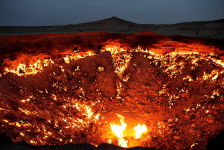
  • Early on, during the gas drilling stage at the Door to Hell, the site collapsed and formed a 69 metre (225 feet) diameter hole, that is 30 metres (99 feet) deep.
  • When the collapse at the Door to Hell occurred, large quantities of toxic and non-environmentally friendly methane gas were released, which to remove, was set alight.
Door to Hell, Turkmenistan, Gas Field, Fire, Light, Amazing, Bright, Ten Random Facts, Flickr, Wonder
The Door to Hell
Image courtesy of flydime/Wikimedia
  • The original fire of the Door to Hell is said to have been burning since 1971, although at the time, it was expected that the fire would only last a few days or weeks.
  • In late 2013, adventurer George Kourounis, a Canadian, reached the Door to Hell’s base, becoming the first person to accomplish this, and he collected soil samples from within that contained extremophile bacteria.
  • To protect and allow future gas mining in the area, the Door to Hell was commanded to be closed in early 2010, by Turkmenistan’s then President Gurbanguly Berdimuhamedow, although it was not accomplished.
  • The nearby town of Derweze is said to have had a forced population reduction from approximately 1,700 people, to 350 in 2004, by the then President Saparmurat Niyazov’s orders, to ‘protect’ the tourism industry of the Door to Hell.
  • The Door to Hell is a popular tourist attraction for those visiting the area, with people venturing onto the crater’s edges, which are susceptible to collapsing, to view the spectacular fires in the crater.
Bibliography:
Door to Hell, 2014, Wikipedia, http://en.wikipedia.org/wiki/Door_to_Hell
Nunez C, Q&A: The First-Ever Expedition to Turkmenistan’s “Door to Hell“, 2014, National Geographic News, http://news.nationalgeographic.com/news/energy/2014/07/140716-door-to-hell-darvaza-crater-george-kourounis-expedition/
Turkmenistan’s Door to Hell, 2013, Sometimes Interesting, http://sometimes-interesting.com/2013/07/31/turkmenistans-door-to-hell/

Amazon:      

Beaver

Beaver

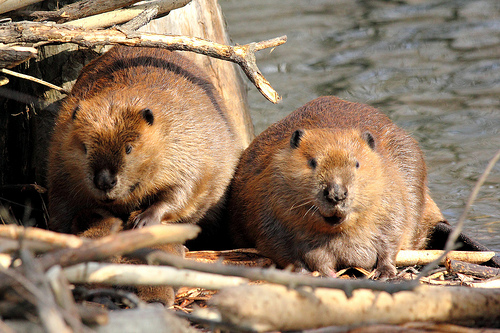
Do you beaver around a lot?

  • Beavers are rodents that are generally active at night, and their habitat is primarily water bodies in forest areas of North America, Europe and Asia.
  • Beavers spend significant quantities of time constructing and maintaining dams and other aquatic structures like lodges, that provide protection and housing, as well as water movement that allows resources to float, and they use trees that they cut down with their sharp teeth, as well as rocks, other vegetation and mud as their building materials.
  • Beavers have the scientific name Castor, while they are the only living members of the family Castoridae, and there are two extant species of beaver – Castor fiber which is known as the Eurasian species, and Castor canadensis, the North American species.
  • Beavers are able to move easily in water, and their diet consists of vegetation, particularly material from a variety of trees, including bark, leaves and twigs, as well as aquatic plants and sedges.
  • Beavers grow to lengths of 60 to 120 centimetres (23 to 47 inches), making them the second largest rodent on earth, and weigh 16 to 27 kilograms (35 to 60 pounds).
 Beaver, Brown, Two, Dam, Construction, Ten Random Facts, Flickr, Animals,
Beavers
Image courtesy of flinchlake2000/Flickr
  • Beavers have beige, red-brown, brown, almost black, or grey fur; the back feet are webbed; they have see-through eyelids; and a flat tail that acts like a rudder and provides a loud warning when slapped against water.
  • Beavers live in families in their lodges that consist of as many as ten rodents, and they are preyed on by wolves, bears and lynxes, and the animal has a lifespan of 15 to 20 years, although they can live up to 24 years.
  • Beavers body parts have been used in traditional medicine; the secretions from their castor sacs or scent glands are used in the perfume industry and as a flavouring for food; and the fur coat is a commonly poached item.
  • It is illegal to hunt or kill beavers in some countries and areas, while in other places, including parts of the United States, it is legal to trap or shoot the animal.
  • When introduced without sufficient predators, beavers can overrun habitats, causing extensive forest removal, landscape change and water flow changes, as well as other problems, and they can be a pest on farms and properties.
Bibliography:
Beaver, 2013, A-Z Animals, http://a-z-animals.com/animals/beaver/
Beaver, 2014, National Geographic, http://animals.nationalgeographic.com.au/animals/mammals/beaver/
Beaver, 2014, Wikipedia, http://en.wikipedia.org/wiki/Beaver

Amazon:     

Chisel

Chisel

Chisels, in the wrong hands, could destroy your creation.

  • Chisels are hand tools used to carve or cut objects or materials.
  • Chisels are most commonly used in the carving of wood, metal or stone, and are commonly used by woodworkers and stonemasons.
  • Chisels are typically accompanied with a force, either hand-propelled or mechanical, such as a hammer, to complete a carving action.
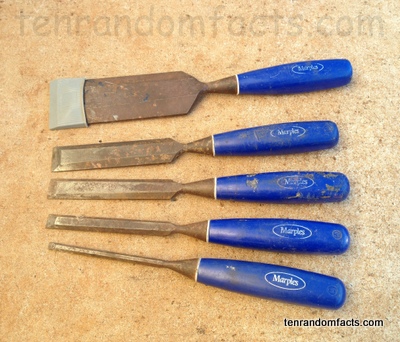
  • Chisels are generally made of a metal such as steel, with a wooden, plastic or metal grip.
  • Chisels are most often used to remove small to medium sized parts in projects, including models, devices or sculptures.

Chisel, Blue, Handle, Tool, Carpentry, Marples, Steel, Metal, Ten Random Facts

  • Chisels often have a rectangular shaped piece of metal that is quite flat and very sharp on the end, with a central upwards slope, although the ends can be various shapes, including v-shaped, and different shapes are used for different purposes.
  • Chisels originate from approximately 8000 BC, initially using a flint base material, and the appearance and use has remained virtually unchanged throughout the years.
  • Chisels come in a variety of sizes, which can make the difference between a perfect or destroyed piece of work.
  • ‘Chisel’ comes from the Old French word ‘cisel’, and originally from ‘cisellum’, which is from the common form of Latin, meaning ‘cutting tool’.
  • Chisels are often incorrectly believed to be an easy tool to master, however mastering the tool can take years of practice.
Bibliography:
Chisel, 2014, Wikipedia, http://en.wikipedia.org/wiki/Chisel
Lee E, History of the Chisel, 2014, eHow, http://www.ehow.com/about_4681861_history-chisel.html
What is a Chisel?, 2014, WiseGEEK, http://www.wisegeek.com/what-is-a-chisel.htm

Amazon:     

Related Posts Plugin for WordPress, Blogger...