Chamois

Chamois

Is a chamois a mountain climbing goat or antelope?

  • Chamois are mammals originating in Europe’s mountainous habitats, and they have an appearance similar to a goat and antelope.
  • Chamois are one of two species in the Rupicapra genus and they have the scientific name Rupicapra rupicapra.
  • The diet of a chamois consists of vegetation including grass, bark, herbs, leaves and shrubs, and they are generally 70 to 80 centimetres (28 to 31 inches) in height and weigh between 25 to 60 kilograms (55 to 132 pounds).
  • Chamois are part of the subfamily Caprinae, or group of caprids or goat-antelopes that includes domestic sheep and goats, that in turn, are from the Bovidae family, the family of horned and cloven hoofed mammals.
  • A chamois is typically brown to grey or black in colour with black and white prominent markings, including a black stripe on its back, and the fur colour changes according to the seasons.

Chamois, Mammal, Hill, Travel, Horns,  Lessinia, Ten Random Facts, Flickr
Chamois
Image courtesy of Umberto Nicoletti/Flickr
  • Female chamois generally live with their young in small groups of up to 30, although in winter they can reach numbers of up to 100; while the mostly solitary males attract these females by engaging in fellow male duels.
  • The lifespan of a chamois ranges from 15 to 17 years, and up to 22 in captivity, with main predators being lynxes, eagles, brown bears and wolves.
  • Chamois are hunted for their meat, fur and/or hide, while the latter is used to make smooth, liquid-absorbing leather known by the same name, although hunting is typically illegal.
  • Chamois can leap up to 2 metres (6.6 feet) high and 6 metres (20 ft) in length, and can move at speeds of 50 kilometres per hour (31 miles per hour).
  • Eight chamois originating from Austria,were deliberately introduced into the mountain regions of the South Island of New Zealand in the Pacific in 1907, with another two in 1914, and they have been legally hunted there since 1930.
Bibliography:
Chamois, 2013, A-Z Animals, http://a-z-animals.com/animals/chamois/
Chamois, 2014, Wikipedia, http://en.wikipedia.org/wiki/Chamois
Huffman, B, Rupicapra rupicapra: Chamois, 2004, Ultimate Ungulate, http://www.ultimateungulate.com/artiodactyla/rupicapra_rupicapra.html

Amazon:     

Fudge

Fudge

Fudge! Well at least these facts aren’t messed up.

  • Fudge is a sweet confectionery food item usually with a strong sweet flavour, that is usually eaten in small quantities.
  • Fudge is typically made of sugar, butter and milk, and sometimes corn syrup, which slows the crystallisation process, and sometimes chocolate, for flavour.
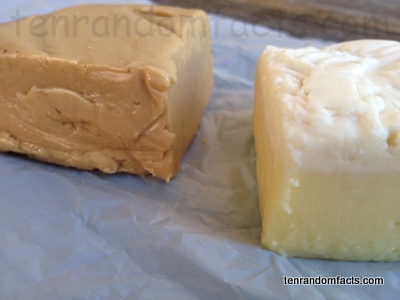
  • Fudge comes in a variety of colours, often coinciding with the various flavours available, and it may contain fruit or nuts.
  • Fudge is typically made by heating the ingredients to temperatures of up to 116°C (240°F) and allowing it to partially cool; then beating the mixture until creamy and smooth and pouring it in a pan to set, before cutting.
  • Although fudge traditionally has a smooth and creamy texture, it will become brittle or hard if cooked at higher temperatures.

Fudge, Lemon Tart, Caramel,  Blocks, Homemade, Sweets, Confectionery,  Ten Random Facts, Australia

  • Fudge can be difficult to master as incorrect crystal sizes, due to imprecise cooking times; temperatures; or cooling processes; can cause more liquid or very hard solid versions of the confectionery.
  • The origin of fudge is uncertain, however it is likely a North America invention, possibly prior to 1886; and the first known instance of commercialisation of the product is said to be in 1886 (sold for 40 cents per pound), in Baltimore in the state of Maryland, in the United States.
  • The term ‘fudge’ possibly originated from the expression of annoyance typically used when something goes wrong, in this case, when making a confectionery that turned into a different substance than expected.
  • Fudge is not very nutritious as it mostly contains large volumes of sugar and a significant portion of fat, although it has a small quantity of manganese and other vitamins and minerals.
  • Fudge is commonly presented and sold in the shape of a rectangular block, and is usually available at market stalls or specialty confectionery stores.


Bibliography:
Fudge, 2014, Wikipedia, http://en.wikipedia.org/wiki/Fudge
The Science of Fudge, 2011, The Big Bake Theory, http://bigbaketheory.com/2011/12/22/the-science-of-fudge/
What is the History of Fudge?, 2014, WiseGEEK, http://www.wisegeek.com/what-is-the-history-of-fudge.htm


Amazon:      

Playground Slide

Playground Slide

Don’t you like sliding down playground slides?

  • Playground slides are entertainment constructions often placed in recreational areas or residential backyards, as well as amusement parks.
  • ‘Playground slides’ are also known as ‘slides’, ‘slippery dips’ and ‘slippery slides’.
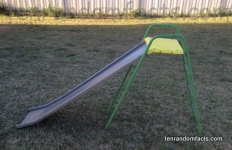
  • Playground slides are often a slippery, flat or partially curved strip of material, with barriers on the left and right, either perpendicular or sloped.
  • Playground slides are used by people, typically children, by them climbing up a ladder or set of stairs to reach the top of the slide, sitting on their backside at the top; and pushing themselves forward so that they are propelled down the slide’s strip.
  • Playground slides are commonly curved in some form, often around a structure, while some are completely enclosed, and they come in a variety of colours.

Playground Slide, Yellow, Park, Recreational, Ten Random Facts, Australia

  • Although fun, playground slides can be quite dangerous; injuries such as bruises, scrapes, cuts and broken bones can occur, often due to an unsafe user or slide, such as a high drop.
  • Playground slides are typically made of plastic, wood and/or metal, although the latter often heats up in the sun and can cause burns.
  • Adults often slide down playground slides with their children, although it is a common cause of broken legs in young children, due to the possibility of the child’s foot catching onto the slide and the force of the parent’s movement pushing the child forward with their foot still caught.
  • The origin of playground slides is uncertain, although one of the first slides patented was possibly by James Kirker of Kentucky in the United States in 1893, which was intended as a fire escape, however earlier patents exist for water slide designs, and slides were being constructed by the beginning of the 1900s.
  • Many laws have been passed regarding the legality and guidelines of construction and placement of playground slides, particularly regarding protruding devices and the slide drop.
Bibliography:
Erickson A, The Politics of Playgrounds, a History, 2012, Citylab, http://www.citylab.com/design/2012/03/politics-playgrounds-history/1480/
Kirker, J 1893, ‘Fire-escape’, US506238, 10 October, p. 1, Google Patents, Google
Playground Slide, 2014, Wikipedia, http://en.wikipedia.org/wiki/Playground_slide

Amazon:      

Great Blue Hole

Great Blue Hole

Don’t fall down the Great Blue Hole.

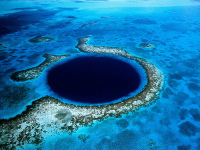
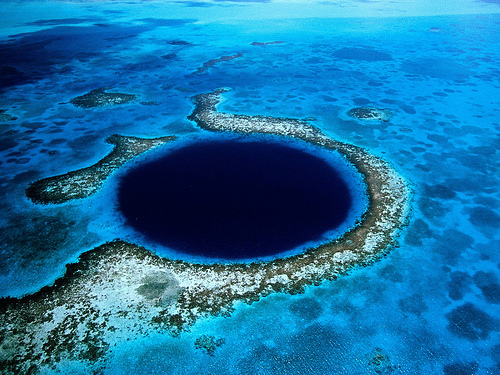
  • The Great Blue Hole is an underwater sinkhole or cave, located near Belize of Central America, in the Lighthouse Reef.
  • The Great Blue Hole is 300 metres (984 feet) in diameter, the largest of known blue holes in the world, and it measures 124 metres (407 feet) in depth.
  • The Great Blue Hole is part of the Belize Barrier Reef Reserve System that became a UNESCO World Heritage Site in 1996.
  • In 1971, explorer and naval officer, Jacques Cousteau from France, publicised the Great Blue Hole as one of the best scuba sites in the world.
  • The Great Blue Hole is the home to numerous limestone formations that are affected by karst phenomena, including stalactites.
Great Blue Hole, Cave, Water, Central America, Natural, Wonder, Amazing, Belize, Reef, Ten Random Facts, FlickrThe Great Blue Hole
Image courtesy of Eric Pheterson/Flickr
  • The Great Blue Hole is the home to many species of fauna that live around the reef that surrounds the outer rim of the hole, including the occasional reef shark.
  • The Great Blue Hole is a popular tourist destination and diving site, due to its great size, clear water, cave formations, and surrounding wildlife, and snorkeling is also popular.
  • The Great Blue Hole is said to have been originally a cave above sea level, that eventually filled with water and collapsed.
  • The Great Blue Hole can be viewed from the air, or accessed via watercraft, and boats can only anchor in specific areas, as they have caused reef damage in the past.
  • The official depth measurement of the Great Blue Hole was recorded in 1997 by the Cambrian Foundation, and the expedition’s primary focus was to collect seafloor samples from the hole.
Bibliography:
Blue Hole Natural Monument, 2008, Belize Audubon Society, http://www.belizeaudubon.org/?page_id=3603
Great Blue Hole, 2014, Atlas Obscura, http://www.atlasobscura.com/places/great-blue-hole
Great Blue Hole, 2014, Wikipedia, http://en.wikipedia.org/wiki/Great_Blue_Hole

Amazon:     

Scorpion

Scorpion

You’ll regret being stung by a scorpion.

  • Scorpions are anthropods belonging to the order Scorpiones, which is also their scientific name, that consists of 13 families and approximately 1750 species, plus around 110 that are extinct.
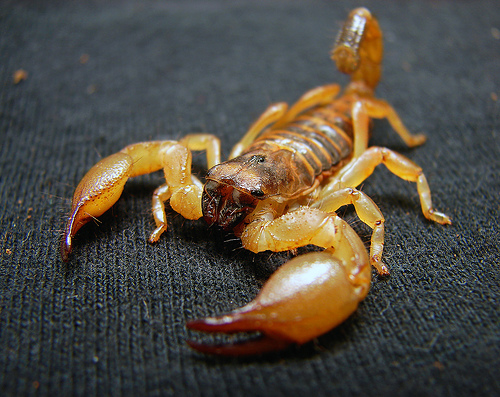
  • Scorpions have two claw-shaped pedipalps; a long segmented body, and a long segmented erect tail, tipped with a stinger and venom.
  • Scorpions are related to spiders, and of the thousands of species, only around 25 to 40 can actually cause a human fatality, and they are preyed on by birds, lizards, rodents and possums.
  • Scorpions are native worldwide, with the exception of Antarctica, although they were introduced to some Pacific Islands, including New Zealand, as well as Europe’s Great Britain.
  • Scorpions can be found in a wide variety of habitats, and typically live in holes in the ground or other similar shelters during the day, and are active during the night.
Scorpion, Yellow, Orange, Arthropod, Close,  Animal, Ten Random Facts, Flickr, Amazing
Scorpion
Image courtesy of Matt Reinbold/Flickr
  • Scorpions are capable of living up to a year without food, and their diet mainly consists of insects, spiders and some small reptiles and mammals, that are trapped via their pincers and/or dangerous venom; and they liquidize their prey before consumption.
  • Scorpions produce from 1 to 105 young over a period of a few weeks, while the young are dependent on their mother and live on her back until their first moult.
  • Scorpions are fried and traditionally consumed in Asia’s China, where a wine made from the creature is also used as medicine.
  • Scorpions range from less than 1 centimetre (0.4 inches) in length, to 21 centimetres (08.3 inches) and weigh 10 to 100 grams (0.4 to 3.5 ounces).
  • Scorpions are typically coloured black, white, red, brown or yellow, and when placed underneath an ultraviolet light, they may emit a fluorescent colour.
Bibliography:
Scorpion, 2013, A-Z Animals, http://a-z-animals.com/animals/scorpion/
Scorpion, 2014, National Geographic, http://animals.nationalgeographic.com.au/animals/bugs/scorpion/
Scorpion, 2014, San Diego Zoo, http://animals.sandiegozoo.org/animals/scorpion
Scorpion, 2014, Wikipedia, http://en.wikipedia.org/wiki/Scorpion

Amazon:     

Thumbtack

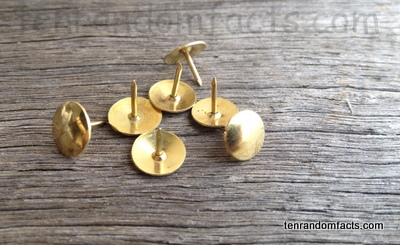
Push pin, gold, rustic, Thumb Tack, Drawing Pin, Flat head, metal, Ten Random Facts, Invention

Be careful not to drop your thumbtacks.

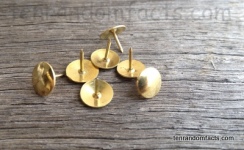
  • Thumbtacks are small items that have a ‘head’ attached to a sharp tip, or body, which can be inserted into a board to hold items in place or used as a marker.
  • ‘Thumbtacks’ are also known as ‘map tacks’, ‘push pins’, ‘drawing pins’, and ‘chart pins’, with various word combinations, sometimes without spaces or with hyphens.
  • Thumbtacks bodies are typically made of metal such as brass, tin, stainless steel or iron, and the head is usually plastic, wood or metal.
  • Thumbtacks are typically pushed into a softer solid, like cork, using one’s fingers and arm strength.
  • Thumbtacks traditionally have a circular or cylindrical head, although they can be other shapes, and the head can be raised, flat, bevelled or indented.

Push pin, gold, rustic, Thumb Tack, Drawing Pin, Flat head, metal, Ten Random Facts, Invention

  • Swallowing thumbtacks can cause great internal damage, including choking and tissue damage.
  • Contrary to popular belief, the thumbtack was invented as early as the mid 1870s, although the British term ‘drawing pin’ was in use sometime in the 1850s or 1860s, and patents exist for the item as early as the 1890s.
  • Thumbtacks can be dangerous if dropped and left unnoticed on the floor, as upward facing pins can be easily stepped on, although some designs are more likely to face downwards if dropped.
  • Thumbtacks were historically used by draftsmen for the purpose of attaching paper to a drawing board, hence the name ‘drawing pin’.
  • Thumbtacks come in a variety of sizes, colours and shapes, that are often used for different purposes, such as in art or as markers, and they are generally considered as stationery items.
Bibliography:
Drawing Pin, 2014, Wikipedia, http://en.wikipedia.org/wiki/Drawing_pin
The Invention of the Push Pin and Its Usages Today, n.d, Answers, http://invent.answers.com/clothing/the-invention-of-the-push-pin-and-its-usages-today

Amazon:        

Related Posts Plugin for WordPress, Blogger...