Panjin Red Beach

Panjin Red Beach

Panjin Red Beach is bright and beautiful.

  • Panjin Red Beach is a beach located in the southern area of Liaoning Province, in northeast China.
  • Panjin Red Beach is covered in flora, notably the brightly coloured and edible Suaeda salsa plants from the family Amaranthaceae, the family of amaranths.
  • ‘Panjin Red Beach’ is also known as ‘Red Seabeach’, ‘Red Beach’ and the ‘home of the cranes’.
  • Panjin Red Beach is part of the 100 square kilometre (38.6 square mile) Red Beach Scenic Area, as well as the Panjin wetlands, that is the home to 260 birds and 399 other fauna, including rare and endangered species of crane.
  • Panjin Red Beach became a protected area as part of the Panjin wetlands in 1988, and was declared a ‘National Nature Reserve’, and it has since become a popular tourist destination.
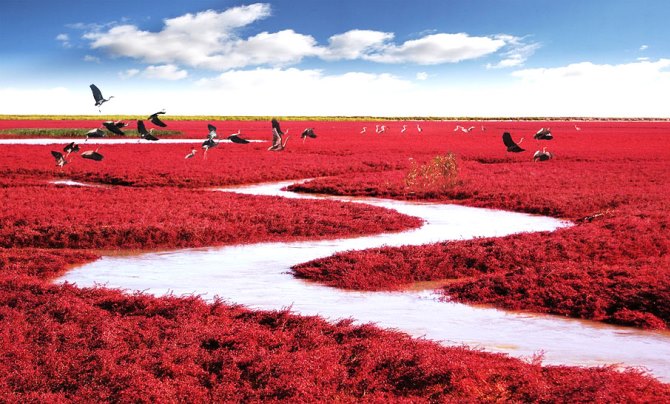
Panjin Red Beach, Bright, Red, China, Ten Random Facts, Seaweed, Lovely, Wonderful
Part of Panjin Red Beach
Image courtesy of Free York
  • Panjin Red Beach is named due to the Suaeda salsa plants that change from the colour green, to orange, pink and eventually a stunning bright red.
  • Panjin Red Beach wetlands area is the home to many species of reed, which are commonly used to make paper, and large sections of the Panjin wetlands have been cultivated for this purpose.
  • While the area is vast, the area of Panjin Red Beach that can be visited by the public is small, and the best time to visit is in mid September through to mid October, when the colour is at its best.
  • The nearest city to Panjin Red Beach by distance is Panjin City, approximately 30 kilometres (19 miles) away.
  • The soil of Panjin Red Beach has a high content of alkaline, which causes soil to be unsuitable for most plants, although the saline loving Suaeda salsa grows prolifically.
Bibliography:
Panjin Red Beach, China, 2011, Amusing Planet, http://www.amusingplanet.com/2011/11/panjin-red-beach-china.html
The Red Beach in Panjin, China, 2014, Where on Earth, http://whenonearth.net/red-beach-panjin-china/
Red Seabeach, 2014, Wikipedia, http://en.wikipedia.org/wiki/Red_Seabeach
Wang, L, On the Countermeasures of Panjin Coastal Wetland Protection in Liaoning Province, 2010, Canadian Center of Science and Education, http://ccsenet.org/journal/index.php/ass/article/download/5675/4592
Red Beach, 2014, Baidu, http://baike.baidu.com/view/83704.htm

Amazon:   

Axolotl

Axolotl

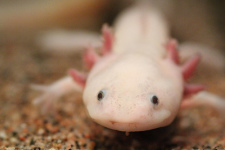
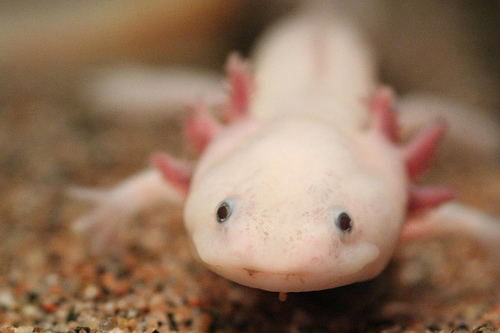
Axolotls are unique but a little bit creepy.

  • Axolotls are amphibians that live permanently in water habitats, and they are native to Central America’s Mexico.
  • ‘Axolotls’ are also known as ‘Mexican salamanders’ and ‘Mexican walking fish’, and they typically grow to be 15 to 45 centimetres (6 to 18 inches) in length, and weigh 60 to 200 grams (2 to 7 ounces).
  • Axolotls have the scientific name Ambystoma mexicanum and are from the family Ambystomatidae, the family of mole salamanders, and while they are from the salamander family, they do not progress beyond the larval stage.
  • An axolotl has a large head, miniscule teeth and no eyelids, as well as external gills that appear like a frill around its neck, and a long fin running down its back.
  • Axolotls are generally black or brown in colour, although they can be gold, grey, pale pink or almost white.
Axolotl, Pink, Looking, Face, animal, Pet, Ten Random Facts, Flickr, Mexican Walking Fish
Axolotl
Image courtesy of Ruben Undheim/Flickr
  • The diet of axolotls generally consists of worms, insects and little fish, and after they have seized their food, it is pulled into their body by an internal suction.
  • Axolotls are known for their regenerating properties, regrowing limbs, as well as organs, and they can also adapt and use another’s body part.
  • Axolotls are critically endangered due to the expansion of Mexico City and the pollution it causes and remaining suitable habitats are also threatened by introduced species of fish.
  • An axolotl can lay 100 to 1000 eggs at one time and the eggs become attached to surrounding natural objects that protect them, due to their adhesive nature.
  • Axolotls can move up to speeds of 17 kilometres per hour (10 miles per hour) and live approximately 10 to 20 years, and while their predators are birds and fish, they are not often preyed upon.
Bibliography:
Axolotl, 2013, A-Z Animals, http://a-z-animals.com/animals/axolotl/
Axolotl, 2014, Wikipedia, http://en.wikipedia.org/wiki/Axolotl

Amazon:     

Marshmallow

Marshmallow

Toasting marshmallows over the campfire, what a traditional thing to do!

  • Marshmallows are sweet confectionery food items made primarily of sugar.
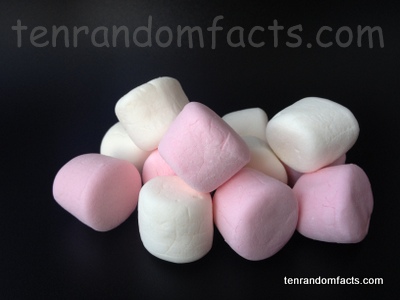
  • Homemade marshmallow is generally cut into square shaped portions, while commercially manufactured pieces are generally cylindrical in shape, although the shapes can vary.
  • Marshmallows were originally made from the root or sap of the mallow plant, Althaea officinalis, a plant that is said to grow near salt marshes, hence the name of the confectionery, and was also commonly used for medicinal purposes.
  • Marshmallow is generally coloured white, although other colours can be achieved through food colouring and pink is a popular coloured variety.
  • Marshmallows are typically made from sugar and corn starch, although wheat starch is sometimes used, as well as egg or gelatine, which helps to prevent the mixture from collapsing, and flavouring is also often included.

Marshmallow, bundle, white, pink, confectionery, cylindrical, traditional, Australia, Ten Random Facts

  • Marshmallow confectionery, that was made of mallow sap and honey, was invented in Ancient Egypt, and was only available to pharaohs, and it wasn’t until the 1800s that the French invented the fluffy style of confectionery that is now eaten.
  • Marshmallows are a sweet snack food that are eaten as is; used as an addition to hot chocolate; are commonly used as an ingredient in other confectionery items, such as rocky road or puffed rice slices or sweets; and are often coated in chocolate.
  • Alex Doumak, an inventor from America, invented a marshmallow extruding machine in 1948, that allowed for mass production and ease of process, and it created cylinder shaped confectionery due to the tubes that it passed through.
  • Marshmallows are often slightly cooked over campfires or other heat sources, which causes the inside to melt and become gooey.
  • Marshmallows contain small amounts of copper, are very high in carbohydrates (sugar) and contain virtually no fat.


Bibliography:
History of Marshmallow, 2014, Boyer, http://www.boyercandies.com/mallo-history.aspx
History of the Marshmallow, 2014, Campfire, http://www.campfiremarshmallows.com/about/history-of-the-marshmallow/
Marshmallow, 2014, Wikipedia, http://en.wikipedia.org/wiki/Marshmallow

Amazon:      

Toy Marble

Toy Marble

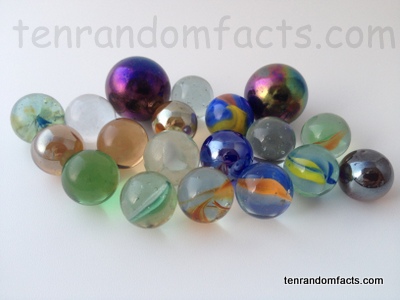
Flick the marble down the hill.

  • Marbles are small ball-shaped toys that have a diameter averaging 1.3 to 2.5 centimetres (0.5 to 1 inch), but they can be as big as 7.6 centimetres (3 inches) and as small as 0.1 of a centimetre (0.03 of an inch).
  • Marbles are most commonly made of glass, although steel, ceramic, plastic or clay is sometimes used.
  • Marbles are often used to play games of the same name, with various rules that usually involve rolling or tossing one at a group of others, often to push them out of a boundary.
  • Marbles were invented thousands of years ago, and were a popular item in Ancient Egypt and Rome.
  • Marbles became commercially viable in the 1800s, particularly later in the century, after American Samuel Dyke and others started mass producing them, as the toy was previously individually handmade.

Marble, Group, Many, Assorted, Colourful, Ten Random Facts, Toy, Glass

  • The British and World Marbles Championships has occurred annually in England’s West Sussex, in Europe since 1932, and other competitions are held around the world, including the United States, and Australia.
  • Marbles typically contain brightly coloured patterns including swirls, although solid colours, clear ones, and others with imagery are also available.
  • Marbles are often collected, due to the variety and value of some, and very rare specimens can sell for up to $10,000, although the value of more common examples can be halved if any defects such as chips or cracks are present.
  • Marbles are often made by melting recycled glass, that is then cut into even portions and dropped onto moving rollers that allow the malleable glass to form balls as they cool.
  • Marbles, said to be named due to the stone that they were manufactured from in the past, have been historically made of clay, and they were also produced using glass or stone.
Bibliography:
A Brief History of the Birth of the Modern American Toy Industry in Akron, Ohio, 2008, American Toy Marble Museum, http://www.americantoymarbles.com/akronhist.htm

History of Marbles, 2012, Oh Marbles!, http://www.imarbles.com/historyofmarbles.php
Marble (Toy), 2014, Wikipedia, http://en.wikipedia.org/wiki/Marble_(toy)

Amazon:     

Hello Kitty

Hello Kitty

“Happiness comes in all colours of the rainbow!” – Hello Kitty

  • Hello Kitty is a licensed, cartoon-style character created as an icon and promotional device for Sanrio, a Japan-based company, and it has become the biggest seller for the company, as well as having been one of the top grossing characters in Japan.
  • ‘Hello Kitty’ is known as ‘Harōkiti’ in Japanese-rōmaji and her complete name is ‘Kitty White’ or ‘Kiti Howaito’ in rōmaji; her birthday is the 1st of November; and she is known as a ‘symbol of friendship’.
  • Hello Kitty has the appearance of a clothed, upright, white, Japanese bobtail cat with a red or pink bow on the left ear and  human personality traits, and she is as tall as 5 apples and weighs as much as 3 apples.
  • Hello Kitty is described as a kind and happy British girl from London, that loves to bake, make new friends, listen to music, travel and read, and she has a twin sister named ‘Mimmy’, a pet hamster named ‘Sugar’, and a pet cat named ‘Charmmy Kitty’.
  • Hello Kitty was originally designed by Japanese designer, Yuko Shimizu, for Sanrio in 1974, due to the company noticing that cute designs increase sales, while the second designer was Setsuko Yonekubo, and the third designer was Yuko Yamaguchi.
Hello Kitty, Logo, Japanese, Sanrio, Ten Random Facts, Face, British, Cartoon, Mascot
Hello Kitty
Image courtesy of Sanrio
  • Hello Kitty’s image was first sold on a purse in 1974, increasing company profits significantly, and appearing in the United States in 1976, although by the late 1970s she had lost popularity.
  • Hello Kitty does not have a mouth, which means she can portray a variety of emotions, and consumers can relate differently to her, depending on their mood.
  • Hello Kitty overcame her significant slump in the late 1970s after Yuko Yamaguchi, her third designer, took over, as she created a story for her, and improved the appearance and style of the character.
  • Hello Kitty was originally designed for young girls, although this market was enlarged to encompass teens and adults by the 1990s, and in 2008, Hello Kitty was featured on 50,000 products, and was worth $7 billion on the icon’s 40th anniversary in 2014.
  • Hello Kitty has been depicted on products ranging from clothing, personal items, credit cards, cafes, household items and transport, and she has been featured in video games and a number of television series, as well as a music album.
Bibliography:
Hello Kitty, 2014, Wikipedia, http://en.wikipedia.org/wiki/Hello_Kitty
Hello Kitty, My Melody, Badtz-Maru and other Sanrio characters at SanrioTown.com, 2011, Sanriotown, http://hello-kitty.sanriotown.com/
Interview: Third Hello Kitty Designer Yuko Yamaguchi, 2014, Tokyo Otaku Mode, http://otakumode.com/news/53856f4a935d07d66400069c/

Amazon:     

Zion National Park

Zion National Park

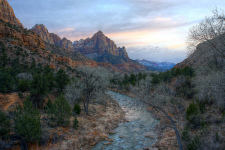
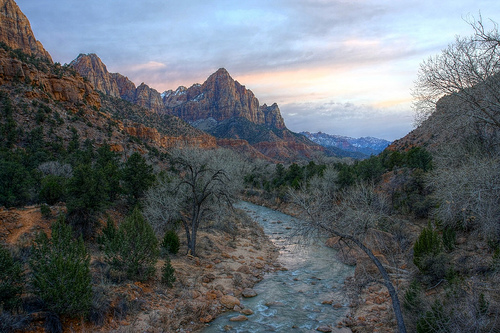
Zion National Park is a park of many habitats.

  • Zion National Park is a natural park found in the area adjacent to Utah’s Springdale, in the United States of America.
  • Zion National Park covers an area of 593 square kilometres (229 square miles), and features forest, desert and riverside habitats, with sandstone canyons and steep cliffs, waterfalls and gorges.
  • ‘Zion National Park’ was originally named ‘Mukuntuweap National Monument’, issued when it was first protected in 1909, by the then president of the United States, William Taft.
  • Zion National Park’s indigenous name was changed to ‘Zion National Monument’ in 1918, as the former name was not favoured, due to Mormon folk who had occupied and previously referred to the area as ‘Zion Canyon’.
  • The highest peak of Zion National Park is named Horse Ranch Mountain, reaching a height of 2,660 metres (8,726 feet).
Zion National Park, Sunset, River, Rocks, Water, United States of America, Ten Random Facts, Flickr
Part of Zion National Park
Image courtesy of Rene Schwietzke/Flickr
  • Zion National Park has a varied climate, with snow in the winter and hot, desert-like summer temperatures, as well as storms and flash flooding.
  • Zion National Park is said to have been first visited by Europeans in 1776, by Franciscan priests Silverstre Escalante and Francisco Domínguez, while in the mid 1800s the area was explored, and in the early 1860s Mormon farmers established agriculture enterprises in the area with produce like sugar cane, tobacco and fruit.
  • Zion National Park is hit by floods each year due to high rainfall, and the water removes up to a combined total of 2.7 million tonnes (3 million tons) of earth and stone from the canyon area via the Virgin River annually.
  • Many species of animal reside in Zion National Park, like the fox, coyote, jay, deer and squirrel, and there are more than 65 mammal species, over 200 bird species, almost 30 reptile species and a number of water creatures, as well as much flora, including cacti and pine and at least a thousand other species of plants.
  • Zion National Park is visited by up to 3 million tourists annually, and rock-climbing, horse-riding, bird watching and hiking are popular activities.
Bibliography:
Zion National Park, 2014, National Geographic, http://travel.nationalgeographic.com.au/travel/national-parks/zion-national-park/
Zion National Park, 2014, Wikipedia, http://en.wikipedia.org/wiki/Zion_National_Park
Janiskee, B, Would You Love Zion National Park As Much If It Were Called Mukuntuweap National Park?, 2008, National Parks Traveller, http://www.nationalparkstraveler.com/2008/07/would-you-love-zion-national-park-much-if-it-were-called-mukuntuweap-national-park
Zion: Nature and Science, 2014, National Park Service, http://www.nps.gov/zion/naturescience/index.htm

Amazon:     

Related Posts Plugin for WordPress, Blogger...