Indri

Indri

An indri is an exotic lemur of Madagascar.

  • Indris are primates, as well as the biggest extant lemur, and are native to Africa’s largest island, Madagascar.
  • Indris have the scientific name Indri indri, and are from the family Indriidae, the family of strepsirrhine primates of large and medium lemurs.
  • ‘Indris’ are also known as ‘babakotos’, meaning ‘father’ in the Malagasy language, and they are preyed on by snakes, birds of prey and fossas.
  • Indris can make sounds that are song-like, that have been compared to those of whales and can be projected for over three minutes, while roars, hums, wheezes and grunts are also common noises.
  • The diet of an indri mainly consists of recently sprouted leaves, as well as fruit, flowers and seeds and they spend most of their time in trees.

Indri, Lemur, Black, White, Primate, Ten Random Facts, Animal, Madagascar, Flickr
Indri
Image courtesy of Frank Vassen/Flickr
  • Although protected in national parks, indris are endangered on a critical level due to habitat loss from logging and agricultural practices, much of which occurs illegally, as well as poaching.
  • Indris are typically considered sacred by native folk to the area, and are often depicted in legends associated with humans.
  • Indris can grow to be 64 to 72 centimetres (25 to 28 inches) in height and generally weigh 6 to 9.5 kilograms (13 to 21 pounds).
  • Indris have fur typically coloured in a combination of white, grey and black or brown, and usually have distinct areas of colour.
  • Indris typically live to be 15 to 22 years in the wild, while barely surviving in captivity, and they reproduce one baby at a time.
Bibliography:
Indri, 2013, A-Z Animals, http://a-z-animals.com/animals/indri/
Indri, 2014, Wikipedia, http://en.wikipedia.org/wiki/Indri

Amazon:       

Curry Powder

Curry Powder

Do not let the curry powder burn your mouth… or these facts burn your brain.

  • Curry powder is a preparation of spices used primarily in dishes to add flavour and a pleasant smell.
  • Curry powder is made primarily of spices, most often turmeric, cumin and coriander, but the mixture also often contains chilli and fenugreek, and sometimes garlic and ginger.
  • Curry powder typically produces both a flavour and a curry similar to foods from Asia’s south and it is often spicy.
  • Curry powder is often used in curry sauces, but also dishes that require a distinct flavour, and the mixture can be homemade or commonly available in supermarkets or Asian grocery stores.
  • Curry powder most likely arrived in European society in 1771, and an advertisement for the product appeared in a British newspaper, dated 1784.

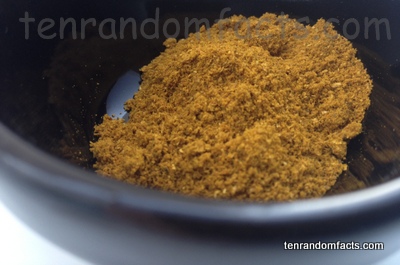
Curry Powder, Orange, Brown, Spicy, Ten Random Facts, Flavour, Australia, Food, Asian Culinary

  • Curry powder became common in the 1800s and 1900s after the introduction of machines that can mass produce, as well as becoming a widespread and popular export.
  • Curry powder became increasingly popular in 1960s to 1970s with the demand and supply of Indian cuisine.
  • Curry powder is typically coloured yellow, orange, red, grey or brown, depending on the spice mix, and the powder particles are often very fine, but vary in size.
  • Commercially bought curry powder often loses its prominent taste and strength after lengthy storage times, and usually starts deteriorating from six months.
  • Curry powder is high in fibre, vitamin E, vitamin K, iron and manganese, and is said to help protect against inflammation and cancer.


Bibliography:
Breslin F, Currying Flavor, 2012, Cook for Your Life, http://www.cookforyourlife.org/ingredients/90-curry-powder
Curry Powder, 2014, Wikipedia, http://en.wikipedia.org/wiki/Curry_powder
History of Spice and Curry Powder, n.d, Vijay, http://www.vijaymasala.com/?page_id=364
Kelley L, The Origins of Curry Powder, 2013, Silk Road Gourmet, http://www.silkroadgourmet.com/curry-powder/

Amazon:      

Hammer

Hammer

Hear those hammers striking iron early in the morning.

  • Hammers are tools used primarily to imply a sharp force on to an object, often to force an item into another.
  • Hammers are often used to secure nails, shape metal or apply components, as well as crush and destroy objects.
  • Hammers have been used since the Stone Ages, and were made of rock, used for carving and breaking items including stone, wood and bone.
  • Hammers most often require a human force to become useful, although mechanical and electrical versions are available.
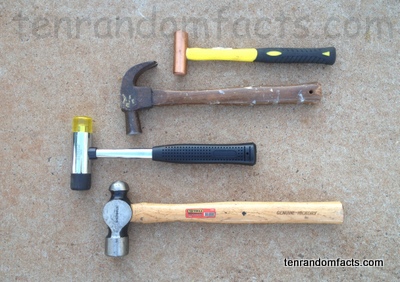
  • Hammers generally are made of a handle and a head, and the head is often shaped and has a flat sided knob that often impacts the item, and sometimes a claw on the opposite end.

Hammer, many, Four, Claw, Mallet, Flat, Knob, Invention, Construction, Ten Random Facts,

  • The head of hammers are generally made of metal, often steel, due to having a suitable mass, although they can be wooden, and these have a softer impact which helps to prevent damage to the item being hit.
  • The claw of a hammer is commonly used to grasp unwanted nails and remove them from the driven object, and there is increased power due to the leverage occurring.
  • Titanium hammer heads have been proven to absorb most recoil from the force of the impact, with recoil being up to ten times greater in typical steel heads.
  • Hammers are often used to symbolise mining, industrial and manufacturing workplaces, and they were adapted as a close combat weapon, used in the late medieval times, although they were larger and heavier than the modern device.
  • The most common style is the claw hammer, that typically weighs between 455 to 680 grams (16 to 24 ounces).


Bibliography:
Different Types of Hammers, 2014, Diydata, http://www.diydata.com/tool/hammer/hammers.php
Hammer, 2014, Wikipedia, http://en.wikipedia.org/wiki/Hammer

Amazon:      

Giant Crystal Cave

Giant Crystal Cave

Giants do not live among crystals in Giant Crystal Cave – the crystals are the giants.

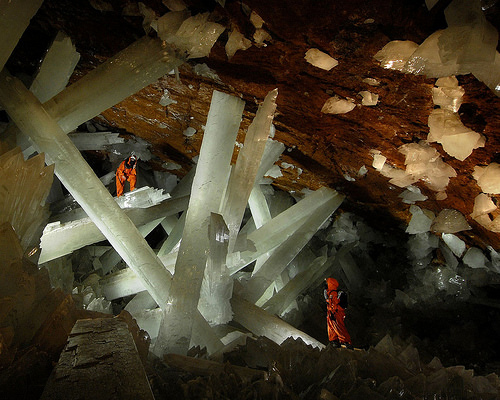
  • Giant Crystal Cave is a cave located in the Naica Mine in Chihuahua’s Naica, in Mexico, in southern North America, at a depth of 300 metres (980 feet).
  • ‘Giant Crystal Cave’ is also known as ‘Cave of the Crystals’, ‘Cave of Crystals’ and ‘Cave of Giant Crystals’.
  • Giant Crystal Cave is the home to some of the largest natural crystals discovered on earth and the crystals are made of selenite, a type of gypsum.
  • The largest crystal of Giant Crystal Cave is said to reach a length of 12 metres (39 feet), a diameter of 4 metres (13 feet) and is believed to weigh approximately 50 tonnes (55 tons).
  • Giant Crystal Cave boasts very high temperatures, averaging 58°C (136°F) and has humidity above 90%, making the cave difficult and dangerous to explore.
Giant Crystal Cave, Mine, Naica, Mexico, Large, Men, Ten Random Facts, Places, Gypsum
Part of Giant Crystal Cave
Image courtesy of Julie Rohloff/Flickr
  • Giant Crystal Cave is situated above a magma chamber, that emanates great heat, and due to the mineral rich water originally in the cave, the undisturbed environment and hydrothermal circulation, the huge crystals had the opportunity to form over thousands of years.
  • Giant Crystal Cave was first discovered in the year 2000 while drilling tunnels in the mine, although the area is to said to have been drained of water since 1975; and while it is possible that the cave may be closed in the future, doing so will allow water levels to rise and the crystals to recommence growing.
  • Giant Crystal Cave is generally only visited by scientists, such as the expedition in 2006 led by crystallographer Paolo Forti, of Italy’s University of Bologna, Europe, that required the invention of special suits.
  • There are possibly more chambers connected to Giant Crystal Cave, however access would require the destruction of numerous crystals.
  • Giant Crystal Cave is owned privately by Industrias Peñoles, a Mexican mining company that mines primarily zinc, silver and lead from the Naica Mine, and the site is not open to the public.
Bibliography:
Cave of the Crystals, 2014, Wikipedia, http://en.wikipedia.org/wiki/Cave_of_the_Crystals
Mexico’s Cave of Giant Crystals, n.d, Crystalink, http://www.crystalinks.com/mexicocrystals.html
Naica Mine, 2014, Wikipedia, http://en.wikipedia.org/wiki/Naica_Mine
Naica, 2014, Proyecto Naica, http://www.naica.com.mx/english/

Amazon:     

Giant Clam

Giant Clam

You may not be a giant when next to a giant clam.

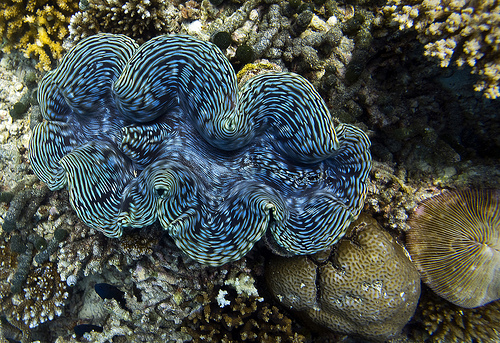
  • Giant clams are very large bivalves, shells with two pieces that are hinged together, and are native to the Indian and Pacific oceans, in coral reefs.
  • The giant clam has the scientific name Tridacna gigas, and is a mollusc from the family Cardiidae, the family of cockles, and it is commonly believed to be the largest extant bivalve, and while it is the heaviest, longer specimens of Kuphus polythalamia have been found.
  • Giant clams typically range from 90 to 120 centimetres (35 to 47 inches) in length, and can weigh 100 to 200 kilograms (220 to 440 pounds), although they can grow larger.
  • The diet of a giant clam primarily consists of nutrients produced by algae that the clam plays host to and with which it lives in a photosymbiosis relationship, and it also consumes plankton and sometimes other plant and animal matter.
  • Giant clams possibly grow around 12 centimetres in length annually, until maximum length has been reached, and they have a lifespan spanning approximately 20 to 100 years in the wild.
Giant Clam, Underwater, Blue, Bright, Beautiful, Animal, Mollusc, Flickr, Blue-lipped Clam, Ten Random Facts, Tridacna gigas
Giant Clam
Image courtesy of Malcolm Browne/Flickr
  • Once a giant clam has found a favourable location, it settles there and does not re-position itself ever again, however, they do have predators, that include eels; fish; starfish; and snails, that are smaller than the clam itself, and once attacked, they will be slowly eaten by their enemies.
  • Giant clams are vulnerably endangered due to coral reef habitat destruction as well as over-fishing partly due to the clam being considered as a delicacy.
  • Giant clams usually close in self defense, but quite slowly, and often not all the way, and while they have often been regarded as highly dangerous and fatal, this is considered a myth and no known fatalities have occurred.
  • Giant clams have a combination of colours that vary, and include yellow, red, orange, green, pink, blue and brown, and it is said that every clam is unique in its appearance.
  • Giant clams are said to be able to produce 500 million eggs at once, that are released in the ocean and once fertilised, they quickly hatch and produce a shell.
Bibliography:
Giant Clam, 2013, A-Z Animals, http://a-z-animals.com/animals/giant-clam/
Giant Clam, 2014, National Geographic, http://animals.nationalgeographic.com.au/animals/invertebrates/giant-clam/
Giant Clam, 2014, Wikipedia, http://en.wikipedia.org/wiki/Giant_clam

Amazon:      

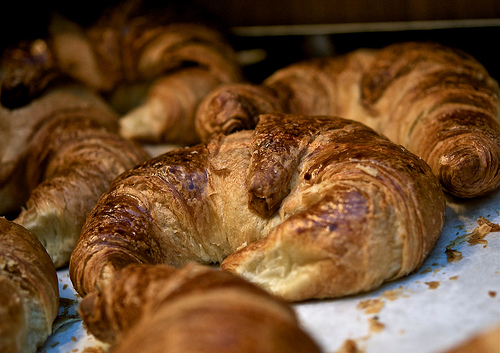
Croissant

Croissant

Do you eat croissants for breakfast?

  • Croissants are puffy bakery food items that are typically flaky and buttery in texture, that are usually tan or light brown in colour.
  • Croissants are said to have been derived from a yeast-dough pastry named ‘kipfel’, in Austria, Europe, that may have its origins as early as the 1200s, although it is possible that they did not exist until the 1600s.
  • Croissants are mainly made with butter and a bread like dough containing yeast, and can be filled and flavoured with numerous foods including chocolate, nut, ham, cheese, dried fruits and apple
  • Croissants are traditionally crescent in shape, but can be spherical or cylindrical, and the typical shape is said to have originated from the Austrian kipfel.
  • Croissants are popularly eaten during breakfast, commonly sold as a type of fast food, and are often sold frozen so that they can be thawed and heated at home.

Croissant, Golden, Cooked, Bakery, Delicious, Flakey, Batch, Ten Random Facts, Food, Flickr, Invention

Croissants
Image courtesy of Zdenko Zivkovic/Flickr
  • There are many legends regarding the history of the croissant, and the most popular is that it originates in the late 1600s, when bakers created crescent shaped pastries based on the Turkish flag, due to the Turks having been defeated by their enemies.
  • The term ‘croissant’ was named after the French word for ‘crescent’, referring to the traditional shape.
  • While the origin of croissants is uncertain, they were probably introduced to France in the late 1830s, by officer August Zang from Austria, in a bakery that he owned and was located in France’s Paris, in Europe.
  • Croissants are typically made by folding butter into dough, rolling the dough into sheets, and then continuing the folding and rolling process known as ‘laminating’, before cutting and rolling into a crescent shape and baking in an oven.
  • Croissants have significant quantities of sodium, selenium, folate and thiamin and are also high in fat.
Bibliography:
Croissant, 2014, Wikipedia, http://en.wikipedia.org/wiki/Croissant
Origins of the Croissant, 2009, The Hungarian Girl, http://thehungariangirl.com/2009/08/12/history-of-the-croissant/
Olver, L, FAQs: Bread, 2014, Food Timeline, http://www.foodtimeline.org/foodbreads.html#croissants

Amazon:      

Related Posts Plugin for WordPress, Blogger...