Origami

Origami

Did you know that there is an art to folding paper? Well, it is called origami.

  • Origami is the art of folding paper, generally without cutting or gluing, that is believed to have originally started in the first or second century AD, in China.
  • Origami generally involves folding a square piece of paper into a two or three dimensional object, while the most common or well known folded object is a paper crane (bird) or ‘orizuru’.
  • In the sixth century AD, origami was introduced to Japanese people, and it eventually became ingrained into the Japanese culture, so much so, that it has been, and is still strongly associated with Japan.
  • Origami paper sizes typically range from 2.5 to 25 centimetre (1 to 10 inch) squares, although they can be larger, and the most common size is 15 cm (5.9 inches).
  • Although folding paper in origami is typically performed by hand only on a smooth surface, tools including a scorer, embosser, paper clips and tweezers can be used for better folds or holds.
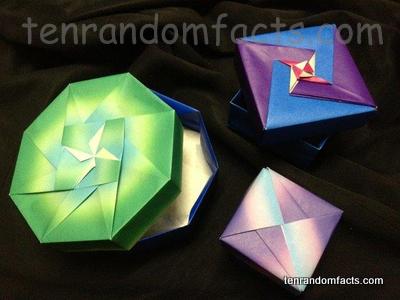
Origami Boxes, Coloured, Green, Purple, Bright, paper, Art, Ten Random Facts, Invention, Craft

  • Some origami models have moving mechanisms once interacted with, and designs include simple jumping frogs and flapping wings to complex models of a figure playing a paper instrument.
  • ‘Origami’ comes from the Japanese words ‘ori’ and ‘kami’ meaning ‘fold’ and ‘paper’ respectively.
  • The final design size of an origami model is dependent on the paper size; and a number of computer programs have been designed that can simulate the art of paper folding, and can also create designs.
  • Origami has a strong link to mathematics, and can be seen used in practical solutions such as airbags in vehicles, and it has been a common subject of copyright issues, as designs have been often stolen and republished.
  • Origami paper is available in a wide range of colours and patterns, that usually range between 55 to 90 gsm in weight, and the paper is often thin, allowing for ease of folding.
Bibliography:
History, n.d, Kid’s Web Japan, http://web-japan.org/kidsweb/virtual/origami/origami01.html
Origami, 2014, Wikipedia, http://en.wikipedia.org/wiki/Origami

Amazon:     

Isaac Newton

Isaac Newton

“We build too many walls and not enough bridges.” – Isaac Newton

  • Isaac Newton was a scientist and mathematician who was an important contributor to the field of physics and its discoveries.
  • Isaac Newton was born on Christmas day, the 25th of December, in 1642 (on the Julian calendar) in Woolsthorpe, in England’s Lincolnshire county in Europe, and he did not meet his father, who had died three months earlier.
  • Isaac Newton spent a number of years at The King’s School in Grantham, England, and was discharged by his mother, who wanted Newton to become a farmer, much against the juvenile’s wishes, although he did later return to school.
  • In 1661, Isaac Newton extended his education at Trinity College in Cambridge, England, and earned himself a scholarship in 1664 that continued until the completion of his degree, that was awarded to him in 1669.
  • Isaac Newton was quite knowledgeable on the subject of mathematics, producing many papers, and among many other things, he discovered the visible spectrum through a prism, defined the laws of motion and gravity and created the concept of Newtonian fluid.

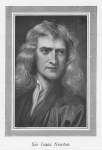
Isaac Newton, Portrait, Sketch, Sir, Pencil, Old, Ten Random Facts, Scientist, Gravity, Motion, Flickr, Human

Portrait of Sir Isaac Newton
Image courtesy of Paukrus/Flickr
  • Isaac Newton died at age 84 on 20 March 1726/7, in the capital of England, London, and was laid to rest at Westminster Abbey, and his death may have been caused by mercury poisoning.
  • Isaac Newton is commemorated by a number of statues, including one at Oxford University Museum and one at Westminster Abbey, and he is known officially as ‘Sir Isaac Newton’, as he was knighted in April 1705 by Queen Anne.
  • A tooth that is believed to have been that of Isaac Newton’s, was sold in 1816 for £730 and in 2001 was said to be worth £25,000 or US$35,7000.
  • It is commonly believed and accepted, that Isaac Newton decided to look into gravity after watching an apple fall from an apple tree.
  • Isaac Newton became ‘Master’ of the Royal Mint in the late 1600s, and he calculated that approximately 20% of coins received where fake, and he caught many offenders.
Bibliography:
Isaac Newton, 2014, Biography, http://www.biography.com/people/isaac-newton-9422656
Isaac Newton, 2014, Wikipedia, http://en.wikipedia.org/wiki/Isaac_Newton
Isaac Newton’s Life, 1998, Isaac Newton Institute, https://www.newton.ac.uk/about/isaac-newton/life

Amazon:     

Beachy Head

Beachy Head

There is no beach at Beachy Head.

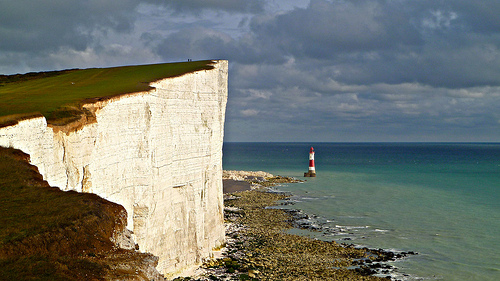
  • Beachy Head is a stunning white sedimentary sea cliff surrounded by water, made primarily of chalk, located in Eastbourne of East Sussex, in England, Europe.
  • Beachy Head reaches heights of 162 metres (531 feet), and is therefore the tallest chalk sea cliff in the United Kingdom.
  • A prominent formation of Beachy Head, named the Devils’ Chimney, broke off the cliff in 2001 due to water in the cracks expanding because of freezing.
  • ‘Beachy Head’ is said to have had two other names, ‘Beauchef’ in the late 1200s and ‘Beaucheif’ in the early 1300s, and all the names are derived from the French words ‘beau chef’, meaning ‘beautiful head’.
  • Beachy Head is the home to two lighthouses, one named ‘Belle Trout’ located on the cliff, built in the 1830s, and the second was later built in the sea in the early 1900s, as mist easily obscured the original light.
Beachy Head, Cliff, White, Ten Random Facts, Lighthouse, Europe, Ten Random Facts, Flickr, Formation, Sea
Beachy Head
Image courtesy of Herry Lawford/Flickr
  • Beachy Head is popularly visited by tourists, particularly due to the nearby attractions of the Seven Sisters chalk cliffs, and Birling Gap, a National Trust owned small settlement situated on the coast.
  • Beachy Head is the home to much wildlife, including gulls and many other species of birds, snakes, rabbits, badgers and foxes.
  • Approximately 20 people commit a fatal suicidal act on Beachy Head every year, even though chaplains and others patrol the area on a regular basis.
  • Beachy Head has been featured in several films and television shows, including a Harry Potter film and Chitty Chitty Bang Bang, and it has also featured in literature and music.
  • Before the first Beachy Head lighthouse was built, numerous ships were wrecked in the waters below, and smuggling of goods to avoid taxes is also said to have occurred there.
Bibliography:
Beachy Head, 2014, Wikipedia, http://en.wikipedia.org/wiki/Beachy_Head
Flora and Fauna, n.d, Beachy Head, http://www.beachyhead.org.uk/education/flora_and_fauna/
History, n.d, Beachy Head, http://www.beachyhead.org.uk/education/history/

Amazon:      

Gerbil

Gerbil

Gerbil… not just a pet.

  • Gerbils are a subfamily of approximately 110 species of mammals, or small rodents, native to Asian, Indian and African deserts and hot areas.
  • A gerbil was historically called a ‘desert rat’, while its scientific name is Gerbillinae, and it belongs to the family Muridae, a family of rodents.
  • Gerbils generally range from 7 to 20 centimetres (2.7 to 7.9 inches) in length, plus the tail that can be just as long, depending on the species, and weigh from 57 to 114 grams (2-4 ounces).
  • Mongolia gerbils were first made available as pets in the mid 1900s, and are now quite popular, although the pet can be illegal in some areas due to threats to agriculture and ecosystems.
  • Some species of gerbil live alone, while others reside in groups, and they use their sense of smell to determine whether fellow rodents belong to their family group or not.
Gerbil, Pet, Animal, Dirt, Brown, Animal, Rodent, Mammal, Ten Random Facts, FlickrA Gerbil
Image courtesy of Shankar S./Flickr
  • Gerbils generally live for three to five years and females have litters of approximately eight, that are born with no fur or sight.
  • The diet of gerbils generally consists of seeds, nuts and fruit, although insects, small birds and eggs, and other plant material are sometimes consumed, depending on the species.
  • Gerbils live in burrows and are prominent diggers, digging underground networks and tunnels with strong claws.
  • Gerbils have fur typically coloured brown, grey, black, white or tan, and those in the pet industry most commonly differ in colour due to select breeding.
  • A gerbil has the ability to shed their tail if it is trapped, and they are preyed on by snakes, birds, feral cats and other small mammals.
Bibliography:
Gerbil, 2013, A-Z Animals, http://a-z-animals.com/animals/gerbil/
Gerbil, 2014, Wikipedia, http://en.wikipedia.org/wiki/Gerbil

Amazon:    

Breakfast Cereal

Breakfast Cereal

Remember to eat some breakfast cereal for a healthy start to your day!

  • Breakfast cereal, also known as ‘cereal’, is a processed grain-based food, usually eaten during the morning, often as the first dish of the day.
  • Breakfast cereal can be eaten both cold or hot, with milk, fruit, yoghurt and sometimes sweeteners added, and it is generally considered as a healthy breakfast option, however, some ready-to-eat cereals are high in sugar.
  • Read-to-eat breakfast cereal has been the subject of a constant increase in popularity, and over 500 cereals or variations have been manufactured throughout the world.
  • Porridge, a type of breakfast cereal, has been eaten since ancient times, and is made of ground, chopped or rolled oats, rice, corn, barley, semolina, wheat or other grains.
  • It is likely that the 1863 Granula breakfast cereal produced by a nutritionist from the United States, James Jackson, was the first to be invented, although the item required a period of soaking before consumption, making it impractical.

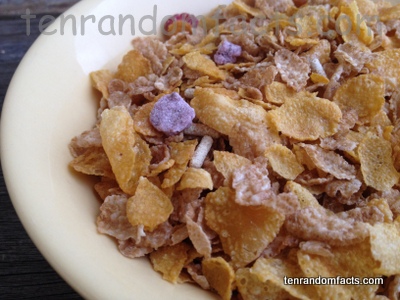
Breakfast Cereal, Bowl, Fruit, Flakes, Dry, Uncle Tobys Antioxidant, Ten Random Facts, Food,

  •  Breakfast cereal was originally scooped from large barrels for each customer, and around the late 1800s it started to become prepackaged in boxes that helped to increase its popularity.
  • Breakfast cereal was popularised around the late 1800s by the American, John Kellogg, a physician and the cofounder of Kellogg’s, along with his brother William, as well as Charles Post, a salesman who became a cereal manufacturer after visiting Kellogg’s sanitarium.
  • Breakfast cereal is available in a wide variety of shapes and colours, but is typically flaky or grainy in texture, and is generally brown to orange in colour, depending on the ingredients.
  • Breakfast cereal often has a high content of fibre, as well as many added vitamins, although some cereals contain a substantial quantity of sugar.
  • Breakfast cereal can be targeted specifically towards adults or children, and is often more sophisticated and healthy for adults, but sweeter, bright and more colourful for children.


Bibliography:
Avey T, What’s for Breakfast? Discover the History of Cereal, 2012, PBS, http://www.pbs.org/food/the-history-kitchen/history-of-cereal/
Breakfast Cereal, 2014, Wikipedia, http://en.wikipedia.org/wiki/Breakfast_cereal
History of Cereals, 2014, Ceereals, http://www.ceereal.eu/asp2/why_breakfast/l1.asp?doc_id=420

Amazon:     

Lawn Mower

Lawn Mower

Now you can mow your lawn with knowledge with these lawn mower facts!

  • Lawn mowers are mechanical or robotic devices used to cut grass, often lawns or grass fields, using blades.
  • Lawn mowers can be powered by hand, electricity or a fuel motor.
  • Lawn mower blades generally spin on a vertical or horizontal axis, and are named ‘rotary mowers’ and ‘reel mowers’ respectively.
  • Lawn mowers were first patented in 1830, by Englishman Edwin Budding, from England’s Gloucestershire in Europe, to replace the scythe, and Budding’s invention was inspired by the cloth cross-cutting machines that were used in the local mills.
  • Reel lawn mowers often have three to seven ribbon like blades that are connected together in a cylindrical formation, while those with rotary blades are typically limited to one relatively flat blade that attaches to the underneath of the machine.

Lawn Mower, Red, Black, Mechanical, Fuel, Lawn, Mow, Grass, Ten Random Facts, Backyard, hand

  • Steam powered lawn mowers were first patented in 1893 by James Sumner in England, although they could only be used after a few hours of heating to allow for pressure buildup.
  • Lawn mowers can propel items like stones, at high speed, that can cause damage, and while many other mowing related injuries can be prevented from wearing correct footwear, in 2004, at least 80,000 people in the United States were injured by mowers or mowing activity.
  • Many lawn mowers emit high quantities of pollution, comparable to domestic cars, and often produce loud noises that can be irritating and damage hearing.
  • Lawn mowers often consist of a motor, blades and a box called a ‘catcher’ that collects grass cuttings, although hand powered reel bladed machines typically have blades and a handle, and sometimes a catcher, although a motor is absent.
  • Ride-on mowers, that allow for a person to sit on the machine, are useful for mowing large areas, while robotic lawn mowers are becoming increasingly popular and only require minimal human interaction.
Bibliography:
Lawn Mower, 2014, Wikipedia, http://en.wikipedia.org/wiki/Lawn_mower
Mower History, 2014, The Old Lawn Mower Club, http://www.oldlawnmowerclub.co.uk/mowinfo/mowhist.htm

Amazon:     

Related Posts Plugin for WordPress, Blogger...