Atlantic Ocean Road

Atlantic Ocean Road

The Atlantic Ocean Road is full of twists and turns.

  • Atlantic Ocean Road is a part of the County Road 64, that passes through one of Norway’s archipelagos in the Eide and Averøy regions, in western Norway, in Europe.
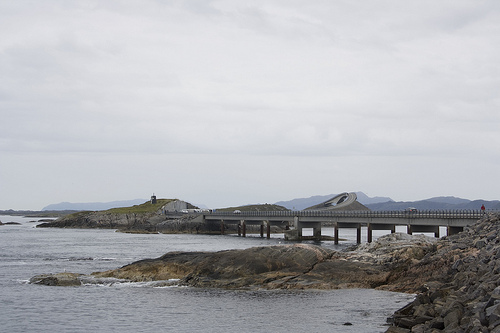
  • Atlantic Ocean Road is built on a number of islands, connected by numerous bridges and the most famous and longest is the Storseisundet Bridge.
  • Atlantic Ocean Road spans a distance of 8.3 kilometres (5.1 miles) and the road includes four rest locations and numerous tourist attractions.
  • The concept of the Atlantic Ocean Road route originated in the early 1900s, originally as a railway, although this was replaced with the idea of road in 1935, but it was not until the 1980s until the project was approved.
  • The construction of Atlantic Ocean Road began on 1 August 1983, opening on 7 July 1989, although the management of the project changed hands during the process; and 12 hurricanes occurred during the building stages.
Atlantic Ocean Road, Twist, Bridge, Archipelago, Island, Ten Random Facts, Place, Norway
Part of Atlantic Ocean Road
Image courtesy of Daniele Faieta/Flickr
  • Atlantic Ocean Road originally had a toll to cover some of the costs, and although the idea was received negatively, due to the expectation that it would take longer than fifteen years to pay off, however the toll had covered the costs by 1999, after only ten years, after which it was removed.
  • Atlantic Ocean Road is a popular tourist attraction and is often said to be among one of the best road trips in the world.
  • Atlantic Ocean Road consists of many dips, curves and turns, as well as many scenic views.
  • Stormy weather at Atlantic Ocean Road can make road trips dramatic, while calm weather allows for the spotting of wildlife, including whales, and other scenery.
  • ‘Atlantic Ocean Road’ is also known as ‘Atlantic Road’, as well as ‘Atlanterhavsveien’ in Norwegian.
Bibliography:
Atlantic Ocean Road, 2014, Wikipedia, http://en.wikipedia.org/wiki/Atlantic_Ocean_Road
Atlantic Ocean Road, n.d, dangerousroads.org, http://www.dangerousroads.org/europe/norway/164-atlantic-ocean-road-norway.html
The Atlantic Road, n.d, Visit Norway, http://www.visitnorway.com/uk/where-to-go-uk/fjord-norway/kristiansund-nordmore/what-to-do-in-kristiansund-and-nordmore/tour-suggestions-in-kristiansund-and-nordmore/the-atlantic-road/

Amazon:      

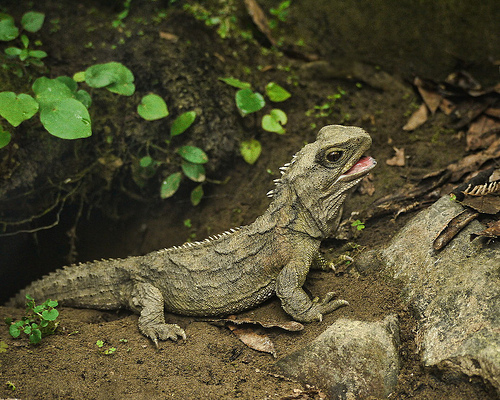
Tuatara

Tuatara

Tuataras are not lizards… but they are reptiles!

  • A tuatara is a species of reptile native to New Zealand and its nearby islands, and are the only extant members of the order Rhynchocephalia.
  • The scientific name of a tuatara is Sphenodon, from the family Sphenodontidae, and there are two living species.
  • Tuataras can grow up to 70 to 80 centimetres (28 to 31 inches) in length, and they can weigh up to 0.6 to 1 kilogram (1.3 to 2.2 pounds).
  • ‘Tuatara’ is a native Maori word, which in English can be translated as ‘spines on the back’, referring to the crested spikes on the animal.
  • The tuatara was first classified in 1831 by the British Museum after studying the reptile’s skull, and it was classed as a lizard, however, in 1867 this was determined to be inaccurate and was changed.
Tuatara, Lizard, Animal, Reptile, Ten Random Facts, Flickr, New Zealand,  endangered, threatened
Tuatara
Image courtesy of Sid Mosdell/Flickr
  • The skin of tuataras can be grey, green or brown in colour, which is shed many times and the reptile also features a spiny back and three eyes, one of which sits on top of its head.
  • Tuataras have a life span that ranges from 60 to 100 years, and they are preyed on by rats, pigs and cats and other introduced species.
  • The diet of tuataras typically includes insects, frogs, spiders, lizards, young birds and eggs, and they live in burrows, generally venturing out at night.
  • Tuataras are mainly found on isolated islands, although they are being reintroduced to mainland New Zealand, and there has also been a concerted effort to protect them, as their numbers are dwindling due to habitat loss, and the eggs and young are very vulnerable to introduced predators.
  • A female tuatara lays up to 19 eggs approximately once every four or five years, although the eggs can take up to 15 months to incubate, and the incubation temperature determines the gender of the hatched reptile.
Bibliography:
Tuatara, 2014, A-Z Animals, http://a-z-animals.com/animals/tuatara/
Tuatara, 2014, San Diego Zoo, http://animals.sandiegozoo.org/animals/tuatara
Tuatara, 2014, Wikipedia, http://en.wikipedia.org/wiki/Tuatara

Amazon:  

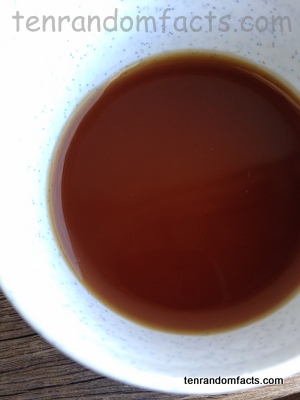
Worcestershire Sauce

Worcestershire Sauce

Worcestershire sauce must be the most mysterious condiment out there!

  • Worcestershire sauce is a condiment in the form of a liquid, made primarily through the process of fermenting.
  • ‘Worcestershire sauce’ is also known as ‘Worcester sauce’ and, in Spanish, ‘salsa inglesa’, meaning ‘English sauce’.
  • Worcestershire sauce is most often used as a flavouring in beef and other meat based dishes, Caesar salad and hamburgers, as well as cocktail beverages.
  • Worcestershire sauce is typically made of anchovies, garlic, spices, molasses and onion, as well as a mixture of other ingredients that often includes vinegar.
  • Although its history is uncertain, Worcestershire sauce is said to have been first invented by English pharmacists John Lea and William Perrins, in England’s Worcester, in Worcestershire,  Europe, and it was sold commercially by them by the year 1838 under the Lea & Perrins brand, now the most popular brand in the world.

Worcestershire Sauce, Worcester Sauce, Condiment, Food, Culinary, Flavour, Ten Random Facts, Flickr

  • The initial Worcestershire sauce made by Lea and Perrins is said to have been very strong and unpleasant and therefore placed in a cellar, however, years later it was tasted and discovered it was pleasant after fermenting.
  • Worcestershire sauce is high in sodium, iron, potassium and vitamin C and it contains many other vitamins and minerals.
  • It is widely accepted that the Lea & Perrins Worcestershire sauce recipe is derived from an Indian condiment, that the Englishmen tried to replicate for an acquaintance who had visited or lived in the country.
  • Worcestershire sauce is commonly available in supermarkets and is usually sold in bottles, under various brand names.
  • The list of ingredients, but no method, of the original Worcestershire sauce by Lea & Perrins was first uncovered in 2009 in a rubbish bin, and the document now resides in the Worcester City Art Gallery and Museum.


Bibliography:
Docio A, History of Worcestershire Sauce, 2013, British Local Food, http://britishlocalfood.com/history-of-worcestershire-sauce/
Smallwood K, What is in Worcestershire Sauce and Why is It Called That?, 2012, Today I Found Out, http://www.todayifoundout.com/index.php/2013/10/worcestershire-sauce-called/
Worcestershire Sauce, 2014, Wikipedia, http://en.wikipedia.org/wiki/Worcestershire_sauce

Amazon:     

Ballpoint Pen

Ballpoint Pen

Do you ever take ballpoint pens for granted?

  • A ballpoint pen is a pen that distributes ink along a writing surface, and it has a very small ball in the writing tip that moves in the process.
  • ‘Ballpoint pens’ are also known as ‘biros’, ‘ball pens’ and ‘Biromes’.
  • The main design of a ballpoint pen originated from an 1888 patent for a pen that could write on leather, by leather tanner John Loud, an American, but the design was unsuitable for writing on paper.
  • Practical ballpoint pens were patented in 1938 by an editor of a Hungarian newspaper, László Bíró, which led to the common name of the modern pen, ‘biro’.
  • Ballpoint pens were introduced to America by Milton Reynolds, an American entrepreneur, who changed Bíró’s design in the mid 1940s, although it wasn’t until the 1950s that a more reliable pen was invented by Marcel Bich in France, that did not leak and had smooth ink flow, and was sold under the name ‘Bic’.

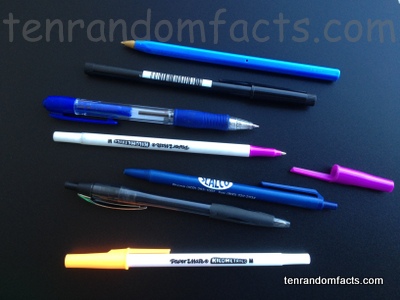
Ballpoint Pen, Bright, Colourful, Biro, Pink, Lid, Retractabel, Blue, black, White, Yellow, Ten Random Facts, Invention, Stationary

  • Ballpoint pens can be disposable or refillable, often with a removable lid or a replaceable tip and reservoir, as well as retractable tips that retract back into the pen cylinder.
  • Ballpoint pens are the most commonly used writing instrument, and they are also used by some artists in their artwork, although any mistakes made generally cannot be removed, unless a pen with erasable ink is used.
  • Ballpoint pens range in colour and designs, and most often have ink coloured blue or black, and the next most popular ink colours are red and green.
  • Due to the availability of mass production, ballpoint pens have become increasingly cheaper and are more commonly used.
  • Ballpoint pens range in numerous shapes and sizes, leading some to become collector’s items; while some brands have been featured in the United State’s New York Museum of Modern Art, including the Bic Cristal pen.


Bibliography:
Ballpoint Pen, 2006, The Great Idea Finder, http://www.ideafinder.com/history/inventions/ballpen.htm
Ballpoint Pen, 2014, Wikipedia, http://en.wikipedia.org/wiki/Ballpoint_pen
The History of the Ballpoint Pen, 2002, Cosmopolis, http://www.cosmopolis.ch/english/cosmo30/history_ballpoint_pen.htm

Amazon:     

Dunnottar Castle

Dunnottar Castle

Dunnottar Castle famous for its romantic spots and… constant destruction.

  • Dunnottar Castle is a ruined castle located in Scotland’s north east, in the United Kingdom in Europe, that was originally built in the medieval period.
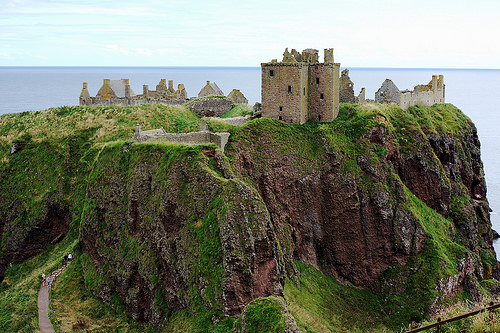
  • Dunnottar Castle covers an area of 3.5 acres (1.4 hectares), and sits on a sea cliff that rises to 50 metres (160 feet) in height.
  • ‘Dùn Fhoithear’ is the Scottish-Gaelic for Dunnottar Castle, and means ‘fort on the shelving slope’.
  • The date the first castle was built on the Dunnottar Castle site is uncertain, although it, or a fort, was possibly erected before the 7th century, as there is reference to a siege in the area in the late 600s.
  • Dunnottar Castle was a significant administration location in the county, under the rule of King William the Lion who reigned from 1165 to 1214.
Dunnottar Castle, Brown, Ruins, Sea Cliff, All, View, Ten Random Facts, Scottish, medieval, Flickr
Dunnottar Castle
Image courtesy of Christian Kadluba/Flickr
  • Dunnottar Castle was bought in 1720 by the York Buildings Company, who removed much of the interior including the floors and roof.
  • Restoration of some parts of Dunnottar Castle began after new owner, the 1st Viscount Cowdray, Weetman Pearson from Yorkshire in England, purchased the property in 1925, and it was eventually passed down to one of his great grandsons, Charles Pearson, who was the owner in 2014.
  • Dunnottar Castle is open to the public and has become a popular tourist attraction, and was visited by approximately 52,000 tourists in 2009.
  • William Keith, a Marischal of Scotland, and his family, were the predominant owners of Dunnottar Castle from the 1300s to 1700s, and it was seized from them by the king in 1716.
  • Throughout its history, Dunnottar Castle was burnt to the ground a number of times, sometimes by the Scottish to kill the invading English.
Bibliography:
Dunnottar Castle, 2014, Wikipedia, http://en.wikipedia.org/wiki/Dunnottar_Castle
Ross D, Dunnottar Castle, n.d, Britain Express, http://www.britainexpress.com/scotland/ruins/Dunnottar-Castle.htm

Amazon:     

Amoxicillin

Amoxicillin

Have you ever been prescribed amoxicillin?

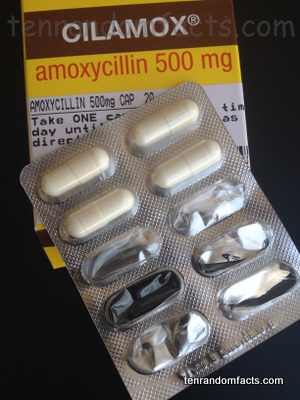
  • Amoxicillin is a medical drug often prescribed to treat bacterial problems or infection.
  • Of all antibiotics, amoxicillin is the most frequently used antibiotic that is given to children.
  • ‘Amoxicillin’ is also known as ‘amoxycillin’ and ‘amox’, and it is packaged under numerous brand names.
  • Amoxicillin was created by The Beecham Group, a pharmaceutical company from the United Kingdom, Europe, in the 1960s, and was first made publically available in 1972.
  • Amoxicillin can cause rashes, nausea, vomiting, diarrhoea, dizziness and other reactions, often as a result of an allergic reaction or incorrect use.

Amoxicillin, Amoxycillin, Tablet, Pill,500mg, Cilamox, Ten Random Fqcts, Drug, Antibiotic, Ten Random Facts

  • Amoxicillin was the second aminopenicillin belonging to the penicillin family, that was made publicly available in the world, and it contains a β-lactam (beta-lactam) ring in the molecule structure that inhibits bacterial cell wall synthesis.
  • Amoxicillin is made of carbon, hydrogen, nitrogen, oxygen and sulphur, in a chemical structure of C16H19N3O5S, and it is listed in the World Health Organistion’s Model List of Essential Medicines as a required medicine for basic healthcare.
  • Amoxicillin is most commonly available in the form of a liquid, capsule, chewable tablet, and powder, and it is usually only available by prescription
  • Typically, amoxicillin is required to be taken during or within an hour of the consumption of food, and should be taken at the same times daily until it is finished.
  • Amoxicillin is often taken by way of mouth, although it can be injected into a vein.


Bibliography:
Allen H, Amoxicillin for Infections, 2013, Patient.co.uk, http://www.patient.co.uk/medicine/amoxicillin-for-infections
Amoxicillin, 2014, Drugs.com, http://www.drugs.com/amoxicillin.html
Amoxicillin, 2014, Wikipedia, http://en.wikipedia.org/wiki/Amoxicillin

Amazon:     

Related Posts Plugin for WordPress, Blogger...