Sesame Seed

Sesame Seed

Ever heard of the phrase ‘Open Sesame’? It is said that it is a reference to the way sesame seed pods open to reveal their seeds.

  • Sesame seeds are oilseeds from the sesame plant Sesamun indicum, that comes from the Pedaliaceae family, the family of sesames or pedaliums.
  • Sesame seeds are extracted from a pod approximately 2 to 8 centimetres (0.8 to 3.15 inches) in length on a plant that grows 50 to 100 centimetres (1.6 to 3.3 feet) in height.
  • Sesame seeds are generally 3 to 4 millimetres in length (0.1 inches) and can be a variety of colours including cream, tan, black, grey, red and gold.
  • Sesame seeds have been harvested since 4000 to 2000BC in ancient civilisations including Egypt, Mesopotamia, India and other Middle Eastern civilisations.
  • Once sesame seeds have been extracted from pods, the seeds are often sorted for quality and colour using a type of scanner.
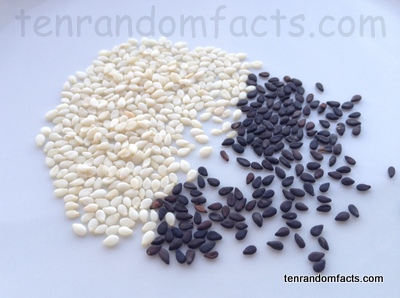
Sesame Seeds, Black, White, Assorted, Ten Random Facts, Small,  Food, Culinary

  • In 2010, Burma, in Asia, was the largest producer of sesame seeds in the world, with 0.72 million tonnes (0.79 million tons) of the 3.84 million tonnes (4.23 million tons) produced worldwide, while India and China ranked second and third respectively.
  • Sesame seeds can cause a severe allergic reaction and an anaphylactic response, with symptoms include swelling, hives, hay fever and throat problems.
  • Sesame seeds have a nutty flavour, evident once cooked, and are often used to flavour bread items, and can be added to main meals, as well as breakfast cereals.
  • Sesame seeds contain numerous phytosterols that can lower cholesterol levels, reduce the likelihood of specific cancers and increasethe performance of the immunity system.
  • Sesame seeds are very high in calcium, iron, copper, manganese and magnesium, and contain many other vitamins and minerals.
Bibliography:
Sesame, 2014, Wikipedia, http://en.wikipedia.org/wiki/Sesame
Sesame Seeds, 2014, The World’s Healthiest Foods, http://www.whfoods.com/genpage.php?tname=foodspice&dbid=84

Amazon:     

Washer

Washer

Washers do not wash… but they spread pressure around.

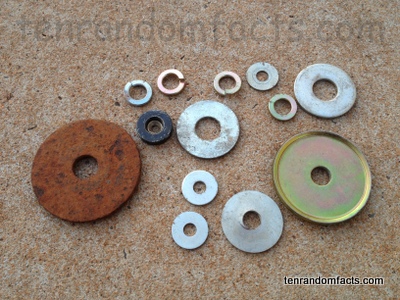
  • Washers are generally a circular shaped item, often thin, with a central hole used primarily to spread pressure from a central fastening point.
  • Some washers are used as a spring, spacer, locker or to prevent corrosion.
  • There are three main different types of washers: ‘plain’, used to spread load and to insulate objects; ‘spring’, to prevent vibrations loosening the fastener; and ‘locking’, to stop the fastener loosening by unscrewing.
  • Washers have numerous forms, which have been classified in the United Kingdom from 1968 using letters A-G, and further classified using diameter and thickness.
  • Washers, although generally flat, can be bevelled or indented, have curved edges or be a split ring.

Washer, Ring, Split, Brown, Gold, Silver, Copper, Assorted, Coned, Ten Random Facts, Tools

  • Washers are typically made of metal, often stainless steel, or plastic, as well as materials such as rubber.
  • Washers can reach sizes of 3 to 175 millimetres (0.1 to 7 inches) in diameter and 0.3 to 14 millimetres (0.01 to 0.55 inches) in thickness.
  • The first reference of the term ‘washer’ originated in the mid 1300s, although its etymology is uncertain.
  • Although generally circular in shape, washers can be the shape of a square, star or gear.
  • Washers are typically silver in colour, although they can be coloured copper or gold, the colour of which is often related to the material used.


Bibliography:
Washer (Hardware), 2014, Wikipedia, http://en.wikipedia.org/wiki/Washer_(hardware)

Amazon:      

Nottingham Castle

Nottingham Castle

Siege, take over, destroy, take over, siege, destroy – the life of Nottingham Castle.

  • Nottingham Castle is a ruined medieval castle, now a museum, located in England’s Nottingham, in Europe, on ‘Castle Rock’.
  • The construction of the first known castle on the Nottingham Castle site, was in 1067, at the request of the Norman king, William the Conqueror, although smaller castles may have been built previously, and in the mid to late 1100s a more robust stone castle was built.
  • Nottingham Castle was built in a strategic position, in an area with cliffs reaching 40 metres (130 feet) in height, as well as near a River Trent crossing and prime hunting areas.
  • Nottingham Castle was originally used as an important vantage point during medieval times, and was taken by Prince John in 1194, as well as King Edward III in 1330, and was later destroyed at the end of the English Civil War in 1649.
  • Nottingham Castle was rebuilt as a ducal mansion in the 1670s by Newcastle’s then Duke Henry Cavendish, and was built on top of the castle’s foundations, although it was burnt down in 1832.
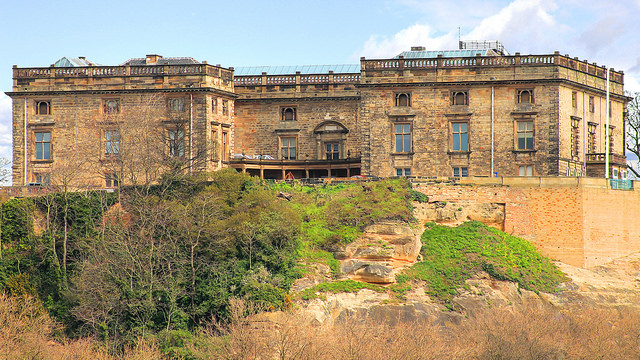
Nottingham Castle
Image courtesy of Arran Bee/Flickr
  • Nottingham Castle and the surrounding area has been associated with the legend of Robin Hood and the story’s Sheriff of Nottingham.
  • Nottingham Castle was restored in 1875, and opened as a museum and art gallery, that is still used for this purpose today, and tours can be taken, some venturing into rock caves and secret passageways.
  • Nottingham Castle has numerous gardens and now includes a themed playground for children.
  • Nottingham Castle is owned and cared for by the Nottingham City Council and the property covers an area of 6 acres (2.4 hectares).
  • Nottingham Castle museum and art gallery includes items such as ceramics, paintings, carvings, costumes and other collections.

Edit: The original picture featured in this post was of Wollaton Hall, not Nottingham Castle. This has since been rectified.

Bibliography:
Nottingham Castle, 2014, One Day In, http://www.experiencenottinghamshire.com/discover/nottingham-castle-p357581
Nottingham Castle, 2014, Wikipedia, http://en.wikipedia.org/wiki/Nottingham_Castle
Visiting Nottingham Castle, 2014, Nottingham City Council, http://www.nottinghamcity.gov.uk/Castle

Amazon:      

Fossa

Fossa

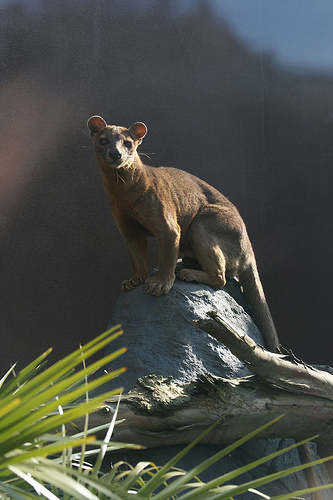
Fossas are Madagascar movie stars.

  • Fossas are mammals that have an appearance similar to cats, although they are more closely related to the mongoose, and they are found only in the forests of Madagascar, an African island.
  • Fossas have the scientific name Cryptoprocta ferox and are from the family Eupleridae, the family of carnivoran Malagasy animals.
  • Fossas grow to be around 61 to 80 centimetres (24 to 31 inches) in length and between 5.5 to 12 kilograms (12 to 29 pounds) in weight.
  • The word ‘fossa’ is also spelt ‘fosa’, which is the Malagasy word for the animal, and the pronunciation also varies, with an ‘o’ sound as in the word ‘clock’ or an ‘oo’ sound as in the word ‘food’.
  • Fossas generally live alone, although they may kill and share prey together, and they communicate with yelps, calls, purrs and mews, as well as other body movements.

Fossa, Animal, Zoo, Rock, Stand, Ten Random Facts, Madagascar,

A Fossa
Image courtesy of Keith Williams/Flickr
  • Fossas are carnivorous, preying primarily on Malagasy lemurs, as well as other animals including birds, rodents, lizards and tenrecs.
  • Fossas have litters of one to six mixed gender cubs, born with closed eyes in isolated locations such as dens, and they live for 15 to 20 years and do not have any natural predators.
  • Fossas are vulnerably endangered due to habitat destruction, which has caused a 30% decrease in populations from 1987.
  • Fossas have short fur, typically light brown to black in colour, a long tail, marginally webbed toes and retractable claws.
  • Fossas spend much of their time in trees, and they mark their territory, as well as communicate, with their scent glands.
Bibliography:
Fossa (Animal), 2014 Wikipedia, http://en.wikipedia.org/wiki/Fossa_(animal)
Fossa, 2013, A-Z Animals, http://a-z-animals.com/animals/fossa/
Fossa, 2014, San Diego Zoo, http://animals.sandiegozoo.org/animals/fossa

Amazon:      

Katsuobushi

Katsuobushi

Foreign food, like katsuobushi, is quite interesting.

  • Katsuobushi is a Japanese food product of fermented, smoked and dried fish, such as bonito or most commonly skipjack tuna.
  • ‘Katsuobushi’ is also known as ‘okaka’, both Japanese words, as well as ‘dried bonito’ and ‘dancing fish flakes’.
  • Katsuobushi is commonly used in Japanese cuisine to make soups and sauce, or more specifically, broth, as well as a garnish or topping that imparts flavour to the dish.
  • Katsuobushi has a savoury taste, and the product includes fungi that is part of the fermentation process.
  • Heat emissions and steam can cause Katsuobushi to move as if the substance is alive, and it is often used decoratively on hot foods for this reason.

Kastuobushi, Dried Bonito Flakes, Bowl, Japanese, Food, Culinary, Small, Ten Random Facts

  • Katsuobushi can be bought either in blocks or as shavings, often in sachets, in a coarse or fine version, and it is typically pink to brown in colour.
  • Katsuobushi is made by filleting the fish, boiling and smoking the fillets, sun-drying them and spraying them with moisture-absorbing fungus, and letting them ferment, while the entire process takes many months.
  • The final product of Katsuobushi, before shaving, is generally a very dry, hard block that looks similar to wood, and weighs over 80% less then the original fillet, and once shaved it resembles wood shavings
  • Katsuobushi is available in fine or coarse flakes, while the larger flakes generally have a stronger taste and are bulkier.
  • Katsuobushi was first made in the 1670s, in Japan, while a more modern version was brought into use by 1770.


Bibliography:
Fujita C, Dried Bonito, 2009, The Tokyo Foundation, http://www.tokyofoundation.org/en/topics/japanese-traditional-foods/vol.-15-dried-bonito
Katsuobushi, 2014, Wikipedia, http://en.wikipedia.org/wiki/Katsuobushi
What is Katsuobushi, 2014, WiseGEEK, http://www.wisegeek.com/what-is-katsuobushi.htm

Amazon:     

Spinning Wheel

Spinning Wheel

Spinning wheels may be old but still are interesting!

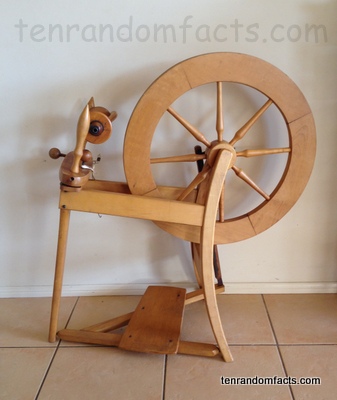
  • Spinning wheels are machines used to spin yarn or other fibres, that were invented to replace the spindle and distaff hand spinning.
  • Illustrations of spinning wheels have originated as far back as 1035, in Asia, while pictures of the machines emerged in the 1200s in Europe, China and Iraq.
  • Notable versions of spinning wheels include the Charkha, among the oldest machines and they have a wheel moved by hand; the ‘great wheel’, often larger and also with a wheel moved by hand; and the treadle wheel, that has a foot peddle that spins the wheel.
  • Spinning wheels are depicted in numerous art and literature forms, including fairy tales such as Sleeping Beauty and Rumplestiltskin.
  • Spinning wheels were invented by the Chinese, and led to increased production of yarn that positively effected many industries including sail making and paper making.

Spinning wheel, brown, wooden, old, Ten Random Facts, Invention, Textiles, Peddle

  • The spinning Jenny was invented in 1764 and replaced the spinning wheel, due to increased efficiency, as it was able to spin multiple threads at once.
  • Spinning wheels can be run by electrical energy, and these machines are usually powered by an electric motor.
  • To produce yarn using a spinning wheel, the fibre is attached to a bobbin that is connected to the machine, and the yarn is fed and guided by the hand while it twists, as the wheel spins.
  • Spinning wheels are traditionally made of wood, but can also be constructed from metal.
  • Spinning wheels have been superseded by modern technology, however they are still used by home hobbyists who prefer to spin their own fibre.
Bibliography:
100 years of Spinning Wheels, 2014, Wild Fibres, http://www.wildfibres.co.uk/html/spinning_wheels_history.html
Spinning Wheel, 2014, Wikipedia, http://en.wikipedia.org/wiki/Spinning_wheel

Amazon:      

Related Posts Plugin for WordPress, Blogger...