Neuschwanstein Castle

Neuschwanstein Castle

Neuschwanstein Castle is a very dreamy castle.

  • Neuschwanstein Castle is a castle located in Germany’s Bavaria, in Europe, built by the German King Ludwig II of Bavaria, and it is a popular filming location and model for fictitious castles.
  • ‘Neuschwanstein’ Castle, which means ‘new swan-on-the-rock’, is also known as ‘New Swan Stone Castle’ in English and ‘Schloss Neuschwanstein’ in German, and it was originally called ‘New Hohenschwangau Castle’.
  • Neuschwanstein Castle was built on the site of old, crumbling medieval twin castles, as a replacement, and King Ludwig II was hoping that it would only take three years to build.
  • Neuschwanstein Castle was designed by Eduard Riedel, a German architect, although King Ludwig II had significant input in the design.
  • Neuschwanstein Castle is a Romanesque Revival styled architectural building, although the castle was first designed in neo-Gothic style.
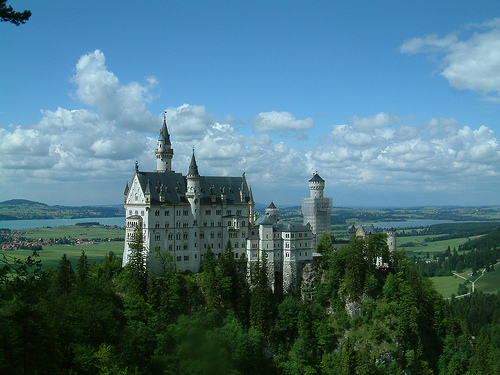
Neuschwanstein Castle, Blue, White, dreamy, mystical, Green, Ten Random Facts, Germany, Flickr
Neuschwanstein Castle
Image courtesy of Raymond Bryson/Flickr
  • King Ludwig II lived in Neuschwanstein Castle throughout various stages of its construction, although it is said that he only spent a total of 172 days in it.
  • The building of Neuschwanstein Castle commenced in late 1869 and ended in 1892, after King Ludwig II’s death in 1886, but the castle was never fully completed.
  • Neuschwanstein Castle originally had in excess of 200 rooms planned, although only approximately 15 were completely finished.
  • The original estimate cost of Neuschwanstein Castle was 3.2 million marks, although the actual cost was at least double that, which contributed to the extensive debts of King Ludwig II.
  • Neuschwanstein Castle was first opened to the public in August 1886, six weeks after King Ludwig II’s death, and is now seen by at least 1.4 million people each year, but it can only be accessed via a guided tour that takes approximately 30 minutes.
Bibliography:
Neuschwanstein, n.d, Bayerische Verwaltung der staatlichen Schlösser, Gärten und Seen, http://www.neuschwanstein.de/englisch/palace/index.htm#
Neuschwanstein Castle, 2014, Wikipedia, http://en.wikipedia.org/wiki/Neuschwanstein_Castle

Amazon:      

Piranha

Piranha

Munch, munch goes the ‘ferocious’ piranha.

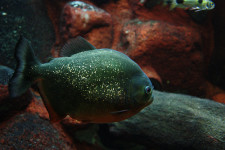
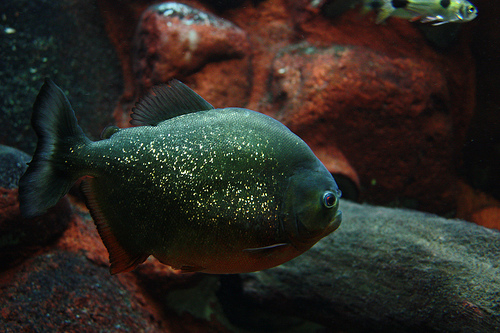
  • Piranhas are a type of fish, that are coloured yellow, grey, red or blue, and are native to South America’s freshwater rivers.
  • A ‘piranha’ is also known as a ‘piraña’, and contrary to popular belief, they are not generally fierce and courageous, and as a result they live in schools for protection.
  • Piranhas are from the family Characidae, a family of tropical and subtropical freshwater fish, and the subfamily Serrasalmidae, the serrated salmon fish, and there are at least three or four official genus groupings, with an estimated species count of 30 to 60.
  • Piranhas generally range in length from 14 to 30 centimetres (5.5 to 11.8 inches), however lengths of up to 80 centimetres (31.5 inches) have been recorded.
  • A piranha’s diet predominantly consists of meat, particularly fish, insects and snails, as well as vegetation in the water, and it can also include birds and mammals.
Piranha, Green, Blue, Fish, Natural, Red-Bellied, America, Ten Random Facts, Flickr
Piranha
Image courtesy of Georgios Michalogiorgakis/Flickr
  • Indigenous South Americans sometimes use the sharp teeth of piranhas to create weapons or tools.
  • Piranhas can be kept in captivity as a pet, but some governments have determined this illegal, and while they rarely cause human deaths by attacks, they can cause various injuries, particularly on the hands or feet.
  • Between 1913 and 1914, the former president of the United States of America, Theodore Roosevelt, saw and documented piranhas, and stated that “They are the most ferocious fish in the world.”
  • Female piranhas lay approximately 5000 eggs in a nest, in one season, and the eggs are heavily protected by the parents, causing a survival rate of up to 90 percent.
  • Piranhas typically live to be 20 to 25 years old, although they are preyed upon by caimans (small crocodylians), some birds, other fish, turtles and dolphins.
Bibliography:
Piranha, 2013, A-Z Animals, http://a-z-animals.com/animals/piranha/
Piranha, 2014, Wikipedia, http://en.wikipedia.org/wiki/Piranha

Amazon:     

Flag

Flag

These facts are the start of your vexillology course – the study of flags.

  • Flags are thin, lightweight, and usually flat objects, typically used for symbolic, ornamental, religious and communication purposes.
  • Flags are most often shaped as quadrilaterals, specifically rectangles, although the shape varies, such as Nepal’s stacked triangular flag.
  • Those who study flags are named ‘vexillologists’, while the study of them is termed ‘vexillology’.
  • Flags are typically produced with a symbolic design and/or colours, and red, white, yellow and green are the most commonly used colours.
  • Flags come in a large range of sizes and can have various uses, and are most notably used as a symbol for a republic, state or country, as well as an organisation.

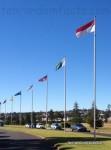
National Flags, Line, Chain, Many, Colour Flagpole, Ten Random Facts,

  • Flags are important devices for ships and other water vehicles, as they are used for courtesy, symbolism and signalling, especially when visiting foreign waters.
  • When produced, fabric flags are typically dyed throughout the material, which will create a mirror image on the back of the flag.
  • In December 2013, the Arab State of Qatar in the Middle East won the world record for the largest flag by size, measuring 101,978 square metres (25.2 acres or 10.2 hectares), and it was later used to make school bags for at least 200,000 needy children around the world.
  • Flags are most commonly made from fabric, although sometimes they are made from plastic for inexpensive, short term uses, especially for organised celebrations that involve large crowds of people.
  • When flapping in the wind, flags can imitate the motions of ocean waves, and they are most commonly hung horizontally, generally on flagpoles, but they can be hung vertically, although small disposable flags have a stick attached and can be held in one’s hand.


Bibliography:
Flag, 2014, Wikipedia, http://en.wikipedia.org/wiki/Flag

Amazon:      

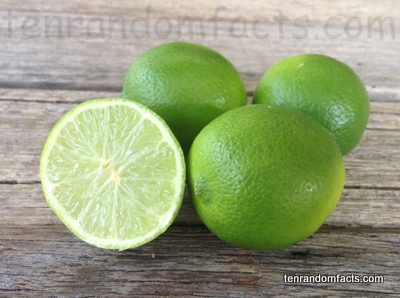
Lime

Lime

These facts are as flavoursome as limes.

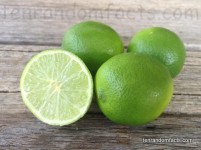
  • Limes are a group of green coloured fruit from the family of Rutaceae, the family of citrus and rue, and they belong to the Citrus genus.
  • There are a number of species of limes, including ‘Key’, ‘kaffir’, ‘desert’, ‘sweet’ and ‘Persian’, and they have various scientific names, while the Persian species are seedless and are the most commonly available.
  • Limes are roughly spherical in shape, and their diameter ranges from 3 to 6 centimetres (1.2 to 2.4 inches).
  • Limes are often sour or bitter in flavour, although some varieties are sweet, and while they are similar to lemons, they are generally more acidic.
  • Most species of limes are believed to be native to Asia, and they were first grown extensively for financial purposes in the ancient civilisation Babylonia, once situated where modern Iran is located.

Lime, Green, Cut, Two, Whole, Sour, Fruit, Citrus, Ten Random Facts, Grown, Australia

  • Due to the pleasant aroma of limes, the fruit’s zest or juice is commonly used in mixtures for its smell, and the juice is commonly used to flavour beverages or condiments, while the zest provides flavour to other dishes.
  • In the 1800s, limes, along with lemons, were used to avoid scurvy by sailors from Britain.
  • In 2007, India was the top lime producer, with 16%, or approximately 2 million tonnes (2,271,000 tons) of the world production of a little over 13 million tonnes (14,365,000 tons).
  • If ultraviolet light is directed at the skin of a person that has touched lime juice, the area of skin can become blistered, swollen or darker in colour.
  • Limes are high in vitamin C, although not as high as lemons, and they have small quantities of many other vitamins and minerals.
Bibliography:
Lemon/Limes, 2014, The World’s Healthiest Foods, http://www.whfoods.com/genpage.php?tname=foodspice&dbid=27
Lime (Fruit), 2014, Wikipedia, http://en.wikipedia.org/wiki/Lime_(fruit)

Amazon:     

Santorini

Santorini

Santorini is an archipelago shrouded with mystery.

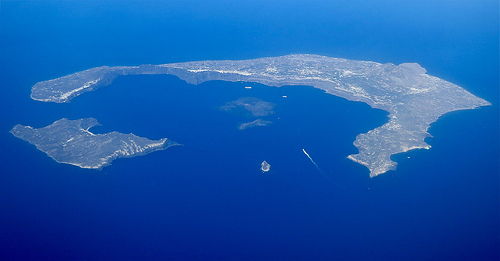
  • Santorini is an archipelago of five islands that is part of Greece, and is located in the Aegean Sea, in the Mediterranean Sea.
  • ‘Santorini’ is also known as ‘Thera’ and ‘Thira’, while the main island is known by the same name – it was named during the Latin empire after the cathedral Saint Irene, and was originally known in the Greek empire as ‘Kallístē’, ‘Strongýlē’ and ‘Thēra’, although the latter was eventually reinstated officially.
  • Santorini has a total area of 90.6 square kilometres (35 square miles), with the main island measuring 73 square kilometres (28 square miles), and it has a bus service, a major airline service and two ports for watercraft.
  • The Santorini archipelago was originally a single island which was destroyed, most likely between 1500 BC to 1700 BC, by the devastating Minoan or Thera volcanic eruption, and before its destruction the original island was well populated, and it was rediscovered and resettled after the Bronze Age.
  • In 2011, Santorini was the home to approximately 15 thousand people, all inhabiting the main island, except for a small population of approximately 150 that live on the island of Therasia.
Santorini, Blue, Island, Archipelago, Birds-eye view, Volcano, Greece, Ten Random Facts, Flickr,
Santorini Archipalego
Image courtesy of Steve Jurveston/Flickr
  • The Santorini islands surround the dormant volcano that destroyed the original island, which is, out of the surrounding volcanic chain known as the South Aegean Volcanic Arc, currently the most volcanically active, and its last eruption was in 1950, and activity was recorded from 2011-2012.
  • Santorini has been ruled by a number of different empires throughout its history, including the Minoan, Greek, Roman, Latin and Ottoman Turkish empires, and most recently, in 1830, it was reclaimed by Greece.
  • Even though up until the 1990s the availability of fresh water was scarce, people on the main island of Santorini have been able to establish prominent wine and tomato agricultural industries.
  • It is said that one of the locations on the original single Santorini Island, now dubbed as ‘Akrotiri’, is possibly the lost city of Atlantis, a Greek-originating legend, that was described by Plato.
  • Santorini buildings are typically Greek in their architectural style, and are shaped as strikingly white cubes, although many of the buildings were destroyed by an earthquake in 1956.
Bibliography:
Geography, 2014, Santorini, http://www.santorini.net/about-santorini/geography/
Santorini, 2014, Wikipedia, http://en.wikipedia.org/wiki/Santorini

Amazon:     

Clouded Leopard

Clouded Leopard

Clouded leopards are not clouds or leopards.

  • Clouded leopards, also known as ‘mint leopards’, are three subspecies of large cats, native to the forests of China and Southeast Asia.
  • Clouded leopards are from the family Felidae, the family of cats, and have the scientific name Neofelis nebulosa.
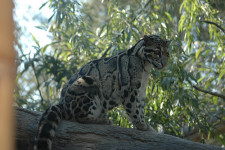
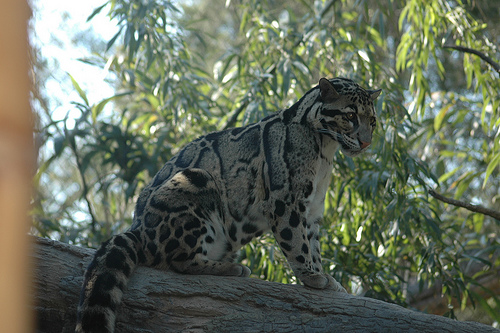
  • A clouded leopard’s fur is dark grey to earthy brown in colour, and it is marked with dark designs, usually in cloud like patterns, as well as stripes and spots.
  • Despite their name, clouded leopards are not in the same genus as leopards and are only related because they belong in the same subfamily.
  • Clouded leopards range from 60 to 108 centimetres (2 to 3.6 feet) in body length, and have a long tail, and can grow to be 11.5 to 23 kilograms (25 to 51 pounds) in weight.
Clouded Leopard, Tree, Sitting, Pale, Grey, Ten Random Facts,
Clouded Leopard Image courtesy of Cathleena Beams/Flickr
  • Compared to their body size, clouded leopards have upper teeth that are exceptionally long, that can be at least 4 centimetres (1.6 inches) in length, and they have longer back legs that allow increased jumping capabilities.
  • Clouded leopards have an average of two or three cubs per litter, with a possibility of one to five cubs.
  • Clouded leopards are said to be the best climbers in the cat family, are good swimmers, and generally they reside in treetops.
  • Clouded leopards have a carnivorous diet, that includes vertebrates that live on land, like pigs and monkeys, as well as birds, but specific prey, along with much other behavioural information, is largely unknown, even though their existence was first recorded in 1821.
  • Clouded leopards are endangered, due to habitat loss and illegal hunting, particularly for fur coats, and in captivity they are known to reach the age of 17, although they are more likely to only live as long as 11 years of age.
Bibliography: Clouded Leopard, 2014, National Geographic, http://animals.nationalgeographic.com.au/animals/mammals/clouded-leopard/
Clouded Leopard, 2014, San Diego Zoo Animals, http://animals.sandiegozoo.org/animals/clouded-leopard
Clouded Leopard, 2014, Wikipedia, http://en.wikipedia.org/wiki/Clouded_leopard

Amazon:     

Related Posts Plugin for WordPress, Blogger...