Can Opener

Can Opener

How would you open a can, without a can opener?

    • Can openers are tools, typically used to open cans, usually in a culinary environments like the food industry and domestic situations.
    • ‘Can openers’ are also known as ‘tin openers’, and are often made of metal such as stainless steel, or plastic, although the cutter is generally metal.
    • While preserved food in cans dates back to the mid to late 1700s and the process became successful, patented, and popular in the early 1800s, can openers were not invented until approximately 50 years later, and were most likely not invented earlier due to the heavy thickness of the iron that the cans were made from.
    • Can openers replaced the common hammer and chisel method of opening a can, and were first invented around the 1850s with a leverage mechanism shaped like a claw.
    • Modern can openers typically involve a sharp metal rotating disc that cuts through cans when moved along the edge.
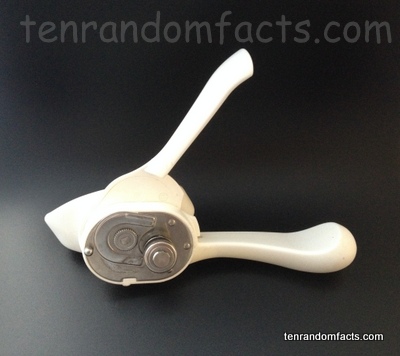
Con Opener, Metalic, Metal, plastic, White, Tool, Kitchen Culinar, Tin, Ten Random Facts, Invention

  • William Lyman, an American inventor from Connecticut’s Meriden, in the United States, is said to have invented the first can opener with a rotating wheel, in 1870, and it is this basic principal which most modern designs use.
  • Early can openers were originally quite dangerous to use, and this problem was fixed by an improved cutting technique and design.
  • Electrically operated can openers were not popular when first invented in 1931, but they were redesigned in 1956 by at least two different companies of which only one became popular.
  • Can openers often use a scissor like mechanism with two handles that pivot and close two discs onto the can, one of which rolls around the can, and the other cuts, both of which move due to the user turning a protruding handle.
  • Can openers have become less essential due to many cans now having their own ring pull lid or pull open top, that easily opens the can without a special tool.
Bibliography:
Can Opener, 2014, Wikipedia, http://en.wikipedia.org/wiki/Can_opener
The Can Opener Wasn’t Invented Until 48 Years After the Invention of the Can, 2012, Today I Found Out, http://www.todayifoundout.com/index.php/2012/06/the-can-opener-wasnt-invented-until-48-years-after-the-invention-of-the-can/

Amazon:     

Mahatma Gandhi

Mahatma Gandhi

“Where there is love there is life.” – Mahatma Gandhi

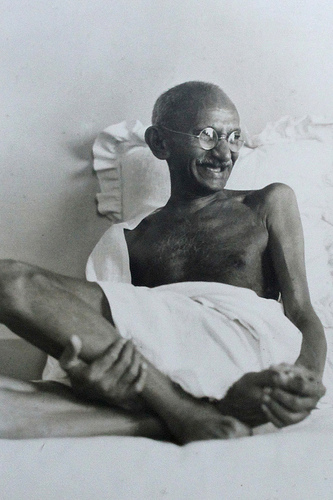
  • Mahatma Gandhi was an Indian political activist, a firm believer of nonviolent resistance, and the primary influence of India’s independence and freedom from Britain in 1947.
  • The full name of Mahatma Gandhi is Mohandas Karamchand Gandhi, born on the 2 October, 1869, in India’s Porbandar, in Asia, and he has also been known as ‘Bapu’, ‘Gandhiji’, ‘Father of the Nation’, and ‘Father of India’, and the title ‘Mahatma’, meaning ‘great soul’ or similar, was first used in relation to him in 1914.
  • Abiding by Indian tradition, Mahatma Gandhi married the similarly aged Kasturbai Makhanji at age thirteen years, in 1883 by an arranged marriage, and had five children, although only four boys survived, with the first child dying days after birth.
  • Mahatma Gandhi studied law in London, in Europe’s England in 1888, returning to India in 1891 after graduation, but then moved to South Africa to work for an Indian trader group in 1893 as a legal representative, where he remained until moving back to India in 1915.
  • While in South Africa, Mahatma Gandhi observed and experienced violent racism, and as a result rallied for the rights of Indians in the country, and when he returned home to India after more than 20 years, he began to campaign for his country’s independence.
Mahatma Gandhi, Indian, Muslim, Peace Maker, Ten Random Facts, Male, Person, Celebrity, Flickr, Ten Random Facts
Mahatma Gandhi
Image courtesy of Nagarjun Kandukuru/Flickr
  • Mahatma Gandhi was assassinated by bullet at 78 years of age, on 30 January, 1948, by Nathuram Godse, a representative of a disagreeing Hindu fundamentalist group, in the area of Birla House, New Delhi in India, which was later renamed Gandhi Smriti and was transformed into a museum.
  • While he studied many different religions, Mahatma Gandhi was mostly influenced by Hinduism and Jainism, and during his lifetime he wrote over 50,000 pages of literature, some of which was previously released, although the whole lot was published collectively by the government in India in the 1960s.
  • Despite being nominated five times, Mahatma Gandhi was not awarded the Nobel Peace Prize during his lifetime, although the story of his life was adapted into the Academy Award winning film Gandhi (1982), starring Ben Kingsley as the main character.
  • Since 2007, the 2nd October has been celebrated each year as the International Day of Non-Violence, in honour of Mahatma Gandhi, which is the Indian’s birthday, and also a public holiday in India, known as ‘Gandhi Jayanti’.
  • Mahatma Gandhi was the subject of at least five failed assassinations, one of which is said to have been the derailing of a train a year and a half before his death.
Bibliography:
Mahatma Gandhi, 2014, History, http://www.history.co.uk/biographies/mahatma-gandhi
Mahatma Gandhi, 2014, Wikipedia, http://en.wikipedia.org/wiki/Mahatma_Gandhi

Amazon:       

Cliffs of Étretat

Cliffs of Étretat

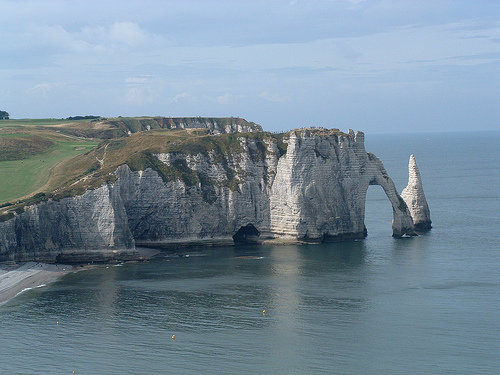
The white coloured cliffs of Étretat are very picturesque.

  • The cliffs of Étretat are numerous sea cliffs and rock formations located in Étretat, Upper Normandy, in Europe’s northern France.
  • The cliffs of Étretat are a common site visited for inspiration for both literature and art purposes; while notable visitors have included Victor Hugo, writer of ‘Les Misérables’, and famous artists like Claude Monet and Gustave Courbet.
  • The cliffs of Étretat are part of a stunning coastline along the English Channel, known as ‘La Côte d’Albâtre’, ‘The Albâtre Coast’ or ‘The Alabaster Coast’ that spans a distance of approximately 130 kilometres (80 miles), and is virtually a long wall of cliff.
  • The cliffs of Étretat are at least 70 metres (230 feet) high and are primarily coloured white to a light grey colour.
  • The cliffs of Étretat is one of the most popular tourist areas along the Alabaster Coast, as it is home to a 50 metre (164 foot) high needle-shaped rock formation, named the ‘Needle’, as well as three large natural arches and a beach area.
Cliffs of Etretat, Sea, White, Needle, arch, Rock, Europe, Ten Random Facts, Flickr, Landform
Part of the Cliffs of Étretat
Image courtesy of Frenlarreo/Flickr
  • The cliffs of Étretat mostly contain chalk and limestone, as well as flint, with the chalk giving the cliffs their vivid white colour.
  • Water sports are popular at the cliffs of Étretat, and due to strong winds atop the cliffs, air gliding is a common sport performed in the area.
  • The cliffs of Étretat were formed primarily by erosion from wind, rain and ocean waves, and coastal erosion is still significant due to the soft chalk.
  • The cliffs of Étretat are the home to seagulls, and the ocean area was once a prime fishing spot and was also used for oyster farming.
  • The cliffs of Étretat are situated next to the fishing village of Étretat, which has become a popular tourist destination and tourism has become one of the main sources of income in the area.
Bibliography:
Beautiful Heights, Sea Cliffs, Etretat, France, 2014, Planet Den, http://planetden.com/nature/beautiful-heights-sea-cliffs-etretat-france
Cliffs, n.d, Etretat, http://www.etretat.net/office-de-tourisme-etretat/modules/content/content.php?page=falaises&lang=en
Étretat, 2014, Wikipedia, http://en.wikipedia.org/wiki/%C3%89tretat
Vallois T, Normandy’s White Cliffs, 2012, France Today, http://www.francetoday.com/articles/2012/08/04/normandy_s_white_cliffs.html

Amazon:      

Mandrill

Mandrill

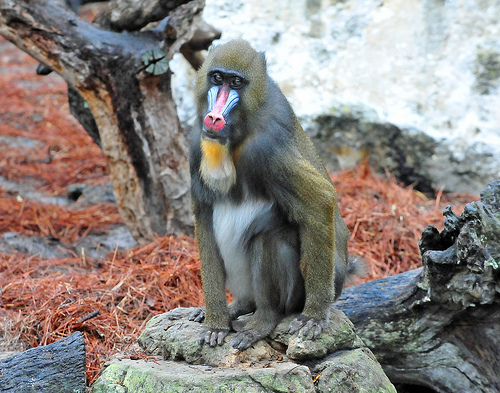
Mandrills are bright, colourful and… unique.

  • Mandrills are the largest extant species of monkey, and are native to regions of western Africa, in mostly forest habitats.
  • Mandrills have the scientific name Mandrillus sphinx, and are from the family Cercopithecidae, the family of Old World monkeys.
  • A mandrill has a dark coloured fur coat, white underbelly, red and blue face and a brightly multi-coloured backside.
  • Mandrills typically grow to be 55 to 95 centimetres (22 to 37 inches) in length and weigh 10 to 37 kilograms (22 to 82 pounds).
  • A mandrill’s diet mainly consists of vegetation such as fruit, bark, leaves and twigs; invertebrates including insects, spiders and snails, as well as frogs, birds, rodents and eggs.
Mandrill, Primate, Zoo, Animal, Ten Random Facts, Flickr, Mammal, Colourful
Mandrill
Image courtesy of Heather Paul/Flickr
  • Mandrills are preyed on by leopards, as well as the occasional crown eagle and python, and they have a typical lifespan of 20 years, although it can range up to 31 years in captivity.
  • Mandrills live in troops of up to 1,300 individuals, but typically this number is closer to 600, often with a dominant male, although males often live alone.
  • Female mandrills generally give birth to a single young approximately every two years; and the mother generally takes care of the baby.
  • Mandrills can make various noises including grunts, roars, screeches and crow-like sounds.
  • Due to the illegal removal of forest habitats and the killing of the animal for bushmeat, mandrills are classified as a vulnerable species.
Bibliography:
Mandrill, 2014, National Geographic, http://animals.nationalgeographic.com.au/animals/mammals/mandrill/
Mandrill, 2014, Wikipedia, http://en.wikipedia.org/wiki/Mandrill

Amazon:      

Corn Starch

Corn Starch

Do not starch these facts with corn starch!

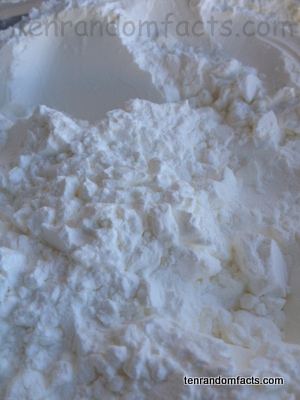
  • Corn starch is a thickener used in cooking, that is extracted from the endosperms of corn or maize kernels and the product is said to have been originally used for starching laundry.
  • ‘Corn starch’ is also known as ‘cornstarch’, ‘maize starch’, ‘maizena’ and ‘corn flour’, although in some countries, wheat starch is sometimes labelled as ‘corn flour’.
  • Corn starch is often used to increase the thickness of soup, sauce, custard and other condiments, as well as the mixtures of bakery items.
  • Pure corn starch is gluten free, and it can be replaced with arrowroot effectively, typically by the same ratio.
  • Corn starch is extracted by softening and lightly fermenting the corn kernels, then the starch is removed and later dried.

Corn Starch, White, Ten Random Facts, Thickener, Food, Culinary, Powder, Australia

  • Corn starch, when mixed with water in the correct ratio, produces a substance named Oobleck with properties that deflect fast moving forces but not slow-moving forces.
  • Corn starch is typically white in colour, and is almost always in a very smooth powdered form, and when cooked, it typically loses its colour, becoming transparent, unlike flour that the starch often replaces.
  • When corn starch is added to liquid for thickening purposes, it is best to heat the mixture to a temperature of 100°C (212°F), to produce the most satisfactory thickened result.
  • The United States business, Colgate and Company are said to be the first to produce corn starch, in 1844, and soon after, Thomas Kingsford, an employee who is said to be the inventor, began a factory in New York to produce the substance.
  • Corn starch is very high in carbohydrates and has small quantities of selenium and other minerals.
Bibliography:
Corn starch, 2014, Wikipedia, http://en.wikipedia.org/wiki/Corn_starch
Cornstarch, 2010, Cooksinfo.com, http://www.cooksinfo.com/cornstarch
The History of Cornstarch, n.d, Eye-on New Media, http://www.eyeon-newmedia.co.za/schweizer/docs/Reports%20-%20General/The%20History%20of%20Corn%20Starch.pdf
What is Cornstarch?, 2014, WiseGEEK, http://www.wisegeek.org/what-is-cornstarch.htm

Amazon:      

Pipe Cleaner

Pipe Cleaner

Pipe cleaners were once a cleaner and now a craft.

  • A pipe cleaner is a long, narrow cleaning utensil that has an abundance of absorbent fibres attached.
  • Pipe cleaners are also know as ‘chenille stems’ and ‘chenille sticks’.
  • Pipe cleaners are most commonly used for cleaning narrow, hollow objects or used in craft projects, and they come in a variety of shapes and thicknesses, with the typical shape being cylindrical.
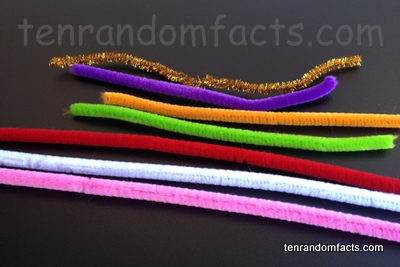
  • Pipe cleaners are commonly coloured in various bright colours and they can be bicoloured or metallic, while the colours are sometimes used to categorise different things or used for craft purposes.
  • Pipe cleaners are generally made of a few pieces of wire that secure numerous short strands of cotton, viscose, nylon, polyester or polypropylene, that form short bristles.

Pipe Cleaners, Craft, assorted, Colourful, Pink, White, Red, Green, Orange, Purple, Gold, Various, Ten Random Facts, Invention

  • Pipe cleaners were originally invented to clean tobacco pipes, but they can be adapted and used to clean many other items.
  • Many different pipe cleaners were invented in the 1800s, although most of them do not resemble modern style ones, although a pipe-stem cleaner, as it was called, with similar qualities, was patented in 1896 by Fredrick Frick, from Rochester, New York, in the United States.
  • Pipe cleaners typically range from 15 to 50 centimetres (6 to 20 inches) in length, depending on their purpose, with shorter lengths often used for cleaning, and longer lengths generally used for craft purposes.
  • The invention of the modern, chenille style pipe cleaner, is often credited to Charles Angel and inventor John Stedman, who was also from Rochester, New York, in the United States, in the early 1900s.
  • The BJ Long company was possibly the first to mass-produce modern style pipe cleaners, since the company was sold rights to Angel’s and Stedman’s design.
Bibliography:
Foster G, John Harry Stedman: His Busy Life and Weird Inventions, n.d, University of Rochester, http://www.lib.rochester.edu/IN/RBSCP/Epitaph/ATTACHMENTS/31_3.pdf
Frick, F 1896, ‘Pipe-stem Cleaner’, US566570, 25 August, p. 1, Google Patents, Google
I Raise my Pipe to the Humble Pipe Cleaner, 2013, rebornpipes, http://rebornpipes.com/tag/history-of-pipe-cleaners/
Pipe Cleaner, 2014, Wikipedia, http://en.wikipedia.org/wiki/Pipe_cleaner

Amazon:     

Related Posts Plugin for WordPress, Blogger...